

Ground Calcium Carbonate
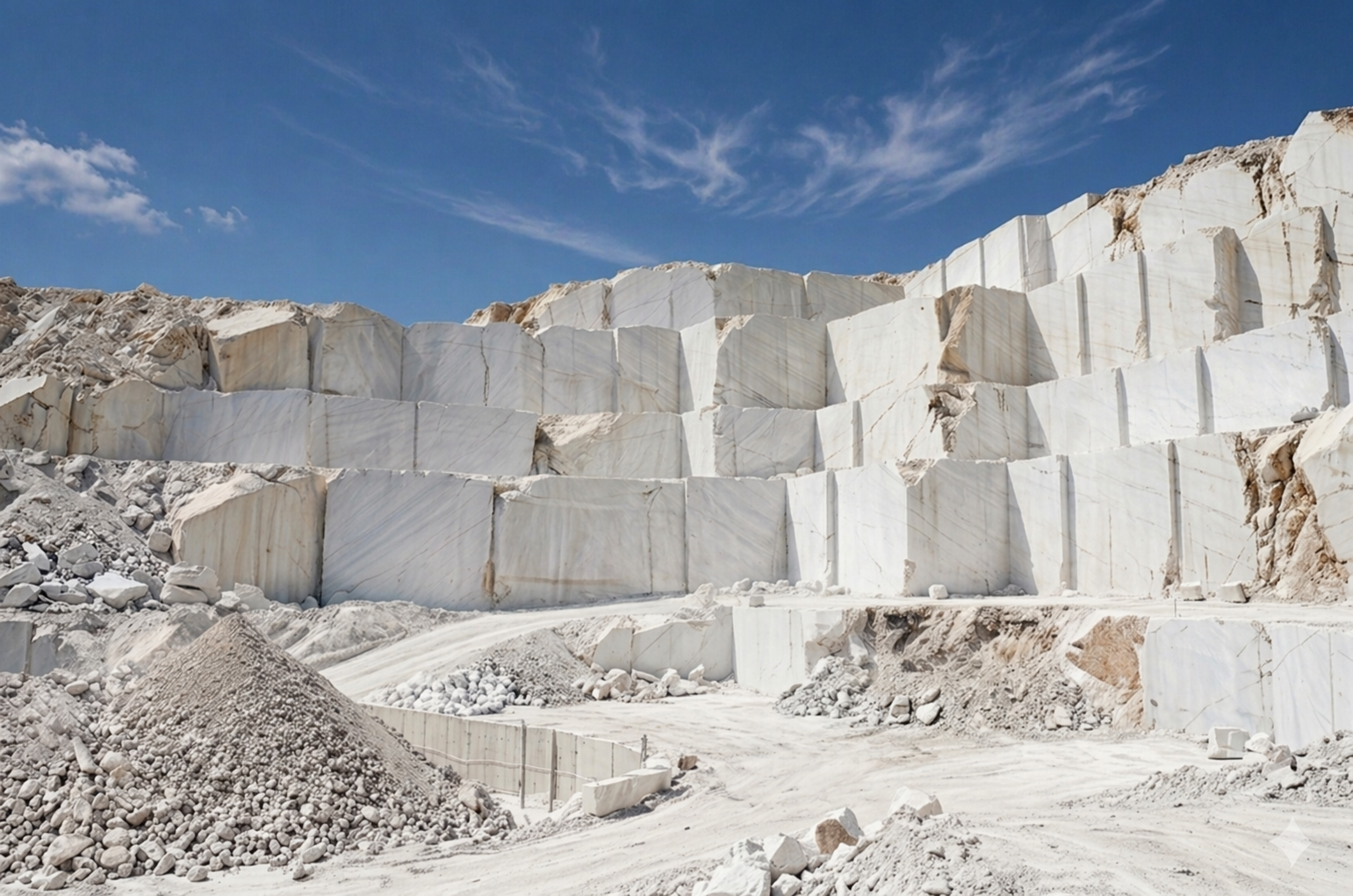
Ground Calcium Carbonate (GCC) is a naturally derived, inorganic mineral material composed predominantly of calcium carbonate (CaCO₃), manufactured through the controlled mechanical crushing, grinding, and particle classification of high-purity limestone, marble, or chalk deposits.
Unlike Precipitated Calcium Carbonate (PCC), which is produced through chemical precipitation, GCC is manufactured using physical processing methods that largely preserve the original crystalline structure and mineralogical characteristics of its natural sources. It primarily occurs in the calcite crystalline form, although its mineralogical composition, particle morphology, and impurity profile may vary depending on the geological origin of the raw material.
GCC is characterized by its high mineral content, relatively high whiteness, controlled particle size distribution, chemical stability under normal processing conditions, and low oil absorption compared with many other mineral fillers. Its physical and functional properties, including particle size, specific surface area, particle shape, surface chemistry, and dispersibility can be precisely tailored through advanced micronization, classification, and optional surface modification processes.
In polymer and plastics applications, GCC functions as a versatile mineral filler and functional additive, contributing to dimensional stability, stiffness, opacity, and formulation cost optimization. Depending on particle characteristics, surface treatment, loading level, and polymer compatibility, it can also influence impact resistance, processing behavior, thermal expansion, and the overall mechanical performance of finished products.
To enhance compatibility with nonpolar polymer matrices such as Polyethylene (PE) and Polypropylene (PP), GCC particles are frequently surface-treated with fatty acids, particularly Stearic acid, or other coupling and dispersing agents. These modifications improve particle wetting, reduce agglomeration, and promote more uniform dispersion within the polymer matrix.

High Whiteness and Brightness
GCC, particularly grades derived from high-purity calcite and marble deposits, exhibits high whiteness and brightness due to its low concentration of naturally occurring chromophoric impurities, such as iron oxides and other colored mineral constituents. Its optical performance is influenced by mineral purity, particle size distribution, refractive index, and light-scattering characteristics.
With a refractive index of approximately 1.49-1.66, depending on crystallographic orientation, calcite contributes to light scattering at interfaces with surrounding materials. The resulting opacity and visual uniformity depend on particle size, dispersion quality, filler concentration, and the refractive-index contrast with the matrix.
These characteristics make high-whiteness GCC particularly valuable in plastic compounds, filler masterbatches, paints, coatings, and paper applications, where it supports color consistency, surface appearance, and formulation efficiency while helping reduce dependence on more expensive white pigments in suitable formulations.
Good Chemical Stability
GCC shows good chemical stability under normal storage, handling, and conventional polymer-processing conditions. Its predominantly Calcite-based mineral structure exhibits low solubility in neutral water and generally maintains its chemical integrity in non-acidic environments, making it suitable for a broad range of industrial formulations.
As an alkaline-earth carbonate, GCC can react with acidic substances, resulting in carbonate dissolution and the release of Carbon dioxide (CO₂). At high temperatures, Calcium carbonate may undergo thermal decomposition into Calcium oxide (CaO) and Carbon dioxide (CO₂), with the decomposition behavior governed by temperature, carbon dioxide partial pressure, particle characteristics, and processing conditions.
Within appropriate operating conditions, GCC provides a chemically stable mineral phase that can support consistent formulation properties, dimensional stability, and reliable processing performance in Polyvinyl chloride (PVC) compounds, Polyolefin masterbatches, rubber, coatings, and other composite materials.

Superior Filler Efficiency
GCC is a highly efficient mineral filler that enables manufacturers to optimize formulation costs while modifying the physical, mechanical, and processing characteristics of polymer-based materials. Its effectiveness is primarily governed by particle size distribution, particle morphology, specific surface area, surface treatment, dispersion quality, and interfacial interactions with the polymer matrix.
When appropriately selected and uniformly dispersed, GCC can increase composite stiffness, improve dimensional stability, reduce thermal expansion, and contribute to consistent processing behavior. Fine-particle and surface-treated grades can enhance compatibility with polymer matrices, particularly in PE, PP, and PVC formulations, by improving particle wetting and reducing agglomeration.
The incorporation of GCC allows partial replacement of polymer resin, potentially reducing raw material costs while maintaining the required balance of mechanical properties and processability. Its effects on impact strength, tensile strength, elongation at break, melt rheology, and final product density depend on filler loading, particle characteristics, surface modification, and formulation design.
Industrial Applications

Construction
The construction industry is a key segment in infrastructure development across every nation, covering diverse applications such as flooring systems,...
Learn more
Pulp & Paper
Opportunities for growth. Our products and services include cost-effective to high-performance products for filling and coating and functional coatings, alongside...
Learn more
Polymer
The polymer industry is a cornerstone of modern manufacturing, covering a wide range of applications from plastics to rubber. It...
Learn more
Agriculture
TLD Vietnam is committed to advancing responsible agriculture practices. Our portfolio of solutions addresses the evolving needs of modern agriculture,...
Learn more
Water Treatment
Water treatment is the process that removes the majority of the contaminants from wastewater or sewage and produces a liquid...
Learn more
Personal care & Home care
The Personal care & Home care industry is a fast-growing and dynamic sector, with increasing demand for safe, high-performance, and...
Learn moreWhy choose us!
TLD Vietnam possess abundant limestone sources with exceptional purity, whiteness, and brightness from premium quarries in Vietnam with the latest production technologies from Germany, Taiwan, and China. We upholds stringent quality control measures at every stage of the production process to ensure consistency and international standards including ISO, Reach, RoHS With to ensure high-performance Ground calcium carbonate that meets the stringent requirements of diverse industries.
With our experience and deep market knowledge, our team strives to understand customer needs and provide the most effective solutions.
7
FACTORIES
Covering a total area of 60,950 m², with a monthly production capacity of 40,000 MT
70
+
COUNTRIES
Serving customers across 5 continents.
1000
+
CLIENTS
Trusted by clients worldwide for our reliability and strong industry reputation.