
Polypropylene is one of the most widely produced plastics in the world, and almost every property that makes it useful can be traced back to the arrangement of its molecules. Polypropylene’s molecular structure determines whether the material is rigid or soft, transparent or opaque, tough at low temperatures or brittle, and how it responds to heat, light and processing. Read this article by TLD Vietnam to understand the chemistry of Polypropylene, the role of tacticity and crystallinity, and how structural differences between grades translate into practical performance.
The Basic Chemistry Of Polypropylene
Polypropylene is a thermoplastic polyolefin made by polymerizing propylene, a gas obtained mainly from petroleum refining and steam cracking. Its general chemical formula is (C₃H₆)ₙ, and it belongs to the same family as polyethylene. However, one small difference in the structure of the monomer gives polypropylene a very different range of properties.
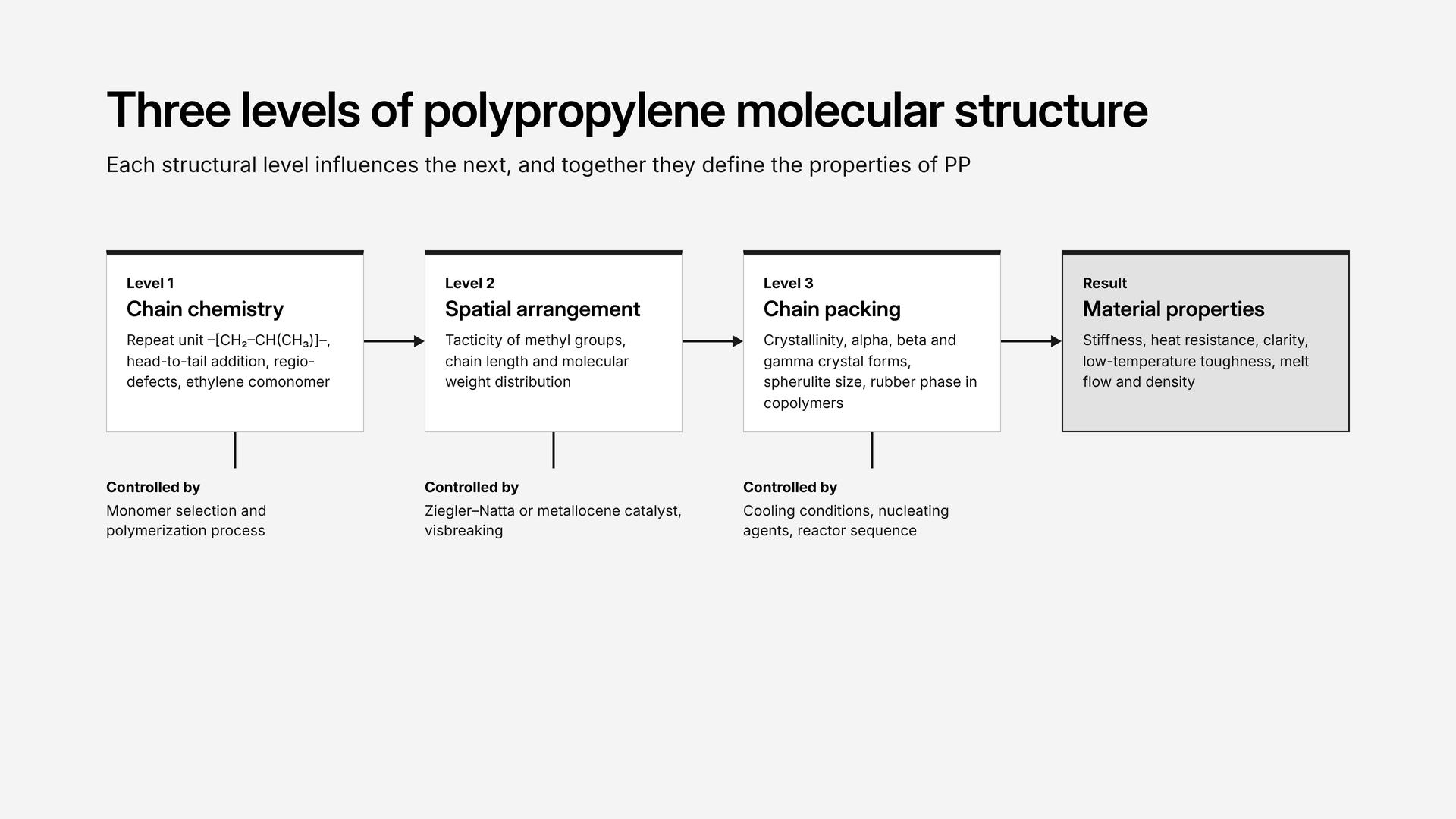
To understand polypropylene molecular structure, it is useful to look at three levels of organization. The first level is the chemical structure of the chain itself, the second is the spatial arrangement of its side groups, and the third is the way chains pack together into crystalline and amorphous regions. Each level influences the next, and together they define the behavior of the finished material.
Monomer And Repeat Unit
The propylene monomer has the formula CH₂=CH–CH₃, which means it carries a methyl group (CH₃) on one of the two carbon atoms of the double bond. When propylene polymerizes, the double bond opens and the monomers link into a long carbon backbone with the repeat unit –[CH₂–CH(CH₃)]–. As a result, every second carbon atom along the chain carries a methyl side group.
This methyl group is the defining feature of polypropylene molecular structure. It makes the chain stiffer than a polyethylene chain, raises the melting point and creates a tertiary carbon atom at every repeat unit. Because the carbon atom bearing the methyl group is attached to four different groups, it is a stereocenter, and the orientation of the methyl groups relative to one another becomes a critical structural variable.
Chain Growth
During polymerization, propylene units can in principle join in different orientations. In commercial processes, the monomers add almost exclusively in a head-to-tail sequence, so the methyl groups appear at regular intervals on alternate carbon atoms. Occasional head-to-head or tail-to-tail insertions, known as regio-defects, interrupt this regularity and slightly reduce the ability of the chains to crystallize.
The length of the chains is also controlled during polymerization. Commercial Polypropylene grades consist of chains with thousands of repeat units, and the average chain length and its distribution have a strong influence on melt flow and mechanical properties. These aspects are discussed in more detail in a later section.
Tacticity In Polypropylene Molecular Structure
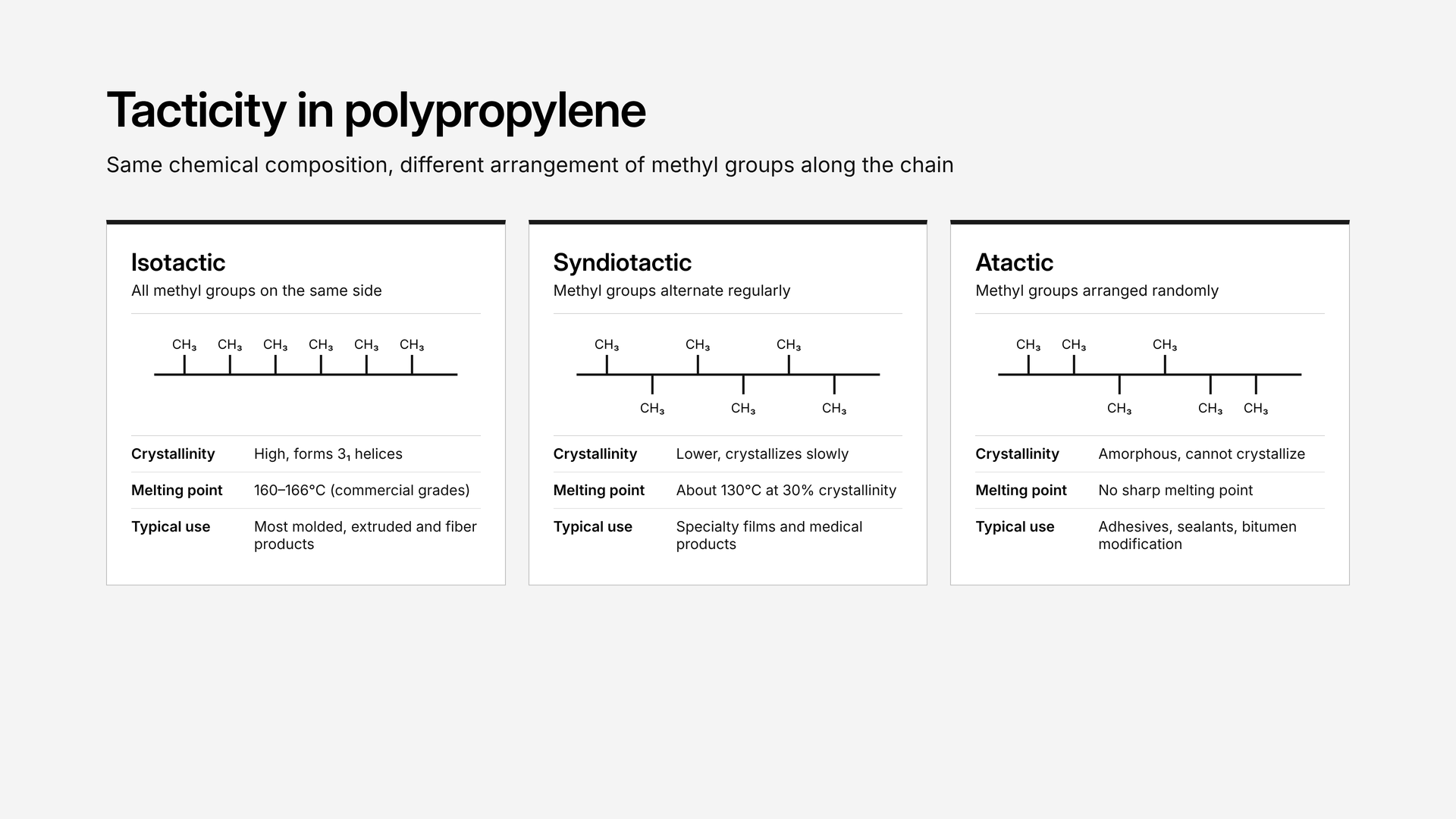
Tacticity describes the spatial arrangement of the methyl groups along the polymer chain. Because each methyl-bearing carbon is a stereocenter, the methyl groups can point to the same side of the backbone, alternate from side to side or be arranged at random. These three arrangements are called isotactic, syndiotactic and atactic, and they produce materials with remarkably different properties even though their chemical composition is identical.
Isotactic Polypropylene
In isotactic polypropylene, all methyl groups point to the same side when the chain is drawn in an extended zigzag form. This regularity allows the chain to adopt a helical conformation with three repeat units per turn, known as a 3₁ helix, and the helices pack efficiently into crystals. Giulio Natta’s identification of isotactic polypropylene as a three-fold helix in March 1954 marked the beginning of the commercial Polypropylene industry.
Most commercial Polypropylene is isotactic, because this form combines good stiffness, strength and heat resistance with low density. Commercial isotactic Polypropylene typically melts between 160 and 166°C, while a perfectly isotactic polymer would melt at about 171°C. The difference reflects the small number of stereo-defects and regio-defects present in real chains.
Syndiotactic Polypropylene
In syndiotactic polypropylene, the methyl groups alternate regularly between the two sides of the chain. This arrangement can also crystallize, but the crystals form more slowly and the overall crystallinity is usually lower. Syndiotactic Polypropylene with a crystallinity of about 30% melts at around 130°C, considerably lower than isotactic Polypropylene.
Syndiotactic Polypropylene became commercially practical only after the development of metallocene catalysts. It offers better clarity and flexibility than isotactic Polypropylene, but its smaller production volume and higher cost limit it to specialized applications such as certain films and medical products. Its development showed that the same monomer can yield very different materials when only one aspect of polypropylene molecular structure, the arrangement of the methyl groups, is changed.
Atactic Polypropylene
In atactic polypropylene, the methyl groups are arranged randomly, so the chains cannot pack into a regular crystal lattice. The material is amorphous, soft and tacky at room temperature, with little mechanical strength. For this reason, atactic Polypropylene is not used for molded or extruded products, but it finds use in adhesives, sealants and bitumen modification.
In industrial practice, atactic content is also a measure of quality for isotactic grades. A small amount of atactic or poorly isotactic material is always present, and producers control it carefully because it lowers stiffness and melting point. The degree of isotacticity is therefore one of the most important parameters of polypropylene molecular structure in commercial resins.
How Catalysts Control The Structure Of Polypropylene
The catalyst used in polymerization is the main tool for controlling polypropylene molecular structure. It determines how stereoregular the chains are, how long they grow, how widely their lengths are distributed and how comonomers are incorporated. Karl Ziegler and Giulio Natta received the Nobel Prize in Chemistry in 1963 for the catalyst systems that made stereoregular polyolefins possible.
Modern Ziegler–Natta catalysts are typically based on titanium chloride deposited on a magnesium chloride carrier, used together with an aluminum alkyl cocatalyst and electron donor compounds. The electron donors improve stereoselectivity and allow producers to reach very high isotactic content. Because these catalysts contain several types of active sites, they produce chains with a relatively broad distribution of lengths and some variation in structure from one chain to another.
Metallocene catalysts, introduced commercially in the 1990s, have a single type of active site. They produce chains with a narrow molecular weight distribution and a very uniform distribution of comonomer, and they can be designed to make isotactic, syndiotactic or other specific structures. Metallocene Polypropylene grades are used where clarity, low extractables or precise processing behavior are important, while Ziegler–Natta grades remain dominant in volume because of their versatility and cost.
Crystalline Structure And Morphology
Isotactic polypropylene is a semi-crystalline polymer, which means it contains ordered crystalline regions embedded in a disordered amorphous phase. The crystalline regions give stiffness, strength and heat resistance, while the amorphous regions provide flexibility and toughness. Its crystallinity lies between that of low-density and high-density polyethylene, and it can be adjusted through polypropylene molecular structure and the processing conditions.
Crystal Forms Of Isotactic Polypropylene
Isotactic Polypropylene can crystallize in several crystal forms, a phenomenon known as polymorphism. The most common is the monoclinic alpha form, which dominates in most commercially processed products. In this form, the chains adopt the 3₁ helical conformation and pack into a unit cell containing four chains.
The hexagonal beta form appears under specific conditions, such as in temperature gradients or in the presence of beta-nucleating agents. Beta-rich Polypropylene generally has higher impact strength and ductility than alpha Polypropylene, which makes it useful for pipes and other impact-critical products. The orthorhombic gamma form is less common and is favored by high pressure, low molecular weight or chains containing more defects, as found in some copolymers and metallocene grades.
Crystallinity, Spherulites And Nucleation
When Polypropylene cools from the melt, the crystals grow outward from nuclei and form spherical structures called spherulites. The size and number of spherulites depend on how many nuclei are present and how fast the material cools. Large spherulites scatter light and make the material hazy, while smaller and more numerous spherulites improve clarity and often stiffness.
Nucleating agents and clarifiers are added to control this process. They raise the crystallization temperature, reduce spherulite size and shorten cycle times in injection molding. This example shows that the final morphology depends not only on polypropylene molecular structure but also on additives and processing conditions.
Density
Polypropylene has one of the lowest densities among commodity plastics. Amorphous Polypropylene has a density of about 0.855 g/cm³ and fully crystalline Polypropylene about 0.946 g/cm³, so commercial grades with intermediate crystallinity typically fall around 0.90 to 0.91 g/cm³. This low density gives Polypropylene an advantage in weight-sensitive applications such as automotive parts and packaging.
Molecular Weight And Molecular Weight Distribution
The length of the polymer chains is another key dimension of polypropylene molecular structure. Longer chains increase melt viscosity, toughness and melt strength, while shorter chains flow more easily and fill thin-walled molds more readily. In practice, chain length is usually expressed indirectly through the melt flow rate (MFR), which decreases as average molecular weight increases.
Molecular weight distribution describes how widely the chain lengths vary within a grade. A broad distribution, typical of many Ziegler-Natta grades, combines long chains that provide melt strength with short chains that improve flow, which is useful in extrusion and thermoforming. A narrow distribution gives more uniform flow and drawing behavior, which is preferred in fiber spinning and some injection molding applications.
Producers can also modify the distribution after polymerization. In controlled rheology grades, organic peroxides are added during pelletizing to break the longest chains, which raises the melt flow rate and narrows the distribution. This technique, often called visbreaking, allows one reactor grade to be converted into several products with different processing behavior.
Homopolymer And Copolymer Structures
Commercial polypropylene is supplied in three main structural families: homopolymers, random copolymers and impact copolymers. All three are based on isotactic Polypropylene, but they differ in whether and how a comonomer, usually ethylene, is built into the material. These differences have a direct effect on stiffness, clarity and low-temperature toughness.
Homopolymer
Polypropylene homopolymer contains only propylene units and has the highest crystallinity, stiffness and heat resistance of the three families. It is widely used in fibers, raffia, films, injection-molded housings and packaging. Its main limitation is low-temperature impact strength, because the glass transition of Polypropylene lies close to 0°C and the material becomes brittle below this temperature.
Random Copolymer
In random copolymers, small amounts of ethylene are distributed along the Polypropylene chains. These ethylene units interrupt the regular isotactic sequences, which lowers crystallinity and melting point and makes the polymer more transparent. Random copolymers are therefore used for clear containers, housewares, films and hot-water pipes, where clarity or a balance of flexibility and heat resistance is required.
Impact Copolymer
Impact copolymers, also called heterophasic or block copolymers, are produced in a sequence of reactors. A homopolymer matrix is formed first, and an ethylene-propylene rubber phase is then produced within it, creating fine rubbery domains dispersed throughout the material. These domains absorb impact energy and improve toughness at low temperatures, so impact copolymers are used for automotive bumpers, battery cases, crates and other products that must withstand impact in cold conditions.
The structure of impact copolymers shows how polypropylene molecular structure can be engineered on several scales at once. The chemistry of the chains, the composition of the rubber phase and the size of the dispersed domains all influence the final balance between stiffness and toughness.
How Molecular Structure Shapes Polypropylene Properties
The links between polypropylene molecular structure and material performance explain why Polypropylene is chosen for such a wide range of products. The methyl side group, the degree of isotacticity, the crystalline morphology and the chain length each contribute to specific properties. The table below summarizes the most important relationships.
| Structural feature | Main effect on properties |
| Methyl side group | Stiffer chain and higher melting point than polyethylene |
| High isotacticity | Higher crystallinity, stiffness and heat resistance |
| Tertiary carbon atoms | Greater sensitivity to oxidation and ultraviolet light |
| Saturated, nonpolar backbone | Good chemical resistance and very low moisture absorption |
| Glass transition near 0°C | Brittleness at low temperatures unless modified |
| Molecular weight and distribution | Melt flow, melt strength, toughness and processing behavior |
The methyl group raises the melting point of Polypropylene substantially above that of polyethylene. The most regular Polypropylene grades melt around 50°C higher than the most regular polyethylene grades, which allows Polypropylene products to withstand steam sterilization, dishwasher cycles and hot-fill packaging. At the same time, the saturated hydrocarbon backbone gives Polypropylene good resistance to acids, bases and many solvents.
The same structure also explains the main weaknesses of Polypropylene. The hydrogen atom on each tertiary carbon is relatively easy to remove, so Polypropylene oxidizes more readily than polyethylene during processing and outdoor exposure, and it requires antioxidants and, for outdoor use, light stabilizers. The nonpolar surface also has low surface energy, which means that printing, painting and bonding usually require surface treatment such as corona, flame or plasma treatment.
How The Structure Of Polypropylene Is Characterized
Several analytical methods are used to measure polypropylene molecular structure, each focusing on a different structural level. Resin producers use them to control quality, while compounders and converters use them to compare grades and troubleshoot problems. No single method gives a complete picture, so results are usually combined.
Carbon-13 nuclear magnetic resonance spectroscopy (¹³C NMR) is the reference method for tacticity. It distinguishes sequences of stereocenters and reports isotacticity as the fraction of perfectly isotactic sequences, often expressed as the mmmm pentad content. A simpler industrial test measures the xylene-soluble fraction, which mainly contains atactic and low-molecular-weight material and therefore indicates how much non-crystallizable polymer a grade contains.
Thermal and structural methods describe the solid state. Differential scanning calorimetry (DSC) measures melting point, crystallization temperature and degree of crystallinity, while X-ray diffraction identifies crystal forms and can quantify the proportion of the beta form. Gel permeation chromatography measures molecular weight distribution, and infrared spectroscopy can determine ethylene content in copolymers and detect oxidation products in aged samples.
Conclusion
Polypropylene molecular structure begins with a simple repeat unit, –[CH₂–CH(CH₃)]–, but the methyl group on every second carbon atom creates a series of structural variables that define the material. Tacticity determines whether the chains can crystallize, catalysts control stereoregularity and chain length, and crystallization conditions decide which crystal forms and spherulite sizes develop. Copolymerization with ethylene adds a further level of control, producing random copolymers for clarity and impact copolymers for toughness.
These structural features explain both the strengths and the limitations of Polypropylene. High isotacticity and crystallinity give stiffness, heat resistance and low density, while the tertiary carbon atoms and the glass transition near 0°C create sensitivity to oxidation and brittleness in the cold. Understanding polypropylene molecular structure therefore helps formulators choose the right grade and the right additives, such as antioxidants, nucleating agents, light stabilizers and impact modifiers, for each application.