

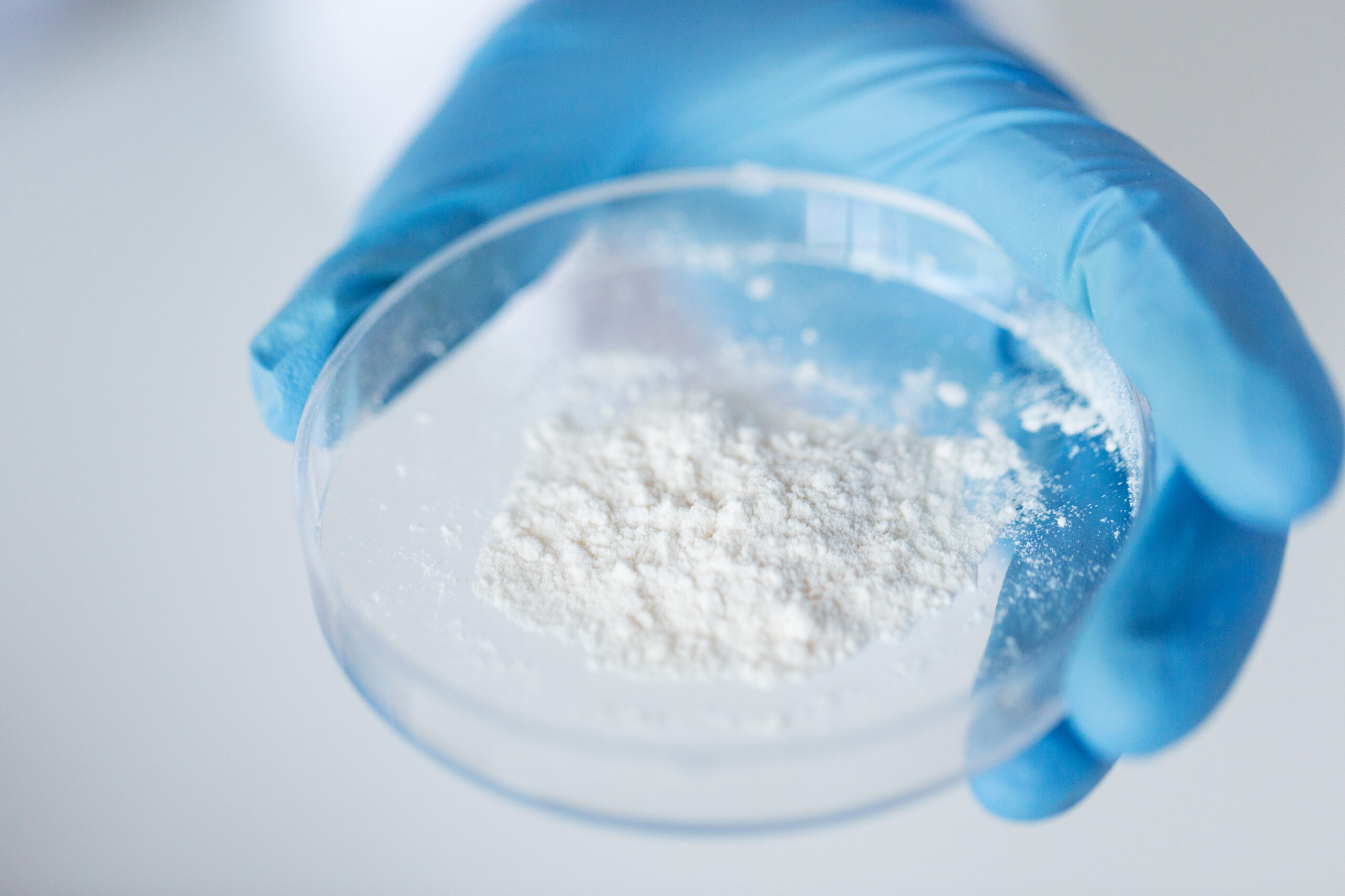
Titanium Dioxide
Titanium dioxide (TiO₂) is a high-performance inorganic white pigment chemically classified as a Titanium oxide, characterized by its exceptional refractive index, optical opacity, brightness, and chemical stability. Naturally occurring primarily in the Rutile and Anatase crystalline forms, Titanium dioxide is industrially manufactured through the Sulfate or Chloride process to achieve controlled particle morphology, crystal structure, and pigment purity. Its outstanding hiding power originates from the substantial refractive-index difference between Titanium dioxide particles and surrounding material matrices, enabling efficient visible-light scattering and strong opacity development.
Rutile grades, with a refractive index of approximately 2.7, generally provide superior hiding efficiency and photochemical durability compared with Anatase grades, which have a refractive index of approximately 2.5. Industrial pigment grades are frequently engineered with inorganic surface treatments, including Alumina and Silica, to regulate dispersion behavior and reduce undesirable photocatalytic activity. These characteristics establish Titanium dioxide as a principal white pigment in Polyvinyl chloride (PVC), Polyethylene (PE), Polypropylene (PP), masterbatches, paints, coatings, and paper formulations, where optical performance, color consistency, and long-term material durability are essential.
Opacity and Whiteness
Titanium dioxide provides exceptional whiteness and opacity through efficient visible-light scattering, primarily attributed to its high refractive index and optimized pigment particle size. Rutile grades achieve particularly strong optical contrast with surrounding polymer matrices, enhancing hiding efficiency and reducing substrate visibility. Optical performance depends on crystal structure, particle size distribution, dispersion quality, pigment concentration, and refractive-index differences between the pigment and the surrounding material matrix.

UV Resistance
Titanium dioxide contributes to ultraviolet protection through strong UV absorption and scattering, reducing radiation penetration into polymer matrices. Properly surface-treated Rutile grades minimize photocatalytic reactions that could otherwise accelerate polymer degradation and discoloration. Weathering performance depends on crystalline structure, inorganic surface coatings, particle dispersion, and formulation chemistry. Optimized pigment selection improves color retention and resistance to photooxidative deterioration during prolonged outdoor exposure under suitable service conditions.

Brightness and Covering Power
Titanium dioxide enhances brightness and covering power through its high refractive index and efficient scattering of visible light across the optical spectrum. Controlled particle morphology and uniform dispersion maximize pigment utilization while minimizing optical crowding at elevated concentrations. Hiding efficiency depends on particle spacing, pigment loading, and matrix compatibility. Proper formulation achieves consistent color development, improved visual uniformity, and efficient pigment consumption in polymer applications.
Global Industrial Applications

Construction
The construction industry is a key segment in infrastructure development across every nation, covering diverse applications such as flooring systems,...
Learn more
Pulp & Paper
Opportunities for growth. Our products and services include cost-effective to high-performance products for filling and coating and functional coatings, alongside...
Learn more
Polymer
The polymer industry is a cornerstone of modern manufacturing, covering a wide range of applications from plastics to rubber. It...
Learn more
Personal care & Home care
The Personal care & Home care industry is a fast-growing and dynamic sector, with increasing demand for safe, high-performance, and...
Learn moreWhy choose us!
Titanium Dioxide provides excellent whiteness and opacity, ensuring consistent color quality and visual performance.
TLD Vietnam supports customers with tailored solutions to enhance efficiency and cost performance. We offer competitive pricing and streamlined supply, along with technical assistance to ensure optimal formulation and product consistency, delivered through a flexible service approach.
2
FACTORIES
Total production capacity of 76,000 tons per year
300
+
GLOBAL CLIENTS
Trusted by hundreds of customers worldwide for reliable chemical solutions
Up to
30
%
COST REDUCTION
Our exclusive all-in-one chemical package helps customers reduce overall
production costs by 25-30%