

Calcium Stearate
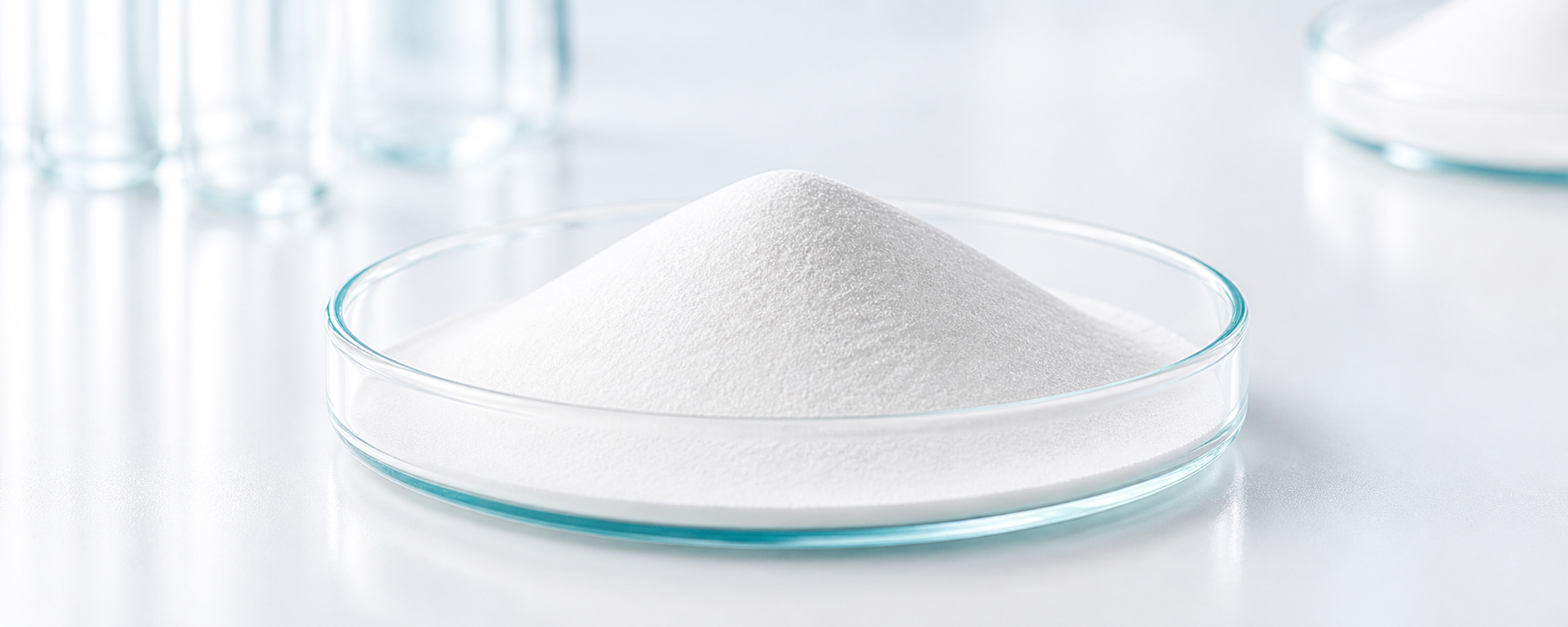
Calcium stearate is a hydrophobic metallic soap chemically classified as the Calcium salt of Stearic acid, with the molecular formula Ca(C₁₈H₃₅O₂)₂. It consists of divalent Calcium ions associated with long-chain Stearate anions and is typically manufactured through the reaction of Stearic acid with Calcium hydroxide or Calcium oxide, or by precipitation from soluble Calcium salts and alkali metal stearates. Characterized by its fine white powder appearance, water insolubility, and limited solubility in most organic solvents at ambient temperatures, Calcium stearate possesses a distinctive combination of ionic carboxylate groups and nonpolar hydrocarbon chains. This molecular architecture governs its hydrophobicity, interfacial lubricity, and interactions with polymer matrices and inorganic surfaces. In industrial formulations, Calcium stearate functions as an external lubricant, mold release agent, acid scavenger, and processing additive. Its performance depends on chemical purity, free fatty acid content, particle size distribution, thermal characteristics, and formulation compatibility, particularly in Polyvinyl chloride (PVC), Polyethylene (PE), Polypropylene (PP), rubber compounds, and mineral-filled polymer systems.

Mold Release
Calcium stearate facilitates demolding by reducing interfacial adhesion between polymer compounds and metal mold surfaces. Its long hydrocarbon chains contribute to the formation of a lubricating boundary layer, limiting material sticking during processing. Compared with more effective external release agents, its release performance is generally moderate and formulation dependent. Appropriate dosage improves demolding consistency, reduces surface damage, and maintains controlled separation from mold surfaces.

Surface Gloss
Calcium stearate contributes primarily to surface uniformity rather than directly generating high gloss in polymer products. Its lubricating characteristics reduce frictional resistance and material adhesion during processing, potentially minimizing surface irregularities associated with uneven flow. The resulting surface appearance depends on polymer composition, mold finish, additive dispersion, and processing conditions. Excessive lubricant concentration may cause surface deposits or reduce gloss through additive migration.

Friction Reduction
Calcium stearate reduces friction at particle interfaces and between polymer compounds and processing equipment through boundary lubrication. Its hydrophobic hydrocarbon chains facilitate relative movement between contacting surfaces, reducing material sticking and processing resistance. Frictional behavior depends on additive concentration, polymer compatibility, temperature, and shear conditions. Controlled incorporation improves material handling, promotes consistent processing, and limits excessive adhesion to equipment surfaces during manufacturing operations.

Processing Lubrication
Calcium stearate provides formulation dependent internal and external lubrication through its amphiphilic molecular structure and interfacial interactions. In PVC compounds, its lubrication balance depends on compatibility, concentration, and processing temperature, affecting fusion behavior and melt rheology. In polyolefin formulations, it also functions as an acid scavenger. Optimized incorporation regulates processing resistance, improves material movement, and minimizes sticking without excessive lubricant accumulation.

Adhesion Control
Calcium stearate regulates interfacial characteristics through interactions between its polar carboxylate groups and compatible particle surfaces. Its hydrophobic hydrocarbon chains modify surface wettability and can reduce filler agglomeration, improving additive distribution within polymer compounds. These mechanisms primarily affect dispersion uniformity rather than directly increasing interlayer adhesion. Excessive surface accumulation may weaken bonding, depending on substrate chemistry, additive concentration, and processing conditions.
Global Industrial Applications

Construction
The construction industry is a key segment in infrastructure development across every nation, covering diverse applications such as flooring systems,...
Learn more
Pulp & Paper
Opportunities for growth. Our products and services include cost-effective to high-performance products for filling and coating and functional coatings, alongside...
Learn more
Polymer
The polymer industry is a cornerstone of modern manufacturing, covering a wide range of applications from plastics to rubber. It...
Learn more
Personal care & Home care
The Personal care & Home care industry is a fast-growing and dynamic sector, with increasing demand for safe, high-performance, and...
Learn moreWhy choose us!
Zinc Stearate functions as a high-performance lubricant and release agent, contributing to improved processing and product finish.
TLD Vietnam provides comprehensive support to optimize efficiency and cost-effectiveness. Our offering includes competitive pricing, streamlined sourcing, and technical assistance in formulation and processing optimization, delivered through a flexible service model.
2
FACTORIES
Total production capacity of 76,000 tons per year
300
+
GLOBAL CLIENTS
Trusted by hundreds of customers worldwide for reliable chemical solutions
Up to
30
%
COST REDUCTION
Our exclusive all-in-one chemical package helps customers reduce overall
production costs by 25-30%