
Chlorinated polyethylene (CPE) is widely used as an impact modifier in rigid Polyvinyl chloride (PVC) formulations. However, its effectiveness depends not only on the amount added but also on how the material is distributed within the PVC matrix. CPE dispersion in PVC plays an important role in determining impact resistance, structural uniformity, and processing performance. Read this article by TLD Vietnam to understand the dispersion mechanism, the factors influencing phase morphology, and the relationship with the mechanical properties of PVC compounds.
What Is CPE Dispersion In PVC?
CPE dispersion in PVC refers to the distribution of chlorinated polyethylene throughout the PVC matrix during compounding and melt processing. Unlike a fully miscible polymer system, conventional impact-modified PVC generally contains distinct CPE-rich and PVC-rich phases. The arrangement, size, and continuity of these phases influence how the final material responds to mechanical stress.
CPE contains flexible polymer chains that can absorb energy through deformation when the material experiences an external force. However, these properties can only contribute effectively to impact modification when the CPE phase develops a suitable structure within the PVC matrix. The effectiveness of dispersion therefore depends on both the distribution of CPE and its interaction with the surrounding PVC.
A well-developed phase morphology does not necessarily require every CPE domain to be as small as possible. Depending on the formulation and processing conditions, CPE may form discrete domains or partially interconnected structures. Both the size and arrangement of these domains must be considered when evaluating the mechanical performance of PVC compounds.
How Does CPE Disperse In The PVC Matrix?
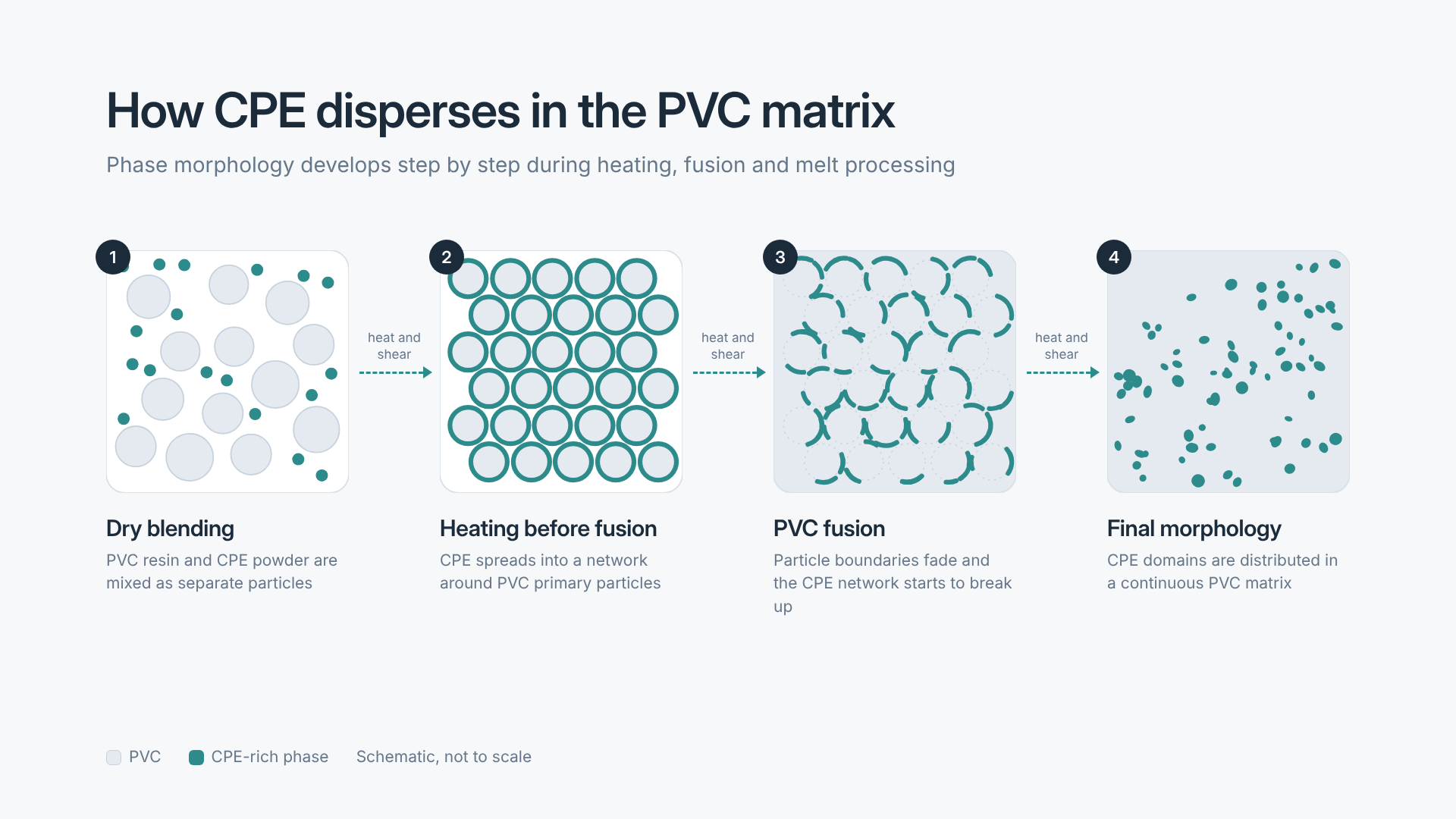
The development of CPE dispersion in PVC is closely associated with the physical changes that occur during mixing, heating, and fusion. At the beginning of processing, PVC and CPE exist as separate powder particles within the formulation. As temperature increases and mechanical forces act on the mixture, the structure gradually changes.
Initial Mixing And Particle Distribution
During dry blending, CPE particles are mixed with PVC resin, stabilizers, lubricants, fillers, and other additives. The initial distribution of these ingredients affects the uniformity of the material entering the subsequent processing stage. Although dry blending improves the distribution of CPE powder, it does not establish the final microscopic morphology of the polymer blend.
As the compound is heated, CPE becomes more deformable and can spread around PVC primary particles. Research on PVC/CPE blends has described the formation of a CPE-rich network surrounding these particles before complete fusion. This intermediate structure can influence the way CPE domains develop during further processing.
PVC Fusion And Phase Transformation
PVC fusion is an important stage in the development of CPE dispersion in PVC. During fusion, PVC primary particles progressively lose their original boundaries as the material undergoes structural consolidation. At the same time, the CPE-rich phase can change from a connected network into smaller domains distributed throughout the continuous PVC matrix.
Berard and Williams (1996) described this mechanism in their study of CPE domain breakup in PVC blends. Their research showed that, under the extrusion conditions examined, CPE initially formed a network around PVC particles before developing into discrete domains as processing continued. The study also identified further domain breakup during melt processing as an important stage in establishing the morphology required for impact modification.
Development Of The Final Phase Morphology
The final stage involves further deformation and redistribution of CPE domains under the combined effects of temperature, shear, and residence time. These conditions determine whether the material develops a fine dispersion, a partially connected structure, or relatively large CPE-rich regions. The resulting morphology depends on the formulation and cannot be predicted from processing temperature alone.
CPE dispersion in PVC must therefore be considered a dynamic process rather than a simple mixing operation. The structure continues to change during processing, and the morphology formed at one stage may differ substantially from that observed in the finished product.
Key Factors Affecting CPE Dispersion In PVC
Several material and processing variables influence the development of CPE dispersion in PVC. These factors are closely connected because changes in polymer characteristics can alter the response of the blend to temperature and mechanical forces.
Chlorine Content and Polymer Compatibility
Chlorine content influences the polarity, crystallinity, and compatibility of CPE with PVC. As chlorine is introduced into the polyethylene structure, the regularity of the polymer chains decreases, generally reducing crystallinity and changing the material’s flexibility. These structural changes affect how CPE interacts with PVC during processing.
The degree of compatibility must be carefully considered when selecting CPE for impact modification. Excessively limited interaction can make it difficult to develop a suitable dispersion, while excessive miscibility may reduce the distinction between the elastomeric and rigid phases. An appropriate balance allows the material to retain the phase characteristics required for effective toughening.
Processing Temperature And Shear Conditions
Temperature and shear strongly influence the formation and breakup of CPE domains. Sufficient thermal and mechanical energy is necessary for PVC fusion and the development of a suitable blend structure. However, excessive processing intensity can alter the morphology in ways that reduce mechanical performance.
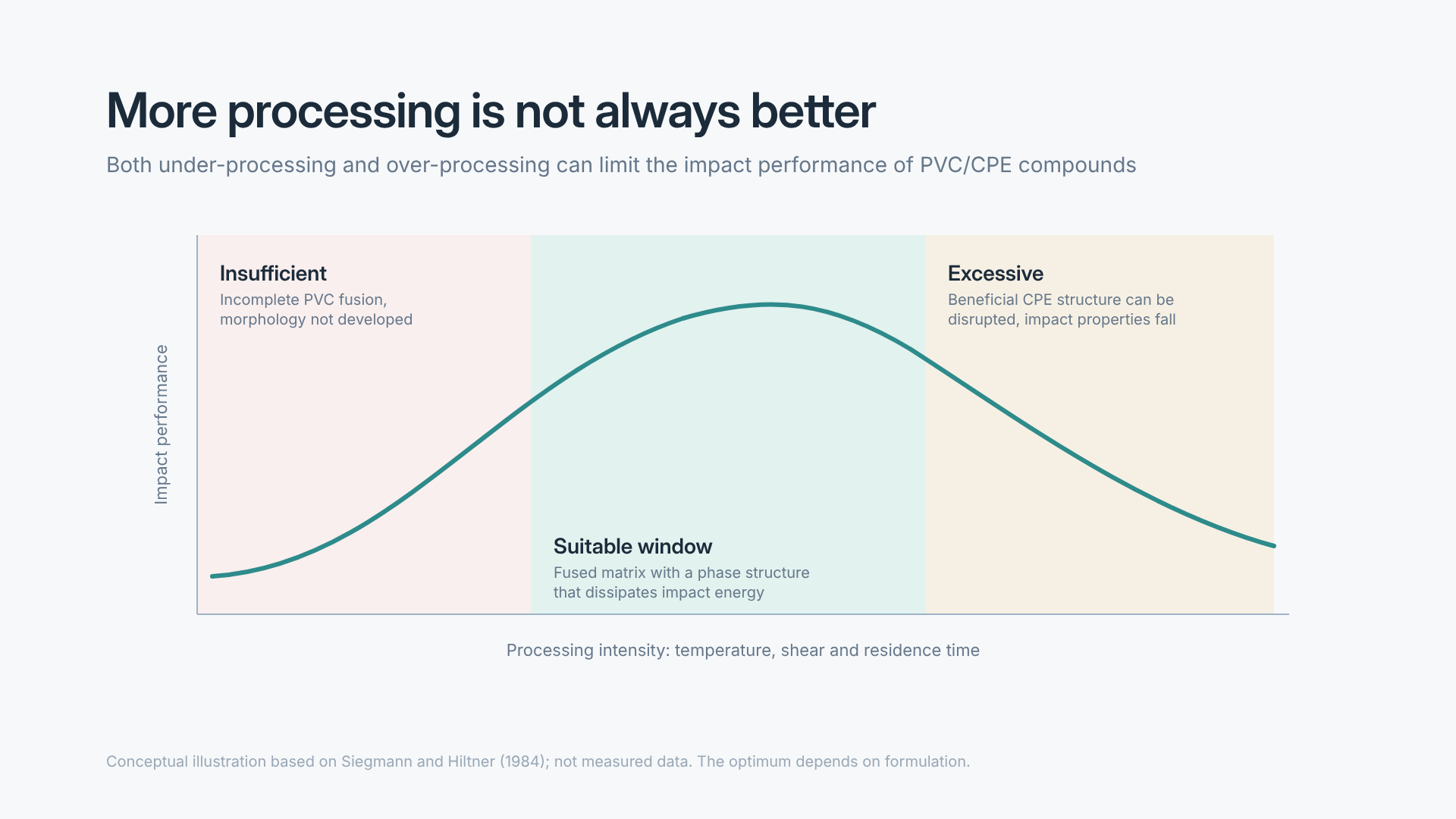
Extended mixing or processing above the fusion temperature of PVC primary particles could destroy the CPE network observed in their experimental blends. This structural change was associated with reduced impact properties. Their findings demonstrate that greater mixing intensity does not necessarily produce a better impact-modified material.
CPE Concentration And Formulation Composition
The concentration of CPE affects the amount and connectivity of the elastomeric phase within PVC. At relatively low concentrations, CPE may form isolated domains, whereas increasing its concentration can encourage the development of more connected structures. The transition between these morphologies depends on the specific formulation and processing history.
Other additives can also influence CPE dispersion in PVC. Calcium carbonate, processing aids, lubricants, and stabilizers change the mechanical and thermal behavior of the compound during fusion. For example, Ventresca and Berard (1997) reported that Calcium carbonate could interact with the CPE domain breakup and dispersion process, demonstrating that filler content can influence phase development rather than acting solely as an inert formulation component.
How Does CPE Dispersion Affect PVC Mechanical Properties?
The relationship between CPE dispersion in PVC and mechanical performance is particularly important in rigid PVC applications, where impact resistance must be improved without excessively reducing stiffness or dimensional stability. The elastomeric phase modifies how the material responds to external forces and how stress develops around local structural features.
Impact Resistance And Energy Absorption
Under impact loading, rigid PVC may fracture when localized stresses exceed the material’s ability to deform. The addition of CPE changes this response by introducing a more flexible phase capable of participating in energy-dissipating deformation mechanisms. Depending on the morphology, these mechanisms can include localized shear yielding and plastic deformation of the PVC matrix.
When CPE domains are distributed appropriately, they can promote deformation across a larger region of the material instead of allowing stress to remain concentrated at one location. This process can increase the energy required for crack propagation and improve the toughness of the compound. However, the resulting impact strength depends on the morphology of both the elastomeric phase and the surrounding PVC.
Tensile Strength And Material Stiffness
Although CPE can improve impact resistance, increasing the concentration of the elastomeric phase may reduce tensile strength or elastic modulus in some formulations. This occurs because the flexible CPE phase behaves differently from the relatively rigid PVC matrix under mechanical loading. The overall properties therefore reflect the combined contribution of both polymer phases.
The objective of formulation development is not simply to maximize the amount of CPE. Manufacturers must determine a concentration and processing condition that provide the required impact resistance while maintaining acceptable tensile properties, stiffness, and dimensional stability.
Structural Uniformity And Product Consistency
CPE dispersion in PVC also affects the uniformity of the finished compound. Large, irregular CPE-rich regions may produce localized differences in mechanical response, particularly when the morphology varies across the material. These differences can contribute to inconsistent test results or make the formulation more sensitive to processing variations.
However, surface defects and unstable processing behavior cannot automatically be attributed to poor CPE distribution. Incomplete PVC fusion, inadequate thermal stabilization, excessive lubrication, filler agglomeration, and moisture contamination can produce similar symptoms. Identifying the actual cause requires evaluation of the complete formulation and processing conditions.
How Can CPE Dispersion In PVC Be Evaluated?
The evaluation of CPE dispersion in PVC requires methods that can reveal polymer morphology and establish its relationship with material performance. Mechanical testing alone cannot directly determine the distribution of CPE domains because different microstructures may produce similar results under certain test conditions.
Scanning Electron Microscopy And Transmission Electron Microscopy
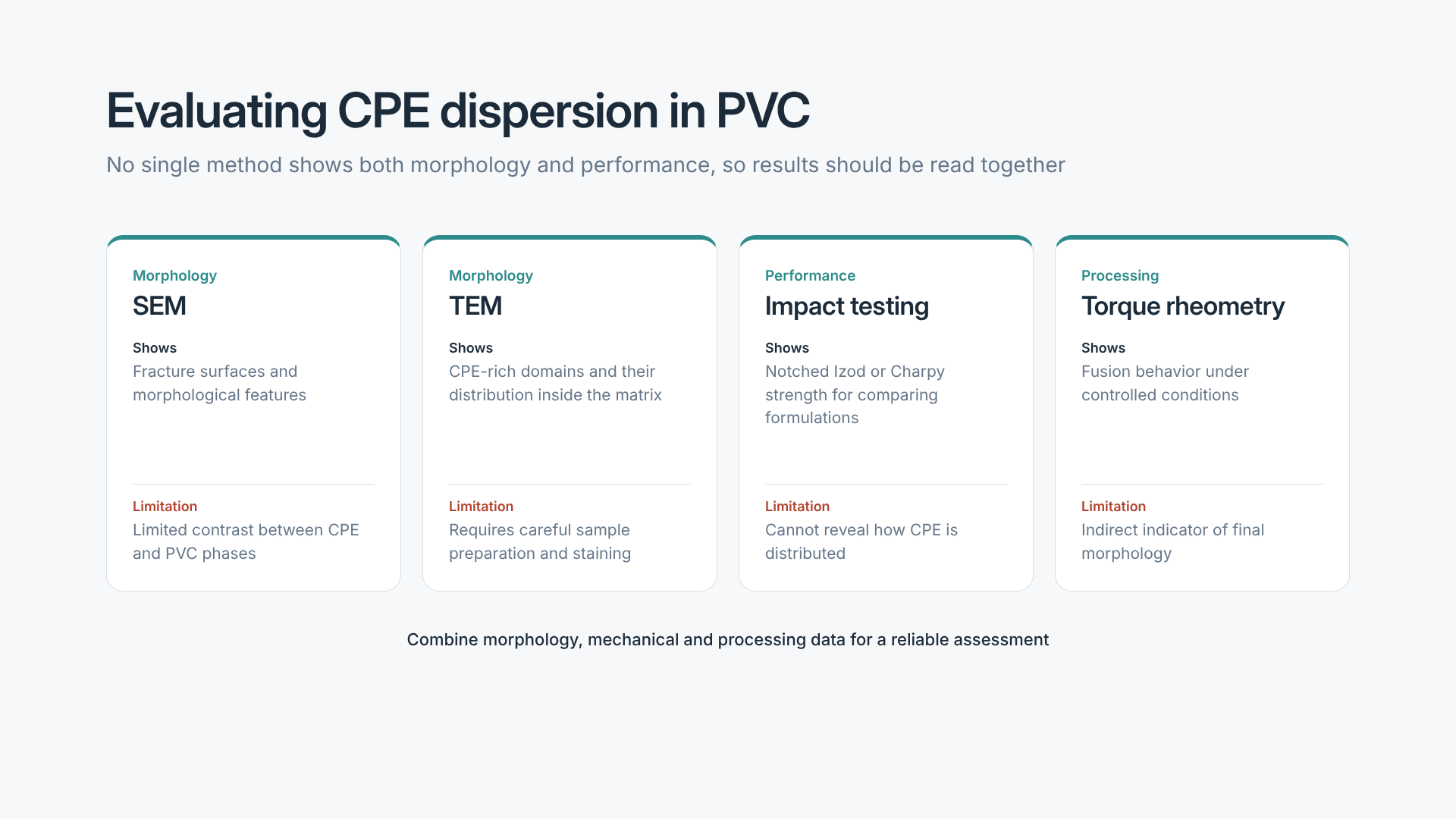
Scanning electron microscopy (SEM) can provide information about fracture surfaces and morphological features within PVC/CPE compounds. However, distinguishing the CPE-rich phase from the PVC matrix can be difficult because the phases may have limited natural contrast. Sample preparation and imaging conditions therefore influence the interpretation of SEM results.
Transmission electron microscopy (TEM) provides more detailed information about the internal morphology of polymer blends. With appropriate sample preparation and staining, TEM can reveal CPE-rich domains and their distribution within the PVC matrix. Chen and colleagues (1995) examined PVC/CPE morphology using SEM, TEM, and scanning transmission electron microscopy, highlighting the advantages and limitations of different imaging methods.
Mechanical Testing And Processing Analysis
Impact testing provides practical information about the effectiveness of CPE modification. Tests such as notched Izod or Charpy impact testing can be used to compare formulations, provided that specimen preparation, conditioning, and testing procedures remain consistent. Changes in measured impact strength can then be examined alongside microscopic observations.
Processing analysis provides additional information about PVC fusion and material behavior. Torque rheometry, for example, can help characterize fusion behavior under controlled conditions. Combining processing data, mechanical results, and microscopic observations provides a more reliable understanding of CPE dispersion in PVC than relying on a single measurement.
How To Improve CPE Dispersion During PVC Processing
Improving CPE dispersion in PVC requires coordinated adjustments to material selection, formulation design, and processing conditions. The objective is to develop a repeatable phase morphology that achieves the required mechanical properties without compromising the stability of the compound.
The first consideration is the selection of a CPE grade with suitable chlorine content, molecular characteristics, and processing behavior. These properties influence the interaction between CPE and PVC and determine how the elastomeric phase responds during fusion. The selected grade should therefore be evaluated under processing conditions representative of the intended application.
The second consideration is the balance between temperature, shear, and residence time. Insufficient processing may prevent the compound from developing the desired morphology, while excessive thermal or mechanical exposure can disrupt beneficial structures. Processing adjustments should be assessed through controlled trials rather than assuming that higher temperatures or longer mixing always improve dispersion.
Finally, the complete additive system must be considered. Lubricants and processing aids affect PVC fusion, while fillers can influence polymer deformation and phase development. Maintaining consistent raw materials, formulation ratios, and processing conditions is essential for achieving reproducible results.
Conclusion
CPE dispersion in PVC is a fundamental factor in the development of impact-modified rigid PVC compounds. The distribution and morphology of the CPE phase influence how the material absorbs mechanical energy, responds to deformation, and maintains consistent properties during processing. These effects depend on the interaction between CPE characteristics, formulation composition, and processing conditions.
Scientific studies have demonstrated that both dispersed domains and connected CPE structures can contribute to impact modification under different conditions. Consequently, effective dispersion should not be defined solely by minimum particle size or maximum mixing intensity. A suitable phase morphology must be established through controlled processing and verified through relevant mechanical and structural analyses.
Understanding these relationships allows PVC compound manufacturers to evaluate CPE performance more accurately and identify the factors responsible for variations in impact strength. A combined assessment of polymer morphology, fusion behavior, and mechanical properties provides a sound technical basis for developing consistent PVC formulations.