
PE wax for color masterbatch plays an important role in pigment dispersion, melt processing, and the consistency of color masterbatch production. As a low-molecular-weight polyethylene material, PE wax can improve pigment wetting, reduce friction during processing, and contribute to more uniform color distribution within a polymer matrix. However, its effectiveness depends on molecular structure, viscosity, thermal properties, and compatibility with the carrier resin. This article by TLD Vietnam examines how PE wax works in color masterbatch formulations, the factors that influence its performance, and the technical considerations involved in selecting an appropriate grade.
What Is PE Wax For Color Masterbatch?
Polyethylene wax, commonly known as PE wax, is a low-molecular-weight polyethylene material used as a processing aid and dispersing agent in polymer formulations. Compared with conventional polyethylene resins, it generally has a lower melt viscosity and a shorter average molecular chain length. These characteristics allow PE wax to influence the flow behavior of pigment-rich compounds during melt processing.
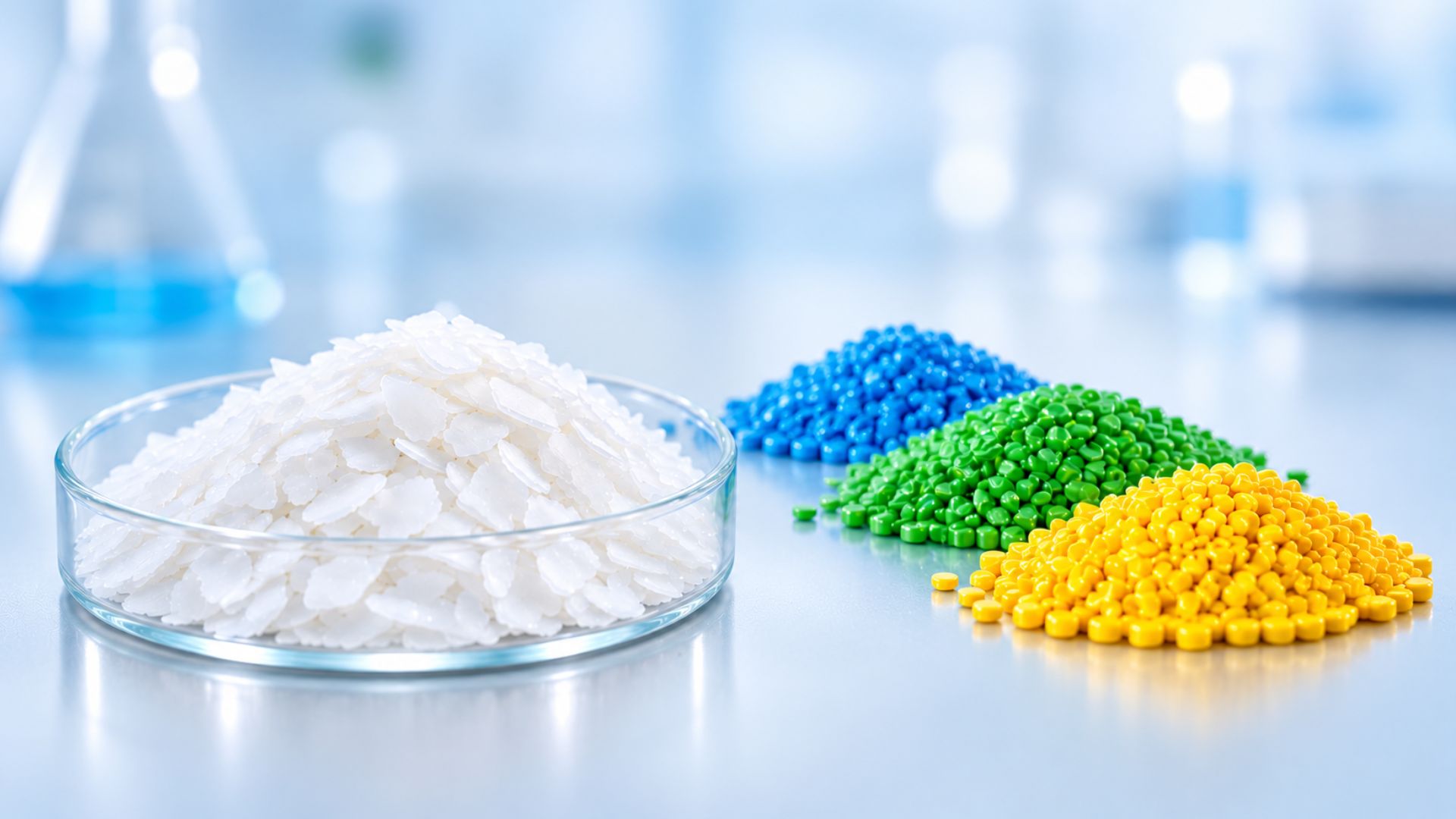
In color masterbatch production, pigments are incorporated into a polymer carrier at concentrations significantly higher than those used in finished plastic products. The high pigment loading increases the contact between solid particles and can make uniform dispersion difficult. PE wax for color masterbatch is introduced to improve pigment wetting and facilitate the distribution of pigment particles throughout the carrier resin.
PE wax is available in different grades, including polymerization-derived waxes and waxes produced through controlled polyethylene degradation. These materials can differ in molecular weight distribution, crystallinity, viscosity, and thermal behavior. Consequently, PE wax grades with similar melting points may perform differently under the same compounding conditions.
Why Pigment Dispersion Matters In Color Masterbatch Production
Pigment dispersion is one of the main factors determining the color strength, appearance, and consistency of a masterbatch. Pigment particles naturally tend to form aggregates and agglomerates because of interactions between their surfaces. When these structures are not adequately broken down during compounding, the resulting masterbatch may contain regions with uneven pigment concentration.
Poor dispersion can lead to visible color specks, streaks, reduced color strength, and inconsistent coloration in finished plastic products. Large pigment agglomerates may also create difficulties in applications requiring thin films, smooth surfaces, or precise color matching. These defects are particularly important when the final product has strict requirements for visual uniformity and surface quality.
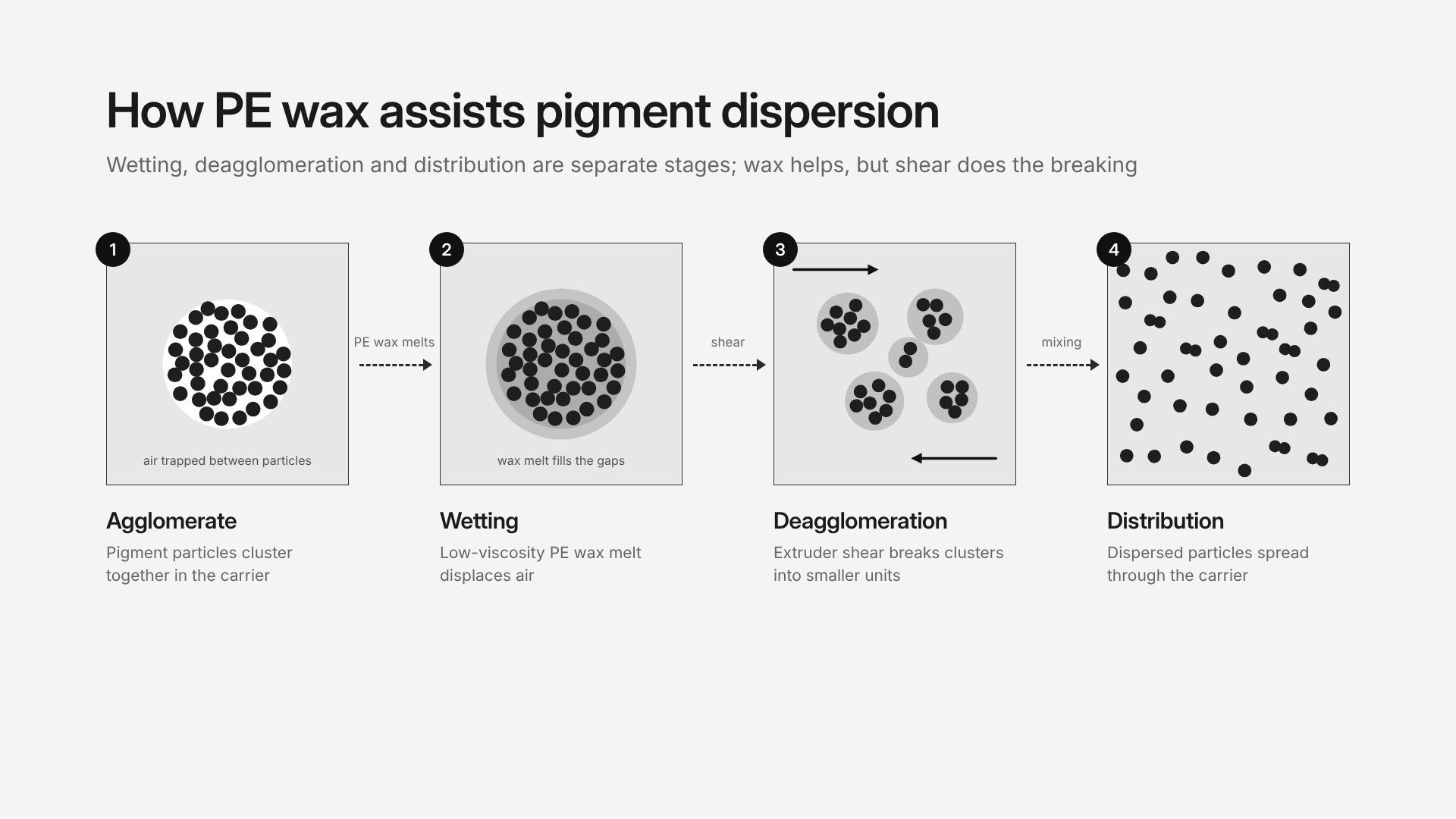
The dispersion process involves pigment wetting, agglomerate breakdown, and stabilization of the dispersed particles. Mechanical shear generated by the extruder contributes to agglomerate breakdown, while the surrounding polymer and dispersing additives influence wetting and subsequent particle distribution. PE wax can contribute to these processes, although it does not replace the mechanical energy required for effective dispersion.
How PE Wax Works As A Dispersing Agent
Improving Pigment Wetting
Pigment wetting occurs when the molten formulation comes into contact with pigment surfaces and displaces air from the spaces between particles. Effective wetting is necessary before mechanical forces can efficiently separate pigment agglomerates. Materials with suitable melt viscosity and interfacial characteristics can improve this stage of the dispersion process.
PE wax for color masterbatch can assist pigment wetting by creating a relatively low-viscosity molten phase around pigment particles. This may improve the penetration of molten material into pigment agglomerates and facilitate their incorporation into the polymer carrier. The actual wetting efficiency depends on the chemical characteristics of the pigment surface and the selected wax grade.
Nonpolar polyethylene waxes are generally more compatible with nonpolar polymer systems such as polyethylene and polypropylene. However, some inorganic pigments and surface-treated pigments have different interfacial requirements. In these cases, oxidized PE wax or other dispersing additives may provide different wetting behavior because of the presence of polar functional groups.
Facilitating Pigment Deagglomeration
Pigment deagglomeration involves breaking down loosely associated pigment clusters into smaller units through mechanical forces. During extrusion, shear stresses generated by the rotating screws act on pigment agglomerates within the molten compound. The efficiency of this process depends on screw configuration, temperature, residence time, and the rheological behavior of the formulation.
PE wax influences the viscosity and flow characteristics of the molten compound, which can affect how mechanical energy is transmitted to pigment agglomerates. An appropriate wax concentration may improve wetting and facilitate dispersion. However, excessive viscosity reduction can decrease the stress applied to agglomerates and limit the effectiveness of mechanical dispersion.
Therefore, PE wax should not be evaluated solely on its ability to reduce melt viscosity. An effective formulation must maintain sufficient shear stress while allowing the pigment to become adequately wetted and distributed. The relationship between wax dosage, pigment concentration, and processing conditions must be considered together.
Improving Pigment Distribution
After pigment agglomerates have been reduced in size, the dispersed particles must be distributed throughout the polymer carrier. Uniform distribution helps minimize local differences in pigment concentration and contributes to consistent color development. This stage is influenced by the flow behavior of the melt and the mixing efficiency of the compounding equipment.
PE wax for color masterbatch can improve melt flow and reduce localized resistance during mixing, which may contribute to more consistent pigment distribution. However, pigment distribution and pigment deagglomeration are different processes. A formulation can distribute pigment clusters uniformly without adequately breaking them into smaller particles.
For this reason, evaluating dispersion quality requires more than observing the overall appearance of masterbatch pellets. Microscopic examination, filter pressure testing, and color strength measurements can provide additional information about the size and distribution of pigment agglomerates.
Key Benefits Of PE Wax In Color Masterbatch Formulations
Improved Color Strength And Uniformity
Color strength depends partly on how effectively pigment particles are dispersed within the polymer matrix. When pigment agglomerates are reduced and distributed more uniformly, a larger proportion of the pigment can contribute to the intended optical effect. This may improve color development and reduce differences between production batches.
PE wax can contribute to this improvement when its properties are suitable for the pigment and carrier resin. However, the relationship between dispersion and color strength varies among pigment types. Organic pigments, titanium dioxide, and carbon black have different particle characteristics and therefore respond differently to changes in dispersing additives.
Uniform pigment dispersion can also reduce visible defects in finished products. In applications such as injection-molded components, films, and extruded profiles, consistent pigment distribution contributes to a more uniform appearance. The final result still depends on masterbatch dilution, processing conditions, and the compatibility of the masterbatch with the base polymer.
Reduced Friction During Melt Processing
PE wax can act as a lubricant during compounding by influencing friction between material components and processing surfaces. Depending on its compatibility with the polymer carrier, the wax may affect both internal flow resistance and interactions with metal surfaces. These effects can influence extrusion pressure, torque, and material transport.
A suitable PE wax grade may help reduce excessive friction and improve processing stability. In some formulations, this can contribute to lower torque or more consistent extrusion behavior. Nevertheless, the magnitude of these effects depends on the extruder configuration, screw speed, temperature profile, and pigment loading.
Excessive lubrication can also create processing difficulties. If the formulation becomes too lubricated, mechanical energy transfer and pigment deagglomeration may become less effective. Therefore, lubrication should be optimized rather than maximized during masterbatch development.
More Consistent Processing Behavior
High pigment concentrations can increase the complexity of melt processing because pigments affect viscosity, particle interactions, and material flow. Variations in pigment dispersion may also cause fluctuations in extrusion pressure and torque. A suitable dispersing system can help maintain more predictable processing conditions.
PE wax for color masterbatch can contribute to processing consistency by modifying the rheological behavior of the pigment-rich compound. When correctly selected, it may help maintain stable material flow and reduce excessive resistance during extrusion. These effects can be particularly relevant in formulations containing pigments that are difficult to wet or disperse.
However, processing stability cannot be attributed to PE wax alone. Moisture content, pigment surface treatment, carrier resin properties, equipment condition, and operating parameters also influence the compounding process. Consistent production requires control of both formulation variables and processing conditions.
How To Select The Right PE Wax For Color Masterbatch
Molecular Weight And Melt Viscosity
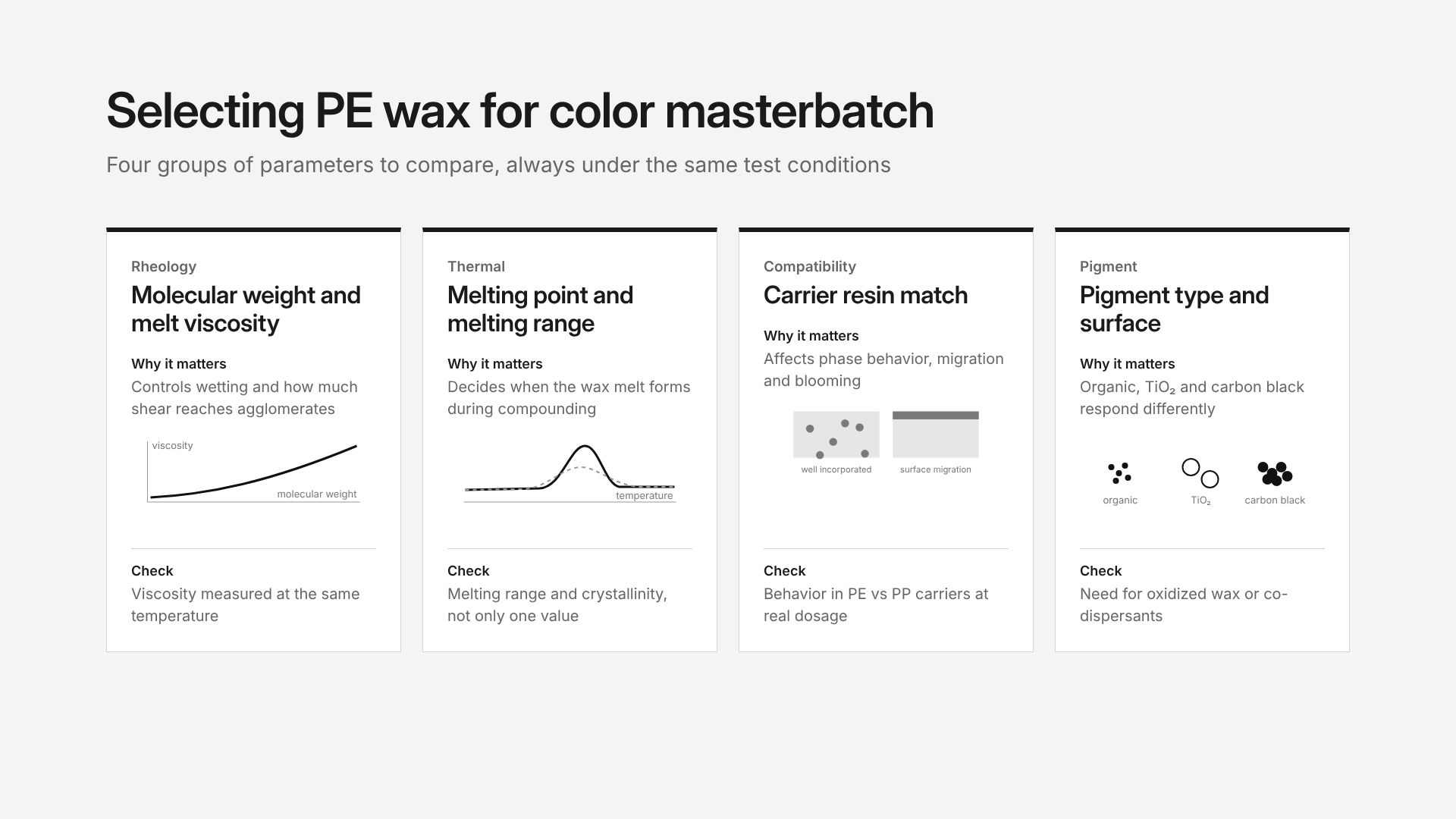
Molecular weight is an important factor affecting the physical and processing characteristics of polyethylene wax. In general, lower-molecular-weight grades tend to have lower melt viscosity, although molecular weight distribution and molecular structure also influence the result. Melt viscosity determines how the wax flows under specified temperature and testing conditions.
A relatively low-viscosity PE wax may improve pigment wetting and facilitate flow within highly filled formulations. However, selecting the lowest available viscosity is not necessarily beneficial. Excessive viscosity reduction may reduce shear stress during compounding and weaken the mechanical forces needed to break down pigment agglomerates.
Manufacturers should compare melt viscosity values measured under equivalent test conditions. Viscosity data obtained at different temperatures cannot be directly compared without considering the temperature dependence of the material. Laboratory dispersion trials are necessary to determine whether a particular viscosity range is appropriate for the formulation.
Melting Point And Thermal Behavior
The melting point of PE wax influences when the material begins to form a molten phase during processing. A wax that melts within the relevant temperature range can participate in pigment wetting and influence the flow behavior of the compound. However, the melting point alone does not fully describe the thermal characteristics of polyethylene wax.
Crystallinity, molecular weight distribution, and molecular structure can affect melting behavior. Two wax grades with similar reported melting points may have different melting ranges and viscosity profiles. These differences can influence their behavior during heating, mixing, and cooling.
PE wax for color masterbatch should be selected with consideration for the carrier resin and processing temperature. The wax must remain suitable for the operating conditions without causing unwanted separation or deterioration in the finished product. Thermal analysis and processing trials can help establish the appropriate grade.
Compatibility With The Carrier Resin
Compatibility between PE wax and the polymer carrier is essential for stable masterbatch performance. Polyethylene wax generally has favorable chemical compatibility with polyethylene-based systems because of similarities in molecular structure. However, compatibility is influenced by molecular weight, crystallinity, wax concentration, and the characteristics of the specific carrier resin.
In polypropylene-based masterbatch, PE wax may still function as a processing aid, but its behavior must be evaluated in the actual formulation. Differences between polyethylene wax and polypropylene can influence phase behavior, migration, and the properties of the final compound. Compatibility should therefore not be assumed simply because both materials are polyolefins.
Inadequate compatibility or excessive wax concentration may contribute to surface migration, blooming, or changes in mechanical and surface properties. These effects are particularly relevant when masterbatch is used in products requiring printing, coating, sealing, or a controlled surface appearance.
Pigment Type And Surface Characteristics
Pigments differ substantially in particle size, surface chemistry, structure, and tendency to form agglomerates. These differences affect the amount of dispersing agent required and the effectiveness of a particular wax grade. A formulation developed for one pigment cannot automatically be applied to another pigment with the same concentration.
Organic pigments often have relatively small primary particle sizes and can form agglomerates that are difficult to disperse. Carbon black may have a high specific surface area and a complex aggregate structure, while titanium dioxide has different surface characteristics depending on its grade and treatment. Each pigment system requires an appropriate balance of wetting and mechanical dispersion.
PE wax for color masterbatch should therefore be evaluated in relation to the pigment’s surface properties and loading level. In some systems, a combination of polyethylene wax and other dispersing agents may be more effective than polyethylene wax alone. The selection should be based on measurable dispersion performance rather than a single general-purpose formulation.
PE Wax Dosage In Color Masterbatch Production
The appropriate dosage of PE wax depends on pigment concentration, pigment surface area, carrier resin, processing equipment, and the intended application. There is no universal dosage that provides optimal dispersion across all color masterbatch formulations. The required concentration must be established through formulation development and comparative testing.
As an initial screening approach, formulators may investigate PE wax concentrations of approximately 1-5% by weight of the masterbatch, then adjust the range according to the pigment system and processing results. This is an experimental starting range rather than a universal recommendation. Highly concentrated pigments or specialized dispersing systems may require substantially different concentrations.
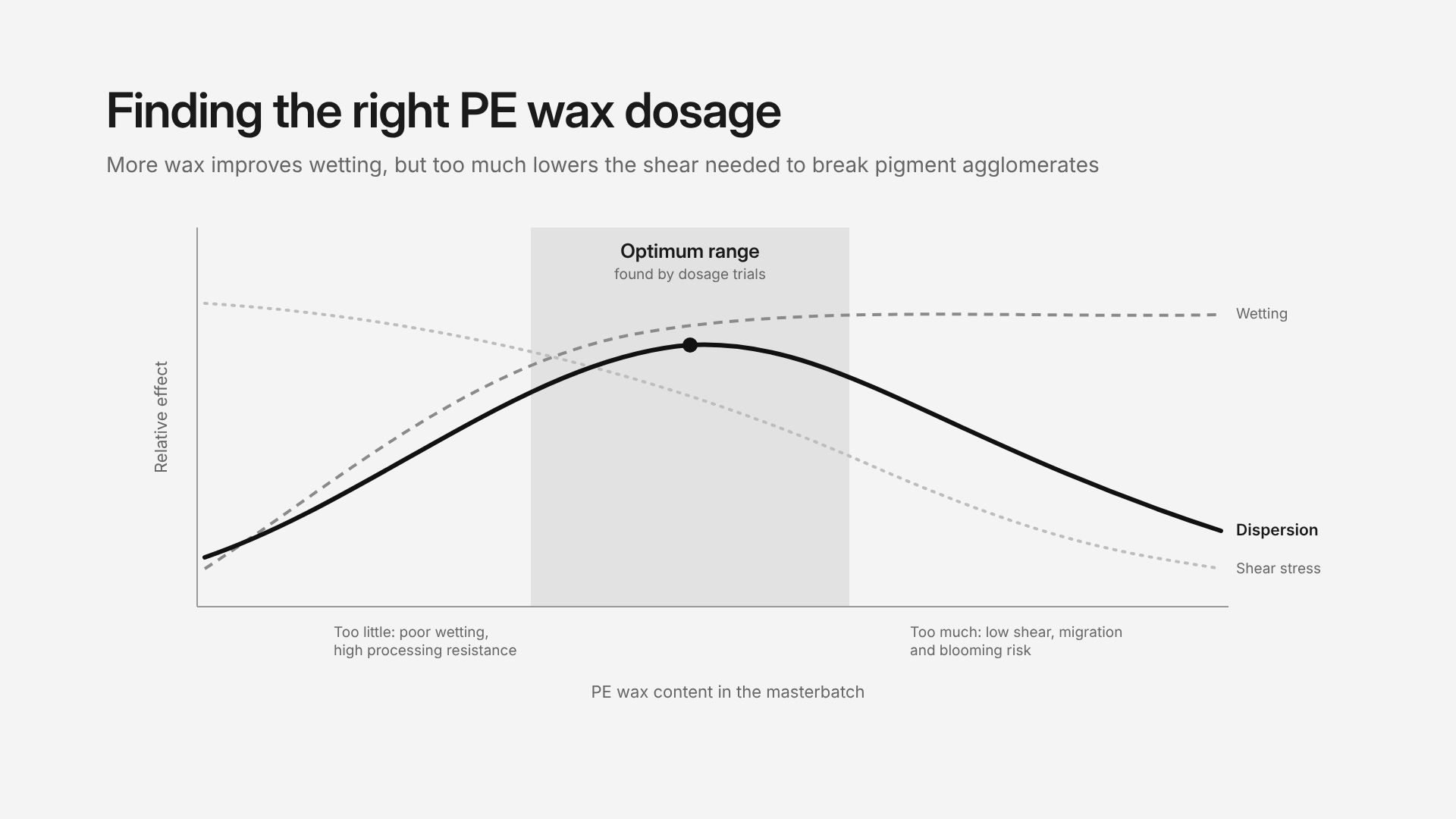
Insufficient PE wax may result in inadequate wetting or excessive processing resistance, depending on the formulation. Conversely, excessive PE wax may reduce shear efficiency, increase migration risk, or affect the properties of the finished plastic product. Increasing the wax concentration does not necessarily improve pigment dispersion beyond an optimal level.
A controlled dosage study should compare formulations under consistent processing conditions. Relevant measurements include color strength, pigment agglomerate size, extrusion pressure, torque, melt flow behavior, and finished-product appearance. This approach provides a more reliable basis for selecting wax concentration than evaluating pellet appearance alone.
PE Wax For Different Color Masterbatch Applications
Polyethylene-Based Color Masterbatch
Polyethylene-based color masterbatch is widely used in film extrusion, blow molding, injection molding, and other plastic processing applications. In these systems, PE wax is commonly considered because of its chemical similarity to polyethylene carrier resins. This similarity can facilitate incorporation into the formulation, although compatibility still depends on the specific grades and concentrations involved.
For film applications, pigment dispersion is particularly important because large agglomerates may cause visible defects or interfere with thin-film processing. The formulation must provide sufficient dispersion while minimizing undesirable effects on film surface properties, sealing performance, and mechanical behavior. The amount and type of PE wax should be evaluated in relation to these requirements.
Polypropylene-Based Color Masterbatch
Polypropylene-based masterbatch is used in injection molding, fiber production, nonwoven materials, and other applications. PE wax may be incorporated to modify processing behavior and assist pigment dispersion, but its compatibility with polypropylene requires careful evaluation. The selection of a suitable wax grade depends on both the carrier resin and the intended end use.
In fiber and nonwoven applications, insufficient pigment dispersion can contribute to filtration difficulties and processing defects. Excessive wax or poorly compatible additives may also affect spinning behavior and surface characteristics. Therefore, polypropylene masterbatch formulations often require stricter evaluation of dispersion quality and additive compatibility.
High-Pigment-Loading Masterbatch
High-pigment-loading formulations present additional challenges because the proportion of solid particles is relatively high compared with the available polymer carrier. Particle interactions become more significant, and the compound may require greater mechanical energy for effective dispersion. The selection of dispersing additives is therefore particularly important.
PE wax for color masterbatch can influence the wetting and flow characteristics of these concentrated systems. Nevertheless, a higher wax concentration does not always produce better results. Formulators must balance pigment wetting, melt viscosity, shear transmission, and carrier resin content to achieve adequate dispersion without compromising processing stability.
Common Problems Caused By Incorrect PE Wax Selection
An unsuitable PE wax grade can contribute to several formulation and processing problems. One potential issue is insufficient pigment dispersion despite the presence of a dispersing additive. This may occur when the wax does not adequately wet the pigment, when its concentration is inappropriate, or when the melt viscosity becomes too low for effective shear transmission.
Another concern is wax migration or blooming, which may appear as an unwanted surface deposit in certain formulations. Migration behavior depends on wax molecular characteristics, concentration, compatibility, and the storage or processing conditions of the final product. Such effects can influence surface appearance and subsequent operations, including printing or coating.
Incorrect wax selection may also alter extrusion behavior or finished-product properties. Excessive lubrication can affect material transport and mixing, while poor compatibility may contribute to changes in surface or mechanical performance. These problems demonstrate why wax selection should consider both masterbatch production and the performance of the final plastic product.
How To Evaluate PE Wax Performance In Color Masterbatch
Color Strength And Color Difference Testing
Color strength testing helps determine whether changes in formulation produce measurable differences in pigment performance. Comparative samples should be prepared using consistent pigment concentrations, dilution ratios, processing conditions, and measurement procedures. This allows the influence of PE wax to be assessed more reliably.
Color difference measurements, commonly expressed using colorimetric parameters such as ΔE, can also help evaluate batch consistency. However, color difference alone does not fully describe pigment dispersion. A formulation may achieve an acceptable color measurement while still containing agglomerates that affect surface quality or processing performance.
Microscopic Dispersion Analysis
Microscopic analysis provides information about pigment distribution and the presence of larger agglomerates. Depending on the material and application, optical microscopy or other imaging techniques may be used to examine prepared samples. The evaluation should consider both agglomerate size and the consistency of their distribution.
For demanding applications, filter pressure testing can provide additional evidence of dispersion quality by measuring pressure development as the melt passes through a defined filter system. This method can be particularly useful when larger particles or agglomerates create filtration problems. Results must be interpreted using consistent test conditions.
Processing And Finished-Product Evaluation
Processing measurements help determine whether PE wax produces practical improvements during compounding. Extrusion pressure, torque, throughput, and melt temperature can be monitored to identify changes in flow behavior. These measurements should be considered together because an improvement in one parameter does not necessarily indicate better overall dispersion.
Finished-product testing is equally important. Depending on the application, evaluation may include surface appearance, mechanical properties, film defects, printability, or sealing behavior. PE wax for color masterbatch should be considered effective only when it provides acceptable dispersion and processing performance without creating undesirable effects in the final product.
Technical Considerations For Consistent Masterbatch Quality
Consistent masterbatch quality requires coordinated control of raw materials, formulation, and processing conditions. PE wax is one component of this system, and its performance depends on the surrounding formulation. Pigment quality, carrier resin properties, and the condition of the compounding equipment must remain sufficiently consistent for meaningful comparisons.
When changing PE wax suppliers or grades, manufacturers should review technical specifications rather than relying only on product descriptions. Important parameters include melt viscosity, melting behavior, density, molecular characteristics where available, and relevant impurity or volatility information. Testing methods and measurement temperatures should also be checked before comparing values.
A laboratory formulation should be validated under representative production conditions before large-scale implementation. Differences in screw configuration, residence time, temperature, and throughput can influence dispersion behavior. A wax grade that performs well in a small laboratory extruder may require dosage or processing adjustments when transferred to industrial equipment.
Conclusion
PE wax for color masterbatch is an important formulation component that can influence pigment wetting, dispersion, lubrication, and melt processing behavior. Its contribution to masterbatch quality depends on the interaction between wax properties, pigment characteristics, carrier resin compatibility, and processing conditions. Effective selection therefore requires a technical understanding of the complete formulation rather than focusing on a single wax specification.
Melt viscosity, molecular weight distribution, melting behavior, and compatibility are among the main parameters that should be considered when comparing PE wax grades. Appropriate dosage is equally important because excessive lubrication can reduce dispersion efficiency or introduce unwanted effects in finished products. Laboratory testing and production validation remain necessary to determine the most suitable formulation.
For manufacturers developing or optimizing color masterbatches, PE wax selection should be guided by measurable performance, including pigment dispersion, color consistency, processing stability, and finished-product quality. A systematic evaluation of these factors provides a reliable foundation for maintaining consistent masterbatch performance across different pigments, carrier resins, and processing applications.