
Calcium carbonate is the most widely used mineral filler in plastics, but its benefits depend on how well its fine particles are dispersed in the polymer. Calcium carbonate agglomeration occurs when these particles cluster together and resist separation during compounding, which can lead to surface defects, weak mechanical properties and unstable processing. Read this article by TLD Vietnam to understand why agglomeration occurs, how it affects plastic products and which measures can reduce it in practice.
What Is Calcium Carbonate Agglomeration
Calcium carbonate (CaCO₃) is used in Polypropylene (PP), Polyethylene (PE), PVC and many other polymer to reduce formulation cost, increase stiffness and improve dimensional stability. It is supplied either as Ground calcium carbonate (GCC), produced by milling natural limestone or marble, or as Precipitated calcium carbonate (PCC), produced through a controlled chemical reaction. Commercial grades for plastics typically have median particle sizes from a few micrometers down to below one micrometer, which gives them a large surface area per unit of weight.
Calcium carbonate agglomeration describes the formation of clusters in which individual particles are held together by relatively weak forces, such as van der Waals attraction, capillary forces from adsorbed moisture and electrostatic charges. These clusters can form in the powder during storage and handling, and they can also persist in the polymer melt if compounding does not separate them. When agglomerates survive processing, they behave as large inclusions in the finished product rather than as the fine particles described on the technical data sheet.
Aggregates Versus Agglomerates
It is useful to distinguish agglomerates from aggregates, because the two require different remedies. Aggregates are particles bonded by strong forces, for example through crystal intergrowth during precipitation, and normal compounding shear cannot break them apart. Agglomerates are looser assemblies that can be separated when the particles are adequately wetted by the polymer and exposed to sufficient shear stress.
This distinction has practical consequences for troubleshooting. Problems caused by agglomerates can often be reduced through better surface treatment, moisture control or compounding conditions, whereas problems caused by aggregates usually require a different filler grade. As polymer scientist Chris DeArmitt has emphasized, the properties of a filled polymer are determined by the size of the filler particles and agglomerates actually present in the material, not by the values listed on the data sheet.
Why Calcium Carbonate Particles Tend To Agglomerate
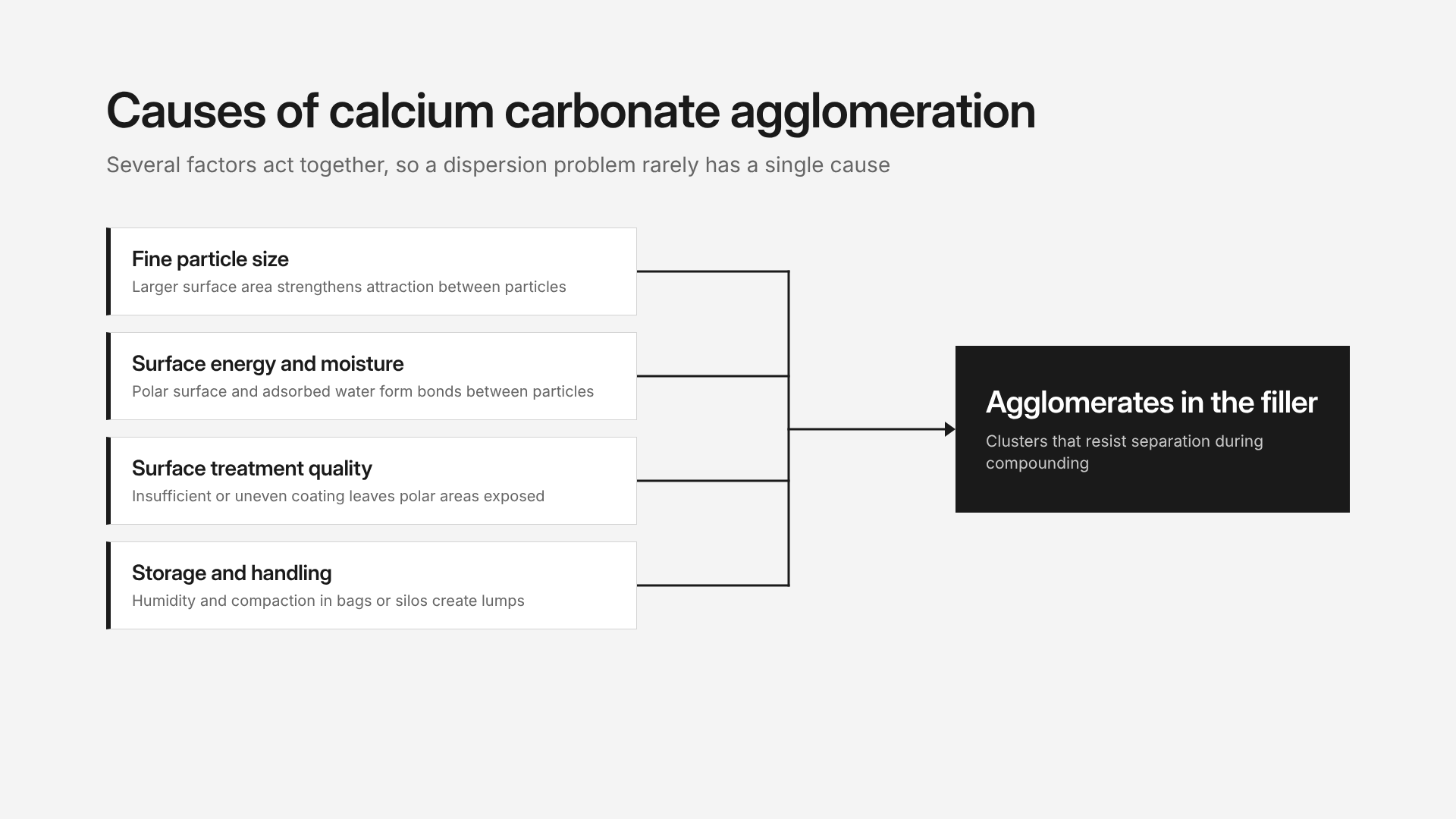
Calcium carbonate agglomeration is not caused by a single factor. It results from the combined effect of particle size, surface chemistry, moisture, surface treatment and the conditions under which the filler is stored and processed. Understanding each factor helps manufacturers identify where a dispersion problem originates and which corrective action is likely to be effective.
Particle Size And Surface Area
As particle size decreases, the specific surface area of the filler increases, and attractive forces between particles become stronger relative to their weight. Very fine particles therefore have a greater tendency to cling together, which makes Calcium carbonate agglomeration more common in fine grades than in coarse ones. Patent literature on surface-treated carbonates notes that reducing the fraction of particles below 0.5 micrometers lowers the surface area of the mineral, which can reduce agglomeration and moisture absorption.
This creates a trade-off in grade selection. Finer grades can improve impact strength, surface smoothness and the performance of thin films, but they generally demand better surface treatment and more efficient compounding. The top cut of the particle size distribution, which describes the largest particles present, is a separate parameter, because a few oversized particles can cause defects even when the filler is well dispersed.
Surface Energy And Moisture
The surface of untreated Calcium carbonate is polar and hydrophilic, whereas Polyolefins such as PE and PP are nonpolar. Because the polymer melt does not readily wet the polar mineral surface, contact between particles remains energetically favorable, and the particles tend to stay together. This mismatch in surface energy is one of the fundamental causes of Calcium carbonate agglomeration in Polyolefin compounds.
Moisture intensifies the problem. Water adsorbed on the particle surfaces can form liquid bridges between neighboring particles, and the resulting capillary forces bind them into agglomerates. During melt processing, the same moisture can vaporize and create bubbles or voids. Patent literature on breathable films identifies insufficient coating and the presence of moisture in the filler as causes of agglomeration and higher failure rates in film production.
Surface Treatment Quality
Most Calcium carbonate grades for plastics are treated with stearic acid or other fatty acids. The treatment reduces the surface energy of the particles, makes them hydrophobic and improves their wetting by nonpolar polymer. When the coating is insufficient or uneven, untreated polar areas remain on the particle surfaces, and these areas can promote agglomeration and moisture pick-up.
Excessive coating also creates problems. Stearic acid that is not bound to the mineral surface can migrate during processing and contribute to plate-out, die build-up and volatile emissions. For this reason, filler producers aim for a coating level that matches the surface area of the particles, often described as monolayer coverage, and some processes are designed specifically to minimize free stearic acid. The correct treatment level therefore depends on the particle size distribution of each grade rather than on a fixed percentage.
Storage And Handling Conditions
Storage conditions can change the condition of a filler that left the production plant in good order. In humid climates, including tropical regions such as Southeast Asia, untreated or poorly treated Calcium carbonate can absorb moisture from the air during storage or transport. Even treated grades can pick up some moisture when bags are opened and left exposed for long periods.
Mechanical compaction is another factor. Powder stored in tall stacks of bags or in silos is compressed by its own weight, which brings particles into closer contact and can produce hard lumps. Pneumatic conveying and long storage times can have similar effects, so first-in, first-out stock management and dry storage areas are practical measures for reducing Calcium carbonate agglomeration before the filler reaches the extruder.
How Agglomeration Affects Plastic Products
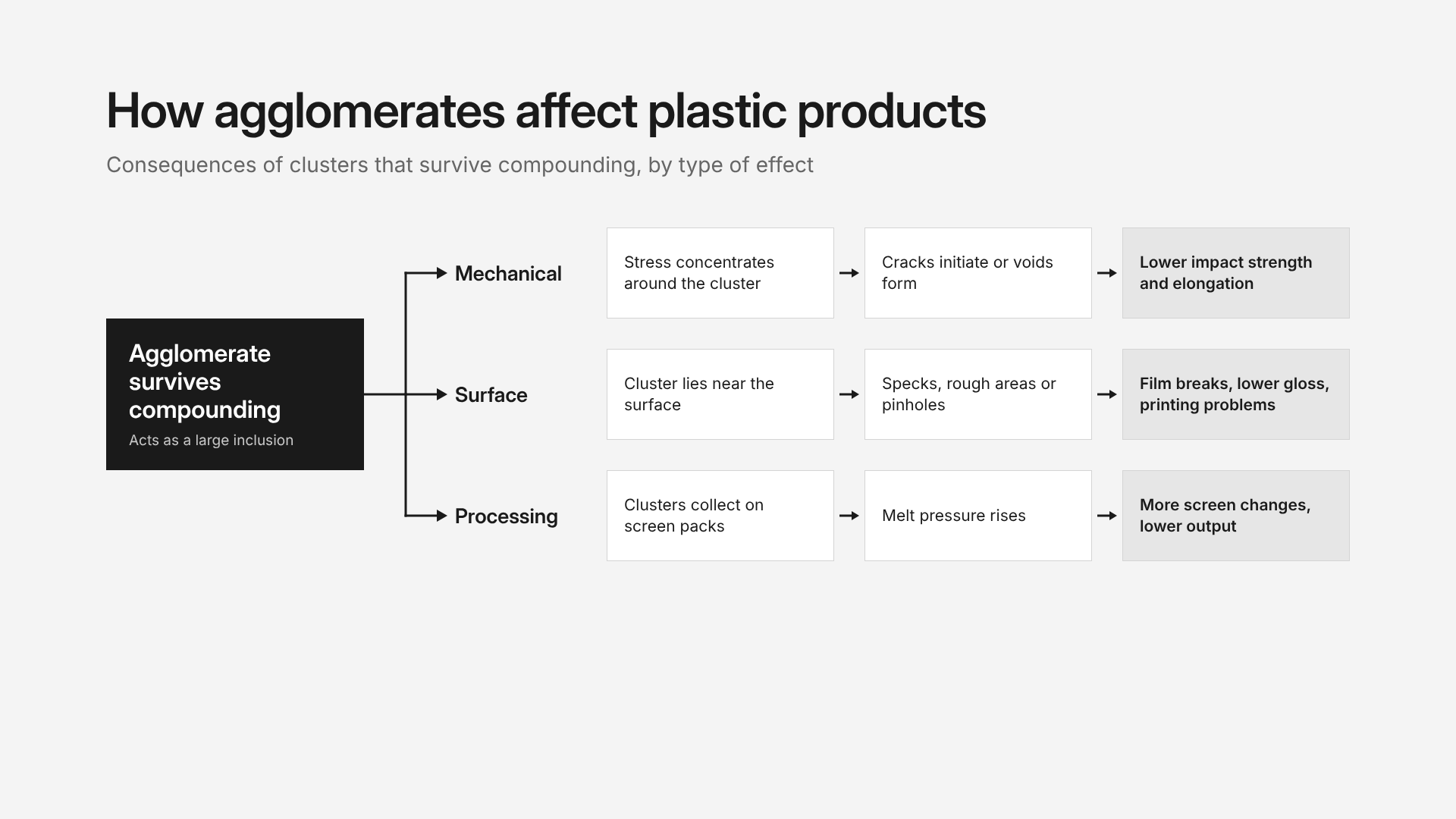
The consequences of poor dispersion depend on the polymer, the filler loading and the application. Thin films, fibers and impact-critical parts are usually the most sensitive, while thick-walled products can tolerate larger particles. In each case, however, agglomerates change the way the material responds to stress, the way its surface looks and the way it behaves during processing.
Mechanical Properties
Well-dispersed Calcium carbonate can increase stiffness without a severe loss of toughness, and in some formulations it can even improve impact behavior. Calcium carbonate agglomeration reverses this effect, because a large cluster acts as a stress concentrator where cracks can initiate under load. Poorly bonded agglomerates can also separate from the polymer and form voids, which further weakens the material.
The size of this effect can be considerable. In a presentation on filled thermoplastics prepared at BASF Plastics Research, DeArmitt reported unnotched impact results in which a compound with untreated filler failed in a brittle manner at around 20 kJ/m², while the corresponding compound with surface-treated filler failed in a ductile manner at around 40 kJ/m². Such figures apply to the specific system tested, but they show how strongly dispersion quality can influence toughness.
Surface And Appearance Defects
Agglomerates near the surface of a product can appear as white specks, rough areas or small bumps. In films, they can cause pinholes, local thinning and breaks during stretching, which is why breathable film producers pay close attention to filler dispersion and moisture. Surface defects can also reduce gloss and interfere with printing, coating or lamination.
In colored products, uneven filler distribution can produce visible variations in shade or opacity. These defects are sometimes attributed to pigments, so it is useful to examine whether Calcium carbonate agglomeration is the actual source before changing the color formulation. A simple comparison between a natural compound and a colored compound made with the same filler batch can often show whether the defect follows the filler or the pigment.
Processing Stability
Agglomerates and oversized particles accumulate on screen packs and melt filters, causing melt pressure to rise during production. Frequent screen changes reduce output and can introduce variation between production runs. In fiber spinning and thin-film extrusion, large particles can also cause filament breaks or film tears.
Poor dispersion can also make the effective filler content less uniform from one section of the product to another. This variation affects density, stiffness and dimensional stability, and it can make quality control results difficult to interpret. Stable processing therefore depends not only on extruder settings but also on the condition of the filler entering the process.
How To Evaluate Calcium Carbonate Dispersion
No single test fully describes dispersion quality, because some methods characterize the filler powder while others examine the filler inside the polymer. A reliable assessment combines powder testing, melt testing and finished-product evaluation. Comparisons are meaningful only when samples are prepared and tested under consistent conditions.
Particle Size Analysis And Powder Tests
Laser diffraction is commonly used to measure the particle size distribution of Calcium carbonate, including the median size and the top cut. However, samples are usually dispersed in a liquid and sometimes treated with ultrasound before measurement, which can break weak agglomerates. The result therefore describes the potential particle size of the filler rather than the state of dispersion in a polymer.
Other powder tests provide useful supplementary information. Sieve residue tests detect coarse particles and hard lumps, moisture measurement shows whether the filler has absorbed water during storage, and simple hydrophobicity checks can indicate whether a treated grade has an adequate coating. These tests are quick to perform and can be used for incoming inspection of each delivery.
Filter Pressure Testing
Filter pressure testing measures how quickly pressure rises when a filled melt is extruded through a fine screen at constant throughput. Agglomerates and oversized particles are retained by the screen, so a faster pressure increase indicates poorer dispersion. The method is standardized for colorants in EN 13900-5 and is widely applied to filler masterbatch and compounds intended for films and fibers.
Because the result depends on screen mesh, throughput, temperature and filler loading, values from different laboratories cannot be compared directly unless the test conditions are identical. The test is most informative when it is used to compare filler grades, coating levels or compounding settings within the same procedure. Recording the full test conditions alongside each result makes it possible to repeat the comparison when a new grade or supplier is introduced.
Microscopy And Finished-Product Testing
Optical microscopy of thin films or pressed samples allows inspectors to count and measure visible agglomerates. Scanning electron microscopy (SEM) of fracture surfaces provides more detailed information, showing whether particles are well wetted by the polymer and whether voids have formed around agglomerates. These observations help explain differences in mechanical results.
Finished-product tests complete the evaluation. Depending on the application, they may include impact strength, tensile elongation, film defect counts, surface roughness and gloss. Linking these results to powder and melt tests gives manufacturers a clear picture of how Calcium carbonate agglomeration affects the performance of their specific product.
How To Prevent Calcium Carbonate Agglomeration
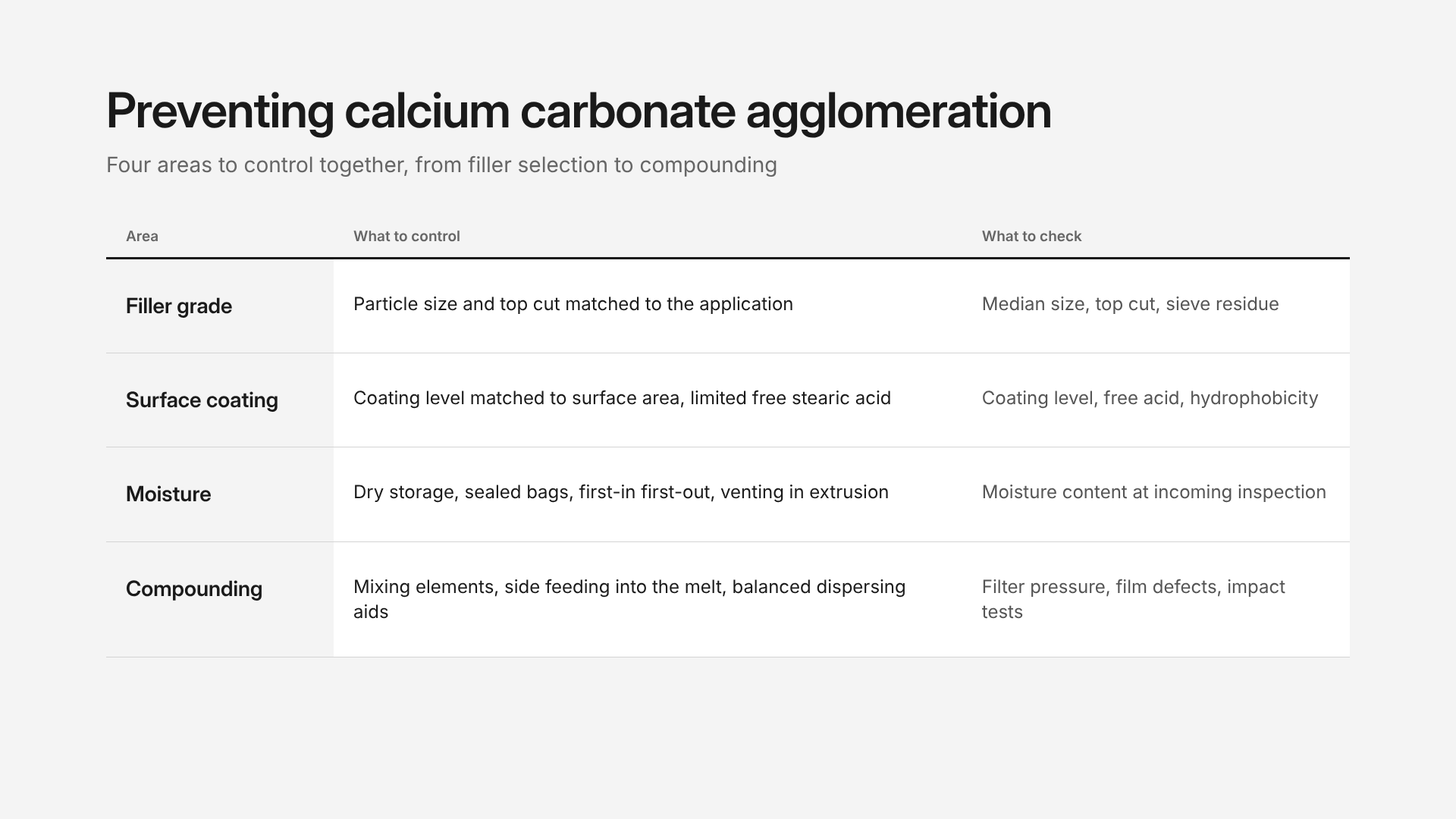
Prevention is more effective than correction, because agglomerates that enter the extruder are difficult to break down completely. The most reliable approach addresses four areas together: the filler grade, its surface treatment, moisture control and compounding conditions. Improvements in one area rarely compensate for serious weaknesses in another.
Selecting An Appropriate Grade
The filler grade should match the requirements of the application. Films and fibers usually need fine grades with a tightly controlled top cut, while pipes, profiles and thick injection-molded parts can often use coarser grades. Selecting a finer grade than the application requires increases surface area and makes dispersion more demanding without necessarily improving the product.
When comparing suppliers, manufacturers should request data on median particle size, top cut, specific surface area, coating level, moisture content and sieve residue. These parameters should be measured with stated methods, because results obtained under different conditions cannot be compared reliably. Trial batches under representative production conditions remain the most dependable basis for approval.
Controlling Surface Coating
For Polyolefin applications, surface-treated grades are generally preferred because they are wetted more easily by the polymer and absorb less moisture. The coating level should correspond to the surface area of the particles, so finer grades require more treatment agent than coarser ones. Manufacturers should also ask whether the supplier controls free stearic acid, since an excess can cause plate-out and volatile emissions.
In applications that require stronger adhesion between filler and polymer, additional coupling agents can be considered. Patent literature describes, for example, treatment layers that combine a hydrophobizing agent with maleic anhydride-grafted PE or PP. Such systems can improve interfacial adhesion, but their benefit should be confirmed through testing in the actual formulation.
Managing Moisture
Moisture control begins at the warehouse. Bags should be stored in a dry area, kept sealed until use and consumed on a first-in, first-out basis, and opened bags should not be left exposed for long periods. Some producers of treated grades specify moisture levels of 0.2% or lower, which gives a useful reference point for incoming inspection.
During processing, vented or vacuum-degassed extruders can remove residual moisture and volatiles from the melt. When the filler has absorbed significant moisture, drying before use may be necessary. These measures reduce both Calcium carbonate agglomeration and moisture-related defects such as bubbles and voids.
Optimizing Compounding Conditions
Compounding equipment and settings have a direct influence on dispersion. Co-rotating twin-screw extruders with suitable kneading and mixing elements provide the shear and distributive mixing needed to separate agglomerates. Feeding the filler through a side feeder into an already molten polymer can improve wetting and reduce compaction of the powder in the solid conveying section.
Dispersing aids such as Polyethylene wax can improve wetting and flow in highly filled compounds and filler masterbatches. However, excessive lubrication can reduce the shear stress transmitted to agglomerates, so the additive level should be optimized rather than maximized. Screw configuration, temperature profile, throughput and screw speed should be adjusted together and verified with dispersion tests.
Conclusion
Calcium carbonate agglomeration is a common cause of weak mechanical properties, surface defects and unstable processing in filled plastics. It arises from the combined effects of fine particle size, polar surface chemistry, moisture, inadequate surface treatment and unfavorable storage or handling conditions. Because these factors interact, a dispersion problem rarely has a single cause or a single solution.
The most effective strategy combines an appropriate filler grade, a coating matched to the particle surface area, consistent moisture control and compounding conditions that provide adequate wetting and shear. Powder tests, filter pressure testing, microscopy and finished-product evaluation together show whether these measures are working. With this systematic approach, manufacturers can reduce Calcium carbonate agglomeration and obtain the full technical and economic value of the filler.
To learn more about additives, fillers and compounding practice, continue reading the TLD Vietnam blog, where our technical team discusses practical topics in plastics processing.