
In industrial paint production, formulation optimization is not limited to achieving an attractive surface appearance. It also determines coating efficiency, raw material consumption, application performance, and overall production cost. Among the most important visual and functional indicators, opacity and whiteness in paint formulation play a central role because they directly influence hiding power, brightness and the number of coats required to obtain a uniform finish.
In practice, opacity and whiteness are sometimes evaluated as separate properties. This approach can lead to unbalanced formulations, excessive pigment loading or unnecessary cost increases. A more effective approach is to understand how opacity and whiteness in paint formulation are connected through light scattering, pigment dispersion and film structure. For that reason, opacity and whiteness in paint formulation should be treated as a combined formulation target.
Read on as TLD Vietnam explores the relationship between opacity and whiteness, and how formulation components can be optimized to improve coating performance while controlling production costs.
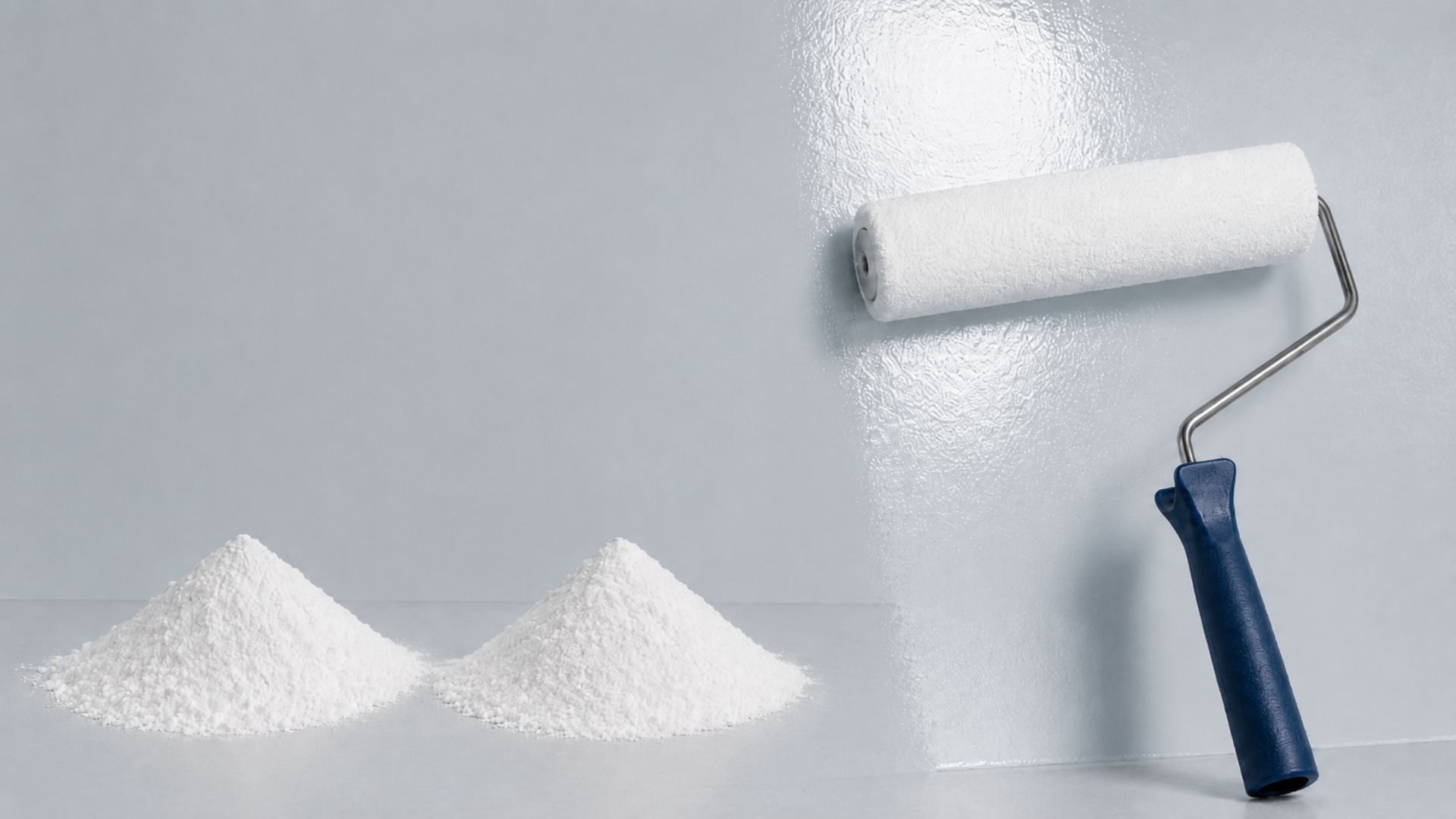
What Are Opacity And Whiteness In Paint Formulation?
Opacity
Opacity is the ability of a paint film to hide the substrate underneath. A coating with high opacity prevents the background color or surface from showing through after application. In practical terms, good opacity can reduce the number of coats needed, improve coverage efficiency and support more consistent surface quality.
Opacity is commonly associated with hiding power or contrast ratio. It depends on the type and concentration of pigments, the dry film thickness, the refractive index difference between particles and the surrounding medium, and the quality of pigment dispersion. For this reason, opacity and whiteness in paint formulation should be evaluated under realistic application conditions rather than through visual inspection alone.
Whiteness
Whiteness describes the perceived brightness and cleanliness of a white or light-colored paint surface. It is related to the ability of the coating surface to reflect visible light evenly. A paint with high whiteness appears brighter, cleaner and more visually uniform, especially in applications where appearance consistency is important.
However, whiteness is not the same as opacity. A paint film may appear bright but still fail to fully hide the substrate if the film is too thin or if pigment dispersion is poor. This distinction is important because opacity and whiteness in paint formulation must be optimized together, not treated as independent targets.
Why Opacity And Whiteness In Paint Formulation Are Related
The relationship between opacity and whiteness comes from the way light interacts with the paint film. When light reaches the coating surface, part of it is reflected, part is absorbed and part enters the film. Inside the film, pigment and mineral particles scatter light in different directions. The more efficiently light is scattered and reflected back to the observer, the better the visual brightness and hiding effect.
Opacity and whiteness in paint formulation are therefore closely linked by the mechanism of light scattering. Efficient scattering reduces the visibility of the substrate while also increases the brightness of the coating surface. However, high whiteness does not automatically guarantee high opacity, because the two properties depend on particle distribution, film thickness and the balance between pigments, calcium carbonate, binder and additives.
The internal structure of the dry paint film is especially important. When particles are well distributed, light can be scattered more effectively throughout the film. When particles agglomerate or are poorly dispersed, scattering efficiency decreases, resulting in lower hiding power, uneven appearance or reduced whiteness. This is why opacity and whiteness in paint formulation require careful control of both raw material selection and processing conditions.
The Role Of Titanium Dioxide In Paint Formulation
Titanium dioxide, commonly known as TiO₂, is the primary white pigment used to control opacity and whiteness in paint formulation. Its high refractive index gives it strong light-scattering power, making it highly effective in improving hiding power and brightness.
When TiO₂ is properly dispersed, individual particles can scatter light efficiently within the coating film. This increases the probability that light will be reflected back from the film rather than passing through to the substrate. As a result, TiO₂ contributes strongly to both opacity and whiteness in paint formulation. This technical role makes TiO₂ central to opacity and whiteness in paint formulation.
The performance of TiO₂ depends not only on dosage but also on dispersion quality, particle spacing and compatibility with the binder system. Adding more TiO₂ does not always result in proportional performance improvement. When particles are too close together or not well dispersed, their scattering efficiency can decline. This phenomenon makes formulation design more complex than simply increasing pigment content.
Because TiO₂ is also one of the higher-cost raw materials in many white paint systems, manufacturers often need to optimize its use carefully. The objective is not to minimize TiO₂ at all costs, but to achieve the required performance with efficient pigment utilization. This is where calcium carbonate becomes relevant in the broader balance of opacity and whiteness in paint formulation.
The Role Of Calcium Carbonate In Paint Formulation
Calcium carbonate is widely used in paint formulation as a mineral filler that contributes to cost control, film structure and surface consistency. In the context of opacity and whiteness in paint formulation, calcium carbonate should be understood as a supporting component rather than a direct replacement for TiO₂.
The refractive index of calcium carbonate is lower than that of TiO₂, so it does not provide the same level of hiding power. However, high-quality calcium carbonate can support the overall formulation by helping control solids content, film texture and pigment volume balance. When properly selected and dispersed, it can contribute to a more stable paint film and help maintain a clean white appearance.
Whiteness is an important quality parameter for calcium carbonate. A calcium carbonate grade with high brightness, low impurity content and consistent color tone can help maintain the visual cleanliness of white paint systems. If the material contains impurities or shows unstable color between batches, the final paint may appear dull, uneven, or slightly tinted.
Particle size also affects how calcium carbonate performs in the coating film. Fine and consistent particles can contribute to a smoother surface and more uniform film structure. However, excessive use or poor dispersion can reduce hiding power, lower whiteness, affect gloss, or weaken film properties. For this reason, calcium carbonate must be optimized as part of the entire system of opacity and whiteness in paint formulation. In opacity and whiteness in paint formulation, the dosage of calcium carbonate should always be evaluated together with TiO₂ efficiency and film performance.
Key Factors When Selecting Calcium Carbonate for Paint
The selection of calcium carbonate should be based on measurable technical properties rather than price alone. Brightness and whiteness are important because they influence the final color appearance of the paint. Particle size and particle size distribution affect surface smoothness, viscosity behavior and film uniformity. Purity is also essential because mineral impurities can affect color tone and long-term consistency.
Moisture content requires attention because excess moisture can affect dispersion, storage stability and processing efficiency. Oil absorption is another relevant parameter because it influences binder demand and formulation rheology. A calcium carbonate grade with stable quality from batch to batch helps manufacturers maintain predictable results in opacity and whiteness in paint formulation.
Dispersibility is equally important. Even a high-brightness calcium carbonate may not perform well if it disperses poorly in the selected binder system. Proper dispersion allows particles to distribute evenly, reducing the risk of agglomeration and supporting a more consistent coating surface.
Practical Optimization Of Opacity And Whiteness In Paint Formulation
Optimizing opacity and whiteness in paint formulation requires a balanced approach. The formulation should begin with a clear performance target, including hiding power, whiteness, gloss, viscosity, application method and dry film thickness. Once these requirements are defined, the relationship between TiO₂, calcium carbonate, binder and additives can be adjusted more effectively.

The dispersion process should be closely controlled because poor dispersion can waste the performance potential of both TiO₂ and calcium carbonate. Proper wetting and dispersion help particles function more efficiently within the coating film. This improves consistency and reduces the need for unnecessary overuse of expensive raw materials.
Testing is essential. Opacity should be evaluated through hiding power or contrast ratio, while whiteness should be measured through suitable colorimetric methods. The formulation should also be tested under practical application conditions, because laboratory appearance may differ from real coating performance on actual substrates.
Significance For Paint Manufacturers
A clear understanding of opacity and whiteness in paint formulation allows manufacturers to design coatings with better technical balance. When opacity and whiteness in paint formulation are understood as connected properties, formulation decisions become more systematic. It supports more efficient use of TiO₂, more controlled application of calcium carbonate and better prediction of final surface quality.
This understanding is particularly important in industrial paint systems where performance and cost must be managed simultaneously. A formulation that achieves high whiteness but poor hiding power may require additional coats. A formulation with acceptable hiding power but weak whiteness may fail to meet appearance standards. In both cases, the result is inefficient production and unstable product quality.
By considering opacity, whiteness, dispersion and film structure together, manufacturers can improve formulation reliability and reduce unnecessary adjustments during production.
Conclusion
Opacity and whiteness in paint formulation are closely connected through the mechanism of light scattering. Although they describe different aspects of paint performance, they are influenced by many of the same variables, including pigment selection, particle distribution, film thickness and dispersion quality.
TiO₂ remains the key pigment for achieving opacity and whiteness, while calcium carbonate helps optimize film structure and formulation cost. The most effective paint formulation balances pigments, fillers, and dispersion quality to achieve the required performance efficiently.
For paint manufacturers, understanding opacity and whiteness in paint formulation is the foundation for developing coatings that are technically reliable, visually consistent and economically balanced.