
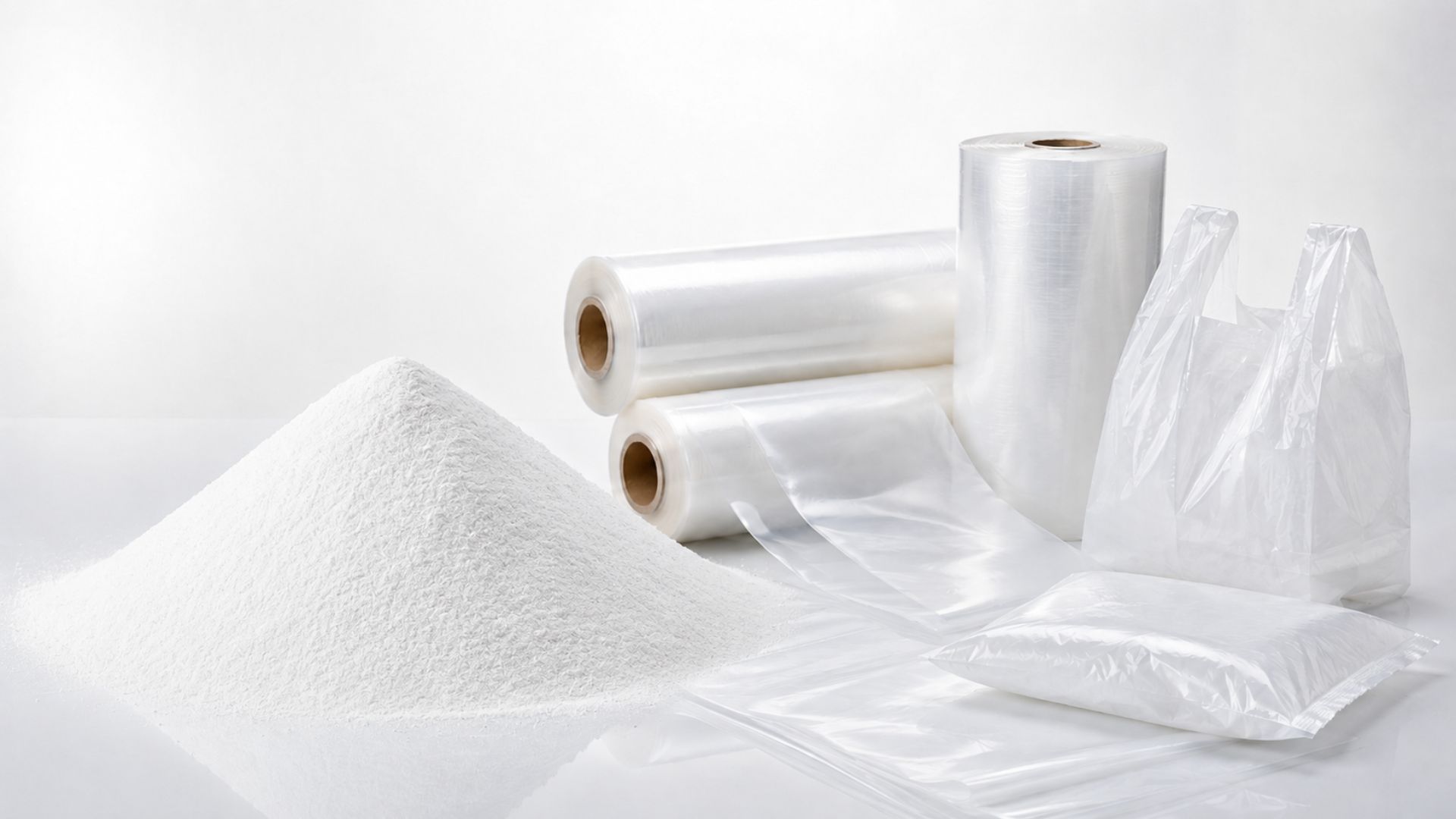
Blown film extrusion is widely used to manufacture shopping bags, refuse sacks, agricultural films, liners, industrial packaging, and lamination films. It produces continuous tubular film with adjustable width, thickness, and mechanical balance in the machine and transverse directions.
Within these formulations, Ground calcium carbonate in blown film is commonly introduced as a mineral filler. Its economic role is well known: it can replace part of the polymer and reduce formulation cost. However, its technical influence is much broader. Ground calcium carbonate changes melt behavior, pressure development, bubble stability, cooling response, film stiffness, optical appearance, sealing behavior, and the way the film performs during printing and bag conversion.
For that reason, Ground calcium carbonate should not be treated as an inert material that simply occupies volume. The performance of ground calcium carbonate in blown film depends on particle size, particle size distribution, surface treatment, moisture, purity, dispersion, and addition level. A properly selected grade can improve processing consistency and functional performance. A poorly selected grade can create unstable extrusion, weak film, excessive haze, die deposits, and sealing problems. Read TLD Vietnam latest blog to explore how GCC selection influences blown film performance and processing.
Understanding Blown Film Processing
Blown film production begins when polyethylene resin and additives are fed into an extruder. The screw conveys, compresses, melts, and mixes the formulation before forcing it through an annular die. The molten tube emerging from the die is inflated with air to form a bubble. The bubble is drawn upward, cooled, collapsed through a collapsing frame, and wound into rolls.
Each stage is sensitive to formulation changes. Melting determines mixture homogeneity; extrusion controls pressure and temperature; bubble formation depends on melt strength and air balance. Cooling determines crystallization and final properties, while winding reveals variations in thickness, stiffness, and surface friction.
This explains why ground calcium carbonate in blown film can affect much more than cost. Any change in filler loading, particle size, or dispersion can alter melt rheology, die pressure, bubble stability, film gauge uniformity, optical properties, and sealing performance. These effects are interconnected. For example, unstable flow at the die may produce thickness variation, which later creates poor winding, inconsistent sealing, and uneven printing.
Why Ground Calcium Carbonate Is Added To Blown Film Formulations
Cost Optimization
The most direct reason for using ground calcium carbonate in blown film is to replace part of the polyethylene while maintaining an acceptable level of performance. Because Ground calcium carbonate has a higher density than PE, substitution should be evaluated on both mass and volume bases. A formulation may appear cheaper per kilogram but produce fewer meters of film at the same thickness if density increases significantly.
Cost optimization therefore, means determining how much polymer can be replaced without unacceptable losses in impact strength, elongation, sealing integrity, process stability, or output.
Improved Stiffness and Handling
Ground calcium carbonate generally increases tensile modulus and reduces the flexibility of the film. This can improve bag rigidity, reduce excessive stretching during use, and make thin film easier to handle during converting. In some applications, higher stiffness allows the converter to reduce film thickness while preserving a sufficiently firm feel.
Higher rigidity can also improve machinability. Film may open more easily during bag making, move more consistently through printing and cutting equipment, and resist wrinkling during handling.
Better Dimensional Stability
The mineral phase limits polymer movement during cooling and stretching. As a result, ground calcium carbonate in blown film may reduce shrinkage, improve dimensional stability, and support more uniform winding. Rolls with stable dimensions are less likely to telescope, wrinkle, or develop uneven tension.
However, dimensional stability improves only when dispersion is uniform. Agglomerates or local concentration differences can create zones with different shrinkage and stiffness, leading to gauge bands and winding defects.
How Ground Calcium Carbonate Influences Melt Rheology
As filler loading increases, particle-particle and particle-polymer interactions restrict molecular movement and normally increase apparent melt viscosity, especially at lower shear rates.
Higher viscosity can increase extrusion pressure and motor load. It can also change the balance between melt strength and drawability. Moderate increases may support bubble stability by making the melt less prone to excessive stretching. Excessive viscosity, however, can reduce output, increase die pressure, and narrow the processing window.
The relationship can be summarized as follows: higher particle loading increases melt viscosity, resulting in higher extrusion pressure, which affects bubble stability and ultimately changes production output.
The result depends on particle size distribution, surface treatment, resin grade, screw design, temperature profile, and shear rate. Ground calcium carbonate in blown film with a narrow distribution tends to produce more predictable flow.
Poorly controlled particle size creates a different response. Coarse particles, agglomerates, or a broad distribution may cause unstable flow, local stress concentration, melt fracture, and pressure fluctuation. These effects appear at the die as pulsation, rough film surface, or inconsistent thickness. High-quality Ground calcium carbonate with controlled top cut and narrow particle size distribution supports smoother flow, more stable extrusion, and better gauge consistency.
Particle Size Matters More Than Many Manufacturers Realize
Particle size affects dispersion, surface quality, mechanical performance, opacity, wear, and filtration, making it a primary specification when selecting ground calcium carbonate in blown film.
Very coarse Ground calcium carbonate particles can protrude through thin films or create stress concentration around the particle-polymer interface. The result may be a rough surface, lower tensile strength, reduced elongation, high haze, and premature tearing. Coarse particles are also more likely to be trapped by fine screens or accumulate at the die.
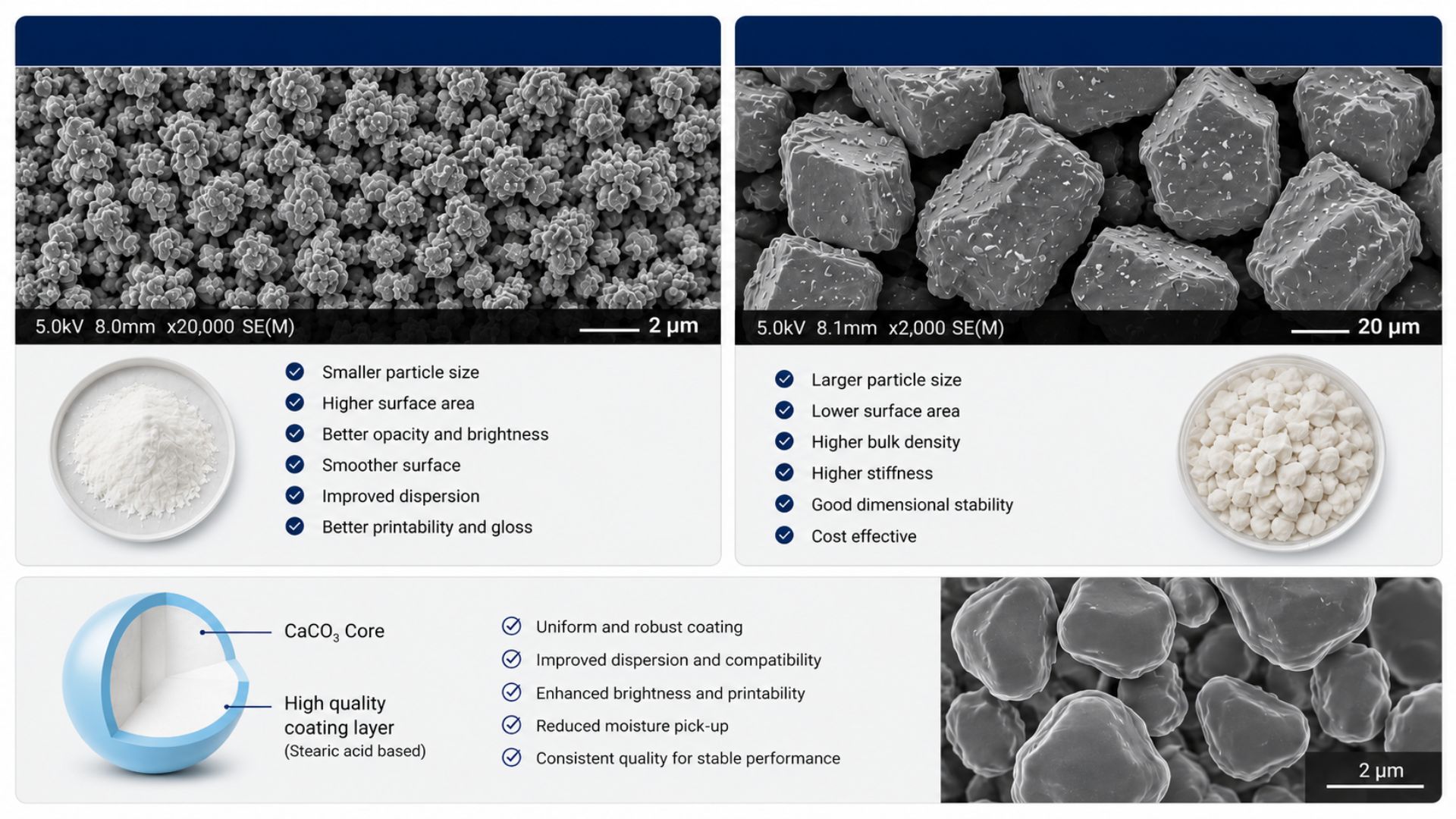
Ultrafine particles generally disperse more evenly and create smaller defects in the polymer matrix. They can reduce stress concentration, improve surface smoothness, support better printability, and preserve mechanical properties more effectively than coarse grades at the same loading. However, ultrafine powder has a higher specific surface area, so it requires effective coating and dispersion. Without adequate surface treatment, the powder may absorb moisture, agglomerate, and demand more processing energy.
For many conventional blown film applications, Ground calcium carbonate grades with median particle sizes around 1-3 μm are commonly considered, but the correct grade depends on film thickness, required opacity, filler loading, resin type, and final performance. Finer grades around 1-2 μm are generally more suitable for thinner films, better surface appearance, and higher mechanical retention. Grades around 2-3 μm may be acceptable for thicker bags and cost-sensitive applications where moderate surface roughness and opacity are tolerated.
Median particle size alone is not sufficient. The coarse top cut is often more critical because a small number of oversized particles can cause more defects than a moderate change in average size. Manufacturers should therefore evaluate the full particle size distribution, not only the D50 value.
Surface Treatment And Compatibility
Untreated calcium carbonate has a hydrophilic mineral surface, while polyethylene is non-polar and hydrophobic. This difference creates poor interfacial compatibility. Untreated particles may absorb moisture, form agglomerates, and disperse unevenly in the polymer melt.
Surface-coated Ground calcium carbonate is commonly treated with stearic acid or a related fatty acid. The treatment modifies the mineral surface, reduces surface energy, and improves compatibility with PE. As a result, coated ground calcium carbonate in blown film can disperse more easily, generate fewer agglomerates, and reduce the risk of white specks or surface defects.
The practical sequence is as follows: surface coating improves compatibility with polyethylene (PE), leading to better filler dispersion, reduced particle agglomeration, lower die build-up, and ultimately higher process stability.
The correct coating level is important. Insufficient coating leaves active hydrophilic sites on the particle surface. Excessive coating may create lubrication, migration, odor, or sealing interference. The treatment must therefore be uniform and matched to the particle surface area.
Good compatibility also reduces moisture-related defects. Water trapped in the filler can vaporize during extrusion and create pinholes, bubbles, or unstable pressure. Low-moisture, properly coated Ground calcium carbonate is much easier to process in thin film applications.
Mechanical Property
Increasing filler loading changes the balance of film properties. Some effects are beneficial, while others represent unavoidable trade-offs.
| Property | Typical Effect As Ground Calcium Carbonate Loading Increases |
| Stiffness | Increases |
| Tensile modulus | Increases |
| Formulation cost | Decreases |
| Elongation at break | Decreases |
| Dart impact strength | Usually decreases |
| Tear strength | May decrease |
| Opacity | Increases |
| Density | Increases |
Stiffness rises because rigid particles restrict polymer chain mobility, while elongation falls because the filled matrix cannot stretch as freely. Impact and tear resistance may decline when coarse, poorly coated, or agglomerated particles act as stress concentrators.
The effect of ground calcium carbonate in blown film is therefore application-dependent. A shopping bag may benefit from stiffness, opacity, and easier opening but still require adequate tear strength and handle performance. A refuse sack may require higher puncture and impact resistance, limiting filler content. A thin liner may tolerate only a low addition level because surface defects and pinholes are unacceptable.
The optimum formulation is not the formulation with the highest Ground calcium carbonate percentage. It is the formulation that meets cost, processing, mechanical, optical, and sealing requirements at the same time.
Optical Performance
Ground calcium carbonate influences opacity, whiteness, gloss, haze, and overall surface appearance. The refractive index difference between calcium carbonate and polyethylene causes light scattering. As filler loading increases, opacity usually increases and transparency decreases.
Fine, well-dispersed ground calcium carbonate in blown film can provide a uniform white appearance and improved hiding power. This is useful in shopping bags, mailing films, hygiene packaging, and other applications where visual coverage is more important than transparency.
Particle size and dispersion determine whether the optical effect is attractive or defective. Uniformly dispersed fine particles create controlled light scattering. Agglomerates create localized scattering and appear as white specks, fish eyes, streaks, or dull areas. Coarse particles can reduce gloss and produce a visibly rough surface.
Whiteness and brightness of the mineral also matter. High-purity Ground calcium carbonate with low levels of iron, silica, and colored impurities produces cleaner film color and more consistent printing. In contrast, mineral variation between batches can cause noticeable color differences in finished rolls.
Sealing And Surface Behavior
Heat sealing is sensitive to filler loading because the mineral does not melt. As Ground calcium carbonate content increases, the continuous polyethylene phase decreases, and more heat may be required to create an effective polymer-polymer bond. Excessive filler at the sealing interface may reduce seal strength or narrow the acceptable sealing temperature window.
Surface-treated ground calcium carbonate in blown film may also affect coefficient of friction, blocking, and film opening. Moderate filler addition can create micro-roughness that reduces contact area between film layers, making bags easier to open. This can reduce the need for some antiblock additives, although the effect depends strongly on particle size and surface treatment.
Too much surface roughness can create poor print definition, uneven ink coverage, and reduced gloss. Formulation development should therefore consider printing, lamination, and sealing together rather than optimizing them separately.
Processing Challenges At High Ground Calcium Carbonate Loading
High filler loading magnifies weaknesses in material quality and process control. Bubble instability may result from excessive viscosity, poor dispersion, uneven cooling, or inconsistent filler concentration. Gauge variation may develop when pressure fluctuates or the melt exits the die non-uniformly.
Poor sealing often occurs when the polymer fraction becomes too low at the seal interface or when excess lubricant from surface treatment interferes with bonding. The build-up can be caused by agglomerates, insufficient coating, volatile contamination, or degraded polymer trapped near the die lip. Filter blockage may result from coarse particles, hard agglomerates, foreign matter, or an excessively fine screen pack.
Excessive equipment wear is commonly associated with abrasive impurities such as silica rather than calcium carbonate itself. Low-purity filler can accelerate wear in screws, barrels, screens, and dies. High extrusion pressure may be caused by excessive loading, inadequate temperature, insufficient dispersion, a narrow die gap, or blocked filtration.
Ground calcium carbonate in blown film should therefore be assessed within the complete extrusion system. Performance may change with screw design, die geometry, output rate, and film thickness.
Choosing The Right Ground Calcium Carbonate Grade
The correct Ground calcium carbonate grade should be selected against the actual performance requirements of the film. Purity is important because unwanted minerals can affect color, abrasion, odor, and thermal behavior. Brightness and whiteness determine the visual cleanliness of the final film, particularly in white or lightly pigmented products.
Particle size distribution controls surface quality, dispersion, rheology, and mechanical retention. The coarse particle fraction should be tightly limited for thin film. Moisture should be low and consistent to avoid porosity and pressure instability. Surface treatment should provide good PE compatibility without excessive lubricant.
Low impurity levels are especially important for long production runs. Silica, metal particles, and foreign contamination can damage equipment, block filters, or create visible defects. Batch-to-batch consistency is equally critical. Even a technically acceptable average specification may be unsuitable if particle size, coating level, or moisture varies widely between deliveries.
When evaluating ground calcium carbonate in blown film, manufacturers should review technical data together with extrusion trials. Useful measurements include melt pressure, motor load, output, bubble stability, gauge variation, film density, tensile properties, elongation, dart impact, tear strength, haze, gloss, opacity, coefficient of friction, and seal strength.
The formulation should then be optimized for a defined application. Thin high-speed film requires finer particles, a tighter top cut, and strong dispersion. Thick commodity bags may tolerate a coarser grade and higher loading. Printed packaging requires good surface uniformity and color consistency. Films exposed to impact or puncture require conservative filler levels and careful mechanical testing.
Formulation And Trial Design
A structured trial is more reliable than changing several variables at once. Begin with a stable resin formulation, introduce one Ground calcium carbonate grade at a moderate level, and then increase filler content stepwise while recording extrusion and film properties.
The masterbatch carrier resin should be compatible with the base polyethylene. The dispersion quality of the masterbatch is as important as the mineral specification because poor compounding can destroy the benefit of a fine, coated Ground calcium carbonate. Let-down ratio, screw mixing, temperature profile, screen pack, blow-up ratio, drawdown ratio, and cooling settings should remain controlled during comparison.
Ground calcium carbonate in blown film should also be tested at normal production speed because die build-up, pressure drift, winding instability, or filter blockage may appear only during extended operation.
Conclusion
Ground Calcium Carbonate is more than a cost-reducing filler in polyethylene blown film. When properly selected and controlled, it improves processing efficiency, film performance, and overall manufacturing value. Long-term success depends on choosing consistent, high-quality Ground calcium carbonate that balances cost optimization with reliable production and end-use performance.