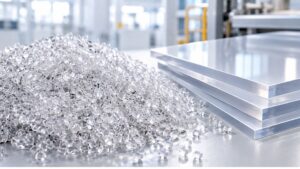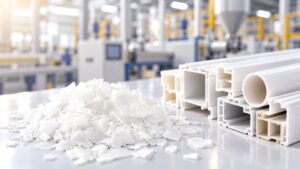

Titanium dioxide is one of the most important white pigments used in PVC production. It improves whiteness, opacity, brightness, UV resistance, and the long-term appearance of both rigid and flexible PVC products. However, the performance of Titanium dioxide in PVC depends on more than dosage alone. Crystal form, particle size, surface treatment, dispersion, heat stability, and compatibility with other additives all influence the final result. This article by TLD Vietnam explains how Titanium dioxide works in PVC formulations and provides practical guidance for selecting dosage levels and solving typical processing problems.
What Is Titanium Dioxide?
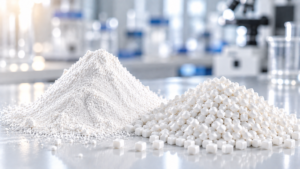
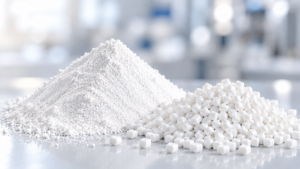
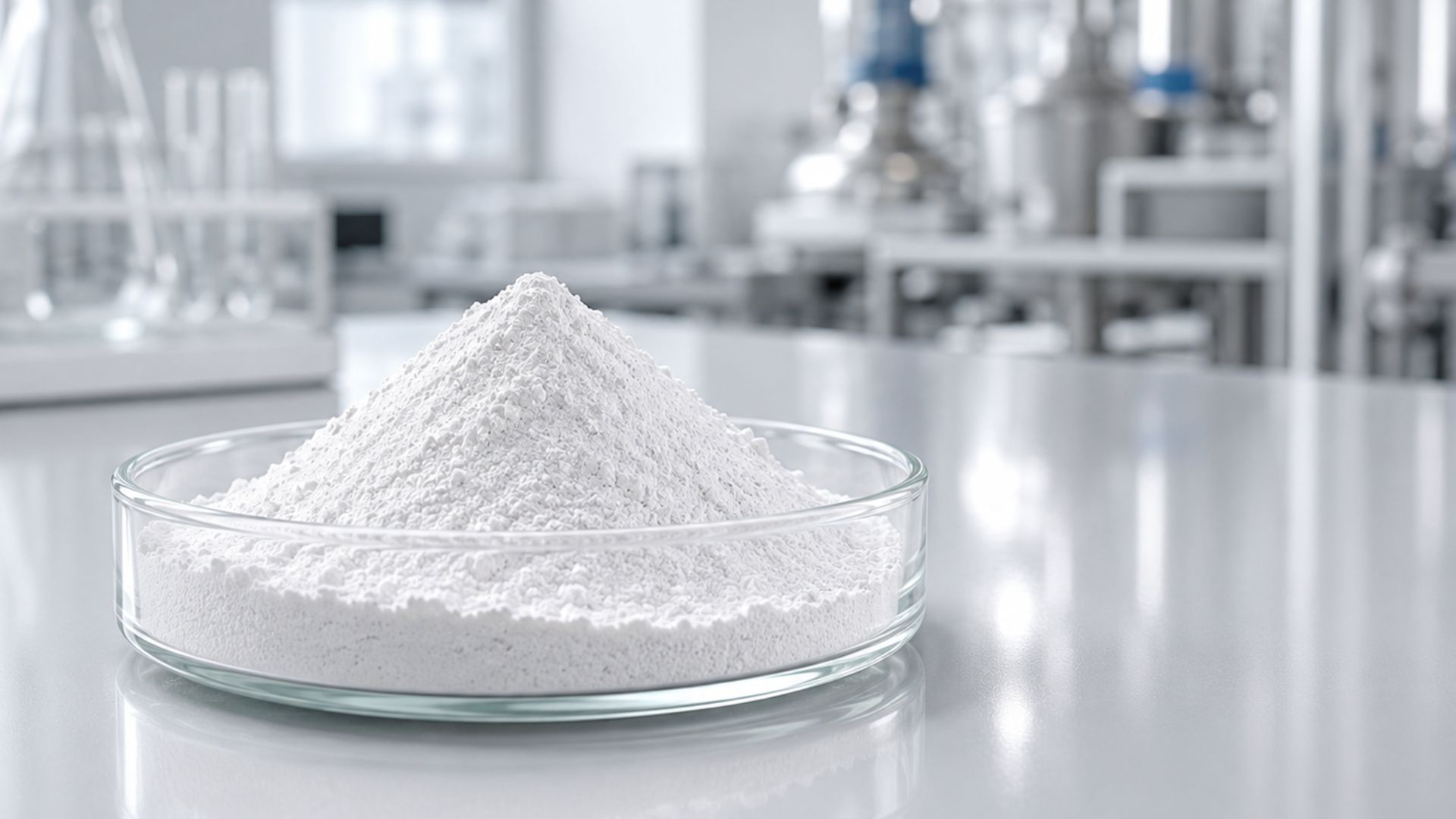
Titanium dioxide, with the chemical formula TiO₂, is an inorganic compound that occurs naturally in several mineral forms. For industrial use, it is processed into a fine white powder with a very high refractive index. This property allows Titanium dioxide particles to scatter visible light efficiently, creating strong whiteness and opacity.
Commercial titanium dioxide is mainly produced in rutile and anatase crystal forms. Both are white pigments, but they differ in crystal structure, durability, UV behavior, and suitability for different applications. Rutile is generally preferred for demanding PVC products, especially outdoor products, because it offers better weather resistance and lower photocatalytic activity.
Why Is Titanium Dioxide Added To PVC?
PVC resin is naturally translucent to slightly opaque and does not provide the clean white appearance required for many finished products. Titanium dioxide is added to produce a brighter, more uniform, and more opaque material.
The pigment also helps mask the natural color of PVC resin, fillers, stabilizers, recycled content, and other additives. This is especially important in rigid profiles, sheets, pipes, and decorative products where small color variations may be visible.
Titanium dioxide in PVC may also contribute to resistance against sunlight. Scattering and reflecting part of the incoming radiation, it can reduce the amount of light that penetrates the polymer. Properly selected rutile grades can therefore help protect the PVC matrix and support longer outdoor durability.
How Titanium Dioxide Works In PVC Formulations
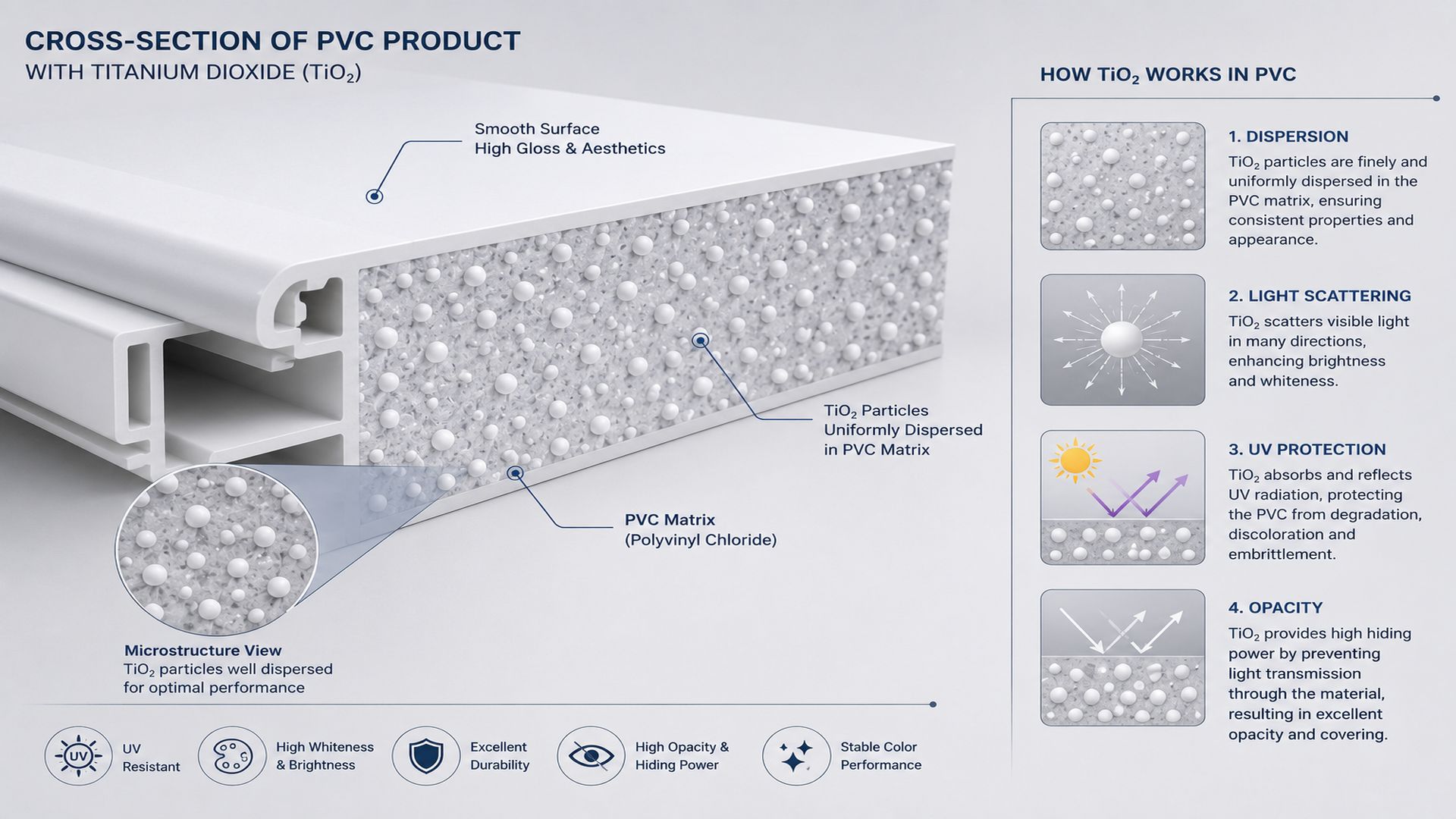
Titanium dioxide works mainly through light scattering. When visible light reaches a Titanium dioxide particle, the large difference between the refractive index of the pigment and that of the surrounding PVC causes the light to change direction. Repeated scattering across many particles creates a white, opaque appearance.
Efficient light scattering requires an appropriate particle size and good separation of individual particles. If the pigment forms agglomerates, the effective surface area decreases, and opacity may fall. Poor dispersion can also create streaks, specks, roughness, and uneven color.
Why Titanium Dioxide Is Essential In PVC Manufacturing
Improving whiteness and brightness
Whiteness refers to how close a material appears to an ideal white, while brightness describes the amount of visible light reflected from its surface. Titanium dioxide is highly effective in increasing both properties.
Titanium dioxide in PVC creates a cleaner and more neutral white than many low-cost white fillers. Calcium carbonate, for example, can contribute to brightness and reduce formulation cost, but it does not have the same refractive index or hiding power as Titanium dioxide.
Increasing opacity and hiding power
Opacity is the ability of a material to prevent light from passing through. Hiding power is closely related and describes how effectively a pigment masks the color beneath or within the product.
In PVC sheets, panels, profiles, and flooring, sufficient opacity is often necessary to hide internal layers, fillers, recycled content, reinforcement, or substrate color. In thin-wall products, the demand on the pigment is usually higher because there is less material available to block light.
Titanium dioxide in PVC provides strong hiding power at relatively low addition levels compared with conventional mineral fillers. However, the best opacity is not achieved simply by adding more pigment. It requires good dispersion, suitable particle size, correct formulation balance, and appropriate product thickness.
Enhancing UV resistance
Ultraviolet radiation can break chemical bonds in PVC and promote discoloration, chalking, embrittlement, gloss loss, and surface cracking. Stabilizers are the main protection against degradation, but Titanium dioxide can support the UV protection system.
Rutile titanium dioxide can reflect and scatter part of the UV radiation before it penetrates deeply into the PVC. Surface-treated grades are especially important because untreated Titanium dioxide may show photocatalytic activity that can accelerate polymer degradation under certain conditions.
Titanium dioxide in PVC should therefore be selected as part of a complete stabilization package. It does not replace heat stabilizers, UV absorbers, antioxidants, or impact modifiers, but it can improve the overall weathering performance of the formulation.
Improving weatherability for outdoor PVC
Outdoor PVC products face sunlight, rain, temperature cycles, pollution, and mechanical stress. Window profiles, siding, roofing sheets, gutters, pipes, and external panels may remain in service for many years. Weather-resistant Titanium dioxide grades help maintain surface appearance and reduce changes in color and gloss. Rutile pigments with inorganic surface coatings, such as alumina or silica, are commonly used because these treatments reduce pigment reactivity and improve durability.
Supporting long-term color stability
Titanium dioxide in PVC is especially useful in pastel and light-colored formulations because it reduces the influence of the base resin and improves shade reproducibility. However, formulators should check interactions with optical brighteners, color pigments, fillers, and stabilizers, since these materials can change the final undertone.
Types Of Titanium Dioxide Used In PVC
The two main crystal forms used commercially are rutile and anatase. Their chemical formula is the same, but their internal structures and performance characteristics differ.
Rutile Titanium dioxide
Rutile is the preferred choice for most rigid PVC and outdoor applications. It has a higher refractive index than anatase, which gives it stronger light-scattering efficiency and generally better hiding power. Rutile Titanium dioxide also has better resistance to weathering and lower photocatalytic activity, especially when treated with inorganic coatings. These characteristics make it suitable for window profiles, exterior panels, outdoor pipes, roofing products, cable sheathing, and other applications exposed to sunlight.
Titanium dioxide in PVC is commonly supplied as a rutile grade with surface treatments designed to improve dispersion, durability, processing behavior, or compatibility. The exact treatment system varies by producer and product grade.
Anatase Titanium dioxide
Anatase titanium dioxide usually provides a bright, slightly bluish white tone and is used in some indoor or less demanding PVC applications. It can be suitable where weather resistance is not critical and where cost or shade is the main consideration.
However, anatase generally has lower hiding power and higher photocatalytic activity than rutile. This can make it less suitable for long-term outdoor use, especially in products expected to retain gloss, color, and mechanical properties over many years.
Rutile vs. anatase for PVC applications
For outdoor rigid PVC, rutile is normally the safer choice because of its weatherability, lower reactivity, and stronger opacity. Anatase may be acceptable for indoor products, short-life applications, or formulations where the required performance is moderate.
Applications Of Titanium Dioxide In PVC Products
PVC pipes and fittings
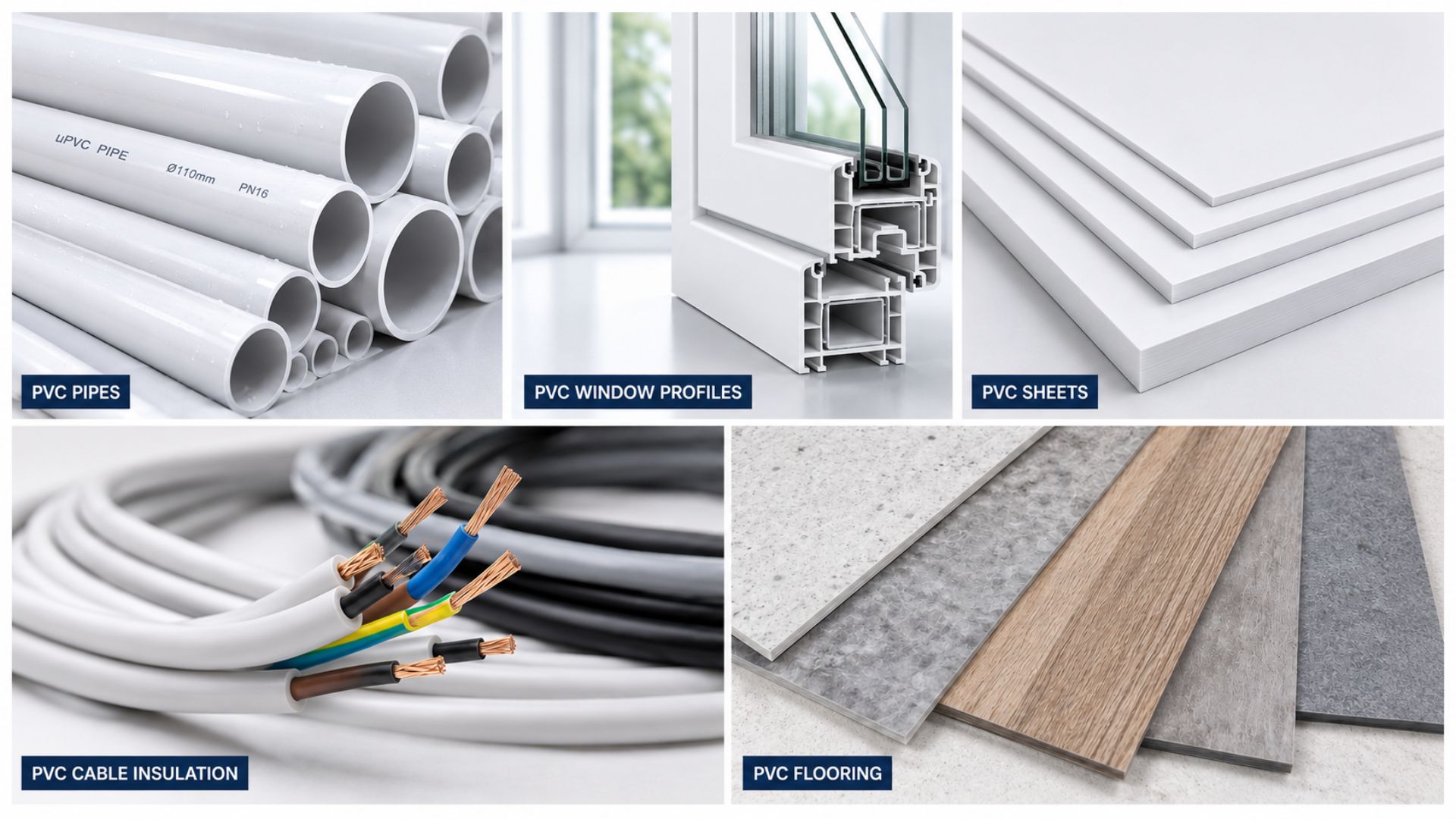
White and light-colored PVC pipes use Titanium dioxide to improve opacity, brightness, and visual uniformity. In drainage, conduit, and pressure pipe applications, the pigment can help mask minor color differences caused by resin, fillers, stabilizers, or recycled material. Titanium dioxide in PVC pipes intended for outdoor storage or use can also support resistance to sunlight.
Window and door profiles
PVC profiles require high whiteness, low color variation, good gloss, and long-term weather resistance. These products are often exposed to sunlight for many years, making rutile Titanium dioxide with durable surface treatment the standard choice.
PVC sheets and panels
Sheets and panels may be used for wall covering, partitions, roofing, furniture surfaces, printing substrates, and decorative applications. Titanium dioxide improves opacity and helps hide internal structures or substrate colors. Titanium dioxide in PVC sheets must provide a uniform appearance across a large surface area. Dispersion defects that are minor in a thick pipe may become clearly visible in a smooth, wide sheet.
Flexible PVC products
Flexible PVC includes films, synthetic leather, hoses, seals, medical items, toys, and coated fabrics. The pigment must be compatible with plasticizers and other liquid additives. In flexible compounds, the surrounding polymer phase has a different refractive index and rheology from rigid PVC. This can affect opacity, dispersion, and pigment efficiency. Formulators should also evaluate migration, surface appearance, and the effect of plasticizers on color.
Cable insulation and sheathing
Cable compounds use Titanium dioxide for color control, opacity, and identification. Outdoor cable sheathing may also benefit from the UV-screening effect of rutile pigment. Heat stability is particularly important because cable compounds can experience demanding processing conditions. The Titanium dioxide grade should not interfere with stabilizers, flame retardants, fillers, or electrical performance.
Flooring and decorative materials
PVC flooring and decorative layers require consistent shade, strong coverage, and controlled gloss. Titanium dioxide helps create light-colored backgrounds and improves the appearance of printed or pigmented layers. Titanium dioxide in PVC flooring may be used in wear layers, backing layers, printed films, or decorative compounds. The required grade depends on layer thickness, transparency, abrasion resistance, and design.
Factors To Consider When Choosing Titanium Dioxide For PVC
Particle size and particle size distribution
The most effective pigment particle size for visible-light scattering is generally in the submicron range. A narrow and controlled particle size distribution supports consistent opacity and brightness. Very small particles may not scatter visible light efficiently, while oversized particles or agglomerates can reduce hiding power and create surface defects. Particle size data should therefore be considered together with dispersion performance.
Dispersion performance
Good dispersion allows individual Titanium dioxide particles to distribute evenly through the PVC matrix. It improves opacity, color uniformity, surface quality, and pigment efficiency.
Titanium dioxide in PVC should be evaluated under actual processing conditions. Laboratory tests may include dispersion ratings, filter pressure, microscopic examination, color measurement, gloss, and visual inspection of extruded or molded samples.
Surface treatment
Many rutile grades are coated with inorganic materials such as alumina, silica, or zirconia. These coatings can reduce photocatalytic activity, improve weather resistance, and influence dispersion. Organic surface treatments may also be used to improve wetting and processing in specific polymer systems. The best treatment depends on whether the product is rigid or flexible, indoor or outdoor, highly filled or lightly filled.
Tinting strength
Tinting strength measures how strongly a white pigment lightens a colored material. High tinting strength is useful in pastel shades and formulations containing other pigments.
Weather resistance
Outdoor products require pigments that remain stable under UV radiation, moisture, and temperature cycles. Rutile grades with durable surface treatment are normally preferred.
Heat stability
PVC is sensitive to heat and can release hydrogen chloride as degradation begins. This causes yellowing and can lead to darkening, loss of properties, and equipment corrosion. Titanium dioxide in PVC must be compatible with the heat stabilizer system and should not promote degradation. Processing trials should examine initial color, dynamic heat stability, residence-time sensitivity, and color after repeated heat exposure.
Compatibility with PVC formulations
A Titanium dioxide grade may perform well in one formulation and poorly in another. Differences in filler content, stabilizer chemistry, lubricant balance, plasticizer type, impact modifier, processing aid, and recycled content can all change pigment behavior. For this reason, final selection should be based on formulation-specific testing rather than supplier data alone.
Recommended Titanium Dioxide Loading Levels In PVC
Dosage for rigid PVC
Rigid PVC products commonly use about 2 to 8 parts of Titanium dioxide per 100 parts of PVC resin, often written as 2–8 phr. Indoor pipes or thick sections may require less, while white outdoor profiles and thin sheets may require more. Titanium dioxide in PVC window profiles is often used at a relatively high level because the product must combine strong whiteness, opacity, and long-term outdoor durability. Exact dosage should be optimized through testing rather than copied directly from another formulation.
Dosage for flexible PVC
Flexible PVC may use approximately 1 to 5 phr, depending on product thickness, plasticizer content, and required opacity. Thin films may need efficient pigment dispersion to achieve coverage without excessive loading.
Balancing cost and performance
Titanium dioxide is often one of the more expensive components in a white PVC formulation. Reducing dosage can lower raw material cost, but excessive reduction may cause poor opacity, lower brightness, visible filler, unstable shade, or weaker weathering performance. The best approach is to measure pigment efficiency, not only pigment price. A higher-performing grade may achieve the target result at a lower dosage, improve production consistency, or reduce rejection rates.
Titanium dioxide in PVC should therefore be optimized based on total formulation cost, processing stability, product quality, and service life.
Common Problems And Troubleshooting
Poor opacity
Poor opacity may result from low Titanium dioxide dosage, an unsuitable pigment grade, poor dispersion, excessive product thinness, or high levels of transparent additives. The first step is to confirm the actual pigment content and mixing accuracy. Next, check for agglomerates, compare the pigment grade, review filler loading, and measure product thickness. Increasing dosage may help, but only after dispersion and formulation balance have been checked.
Yellowing after processing
Yellowing usually indicates PVC degradation, stabilizer imbalance, excessive temperature, long residence time, contamination, or an incompatible additive. Titanium dioxide itself may not be the primary cause.
Titanium dioxide in PVC should be tested with the complete stabilizer and lubricant package. Process temperature, screw speed, fusion behavior, and material hold-up should also be reviewed. A more durable or better-treated pigment may help when pigment reactivity contributes to the problem.
Uneven color
Uneven color can appear as light and dark areas, batch variation, clouds, or localized discoloration. Common causes include poor dry blending, inconsistent dosing, incomplete fusion, pigment agglomeration, or contamination.
Improving premixing, checking feeder calibration, controlling raw material moisture, and adjusting processing conditions can improve uniformity. Color should be measured at several points across the product rather than at only one location.
Surface streaks
Surface streaks may be caused by pigment agglomerates, lubricant imbalance, unstable flow, die contamination, poor fusion, or incompatibility between additives. A dispersion test can help determine whether Titanium dioxide is involved. It is also important to inspect the die, screen pack, mixer, and extrusion conditions. Simply changing pigment dosage may not solve a mechanical or processing problem.
Reduced weather resistance
Unexpected chalking, fading, gloss loss, or embrittlement may result from using anatase instead of rutile, insufficient Titanium dioxide, weak surface treatment, poor stabilizer selection, or under-processing. Titanium dioxide in PVC for outdoor use should be a weather-resistant rutile grade. The formulation should also include an appropriate UV and heat stabilization system. Accelerated and natural weathering tests are recommended before large-scale production.
In practice, reliable performance comes from matching the pigment to the entire PVC system. Crystal form, surface treatment, dispersion, loading level, processing conditions, and end-use exposure must all be considered together. When these factors are properly controlled, Titanium dioxide in PVC can provide strong whiteness, efficient hiding power, stable color, and durable outdoor performance.
Conclusion
Titanium dioxide in PVC improves whiteness, opacity, color consistency, and weather resistance, making it essential for many rigid and flexible PVC applications. Rutile Titanium dioxide is generally preferred for outdoor products due to its superior durability and UV resistance, while anatase is more suitable for indoor use. Optimal performance depends not only on Titanium dioxide grade and dosage but also on proper dispersion and a well-balanced PVC formulation.