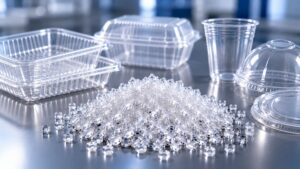

Polystyrene (PS) is valued in injection molding for its rigidity, surface finish, and versatility across a range of applications. However, choosing the right grade requires an understanding of how general-purpose polystyrene (GPPS) and high-impact polystyrene (HIPS) differ in performance. Read this blog by TLD Vietnam to explore the key material properties, processing considerations, and selection criteria for PS resin for injection molding.
An Overview Of PS Resin in Injection Molding
PS is an amorphous thermoplastic produced from styrene monomer. Its molecular structure provides rigidity and relatively low molding shrinkage, contributing to predictable dimensional behavior during cooling. PS resin for injection molding includes GPPS and HIPS, which differ in appearance, stiffness, and impact resistance. These grades also offer good melt processability and surface reproduction, allowing suitable materials to produce rigid components with fine mold details on conventional injection-molding equipment. However, molding performance and dimensional consistency depend on appropriate gate dimensions, balanced cooling, and processing conditions that prevent excessive shear or prolonged thermal exposure.
Structural Differences Between GPPS And HIPS
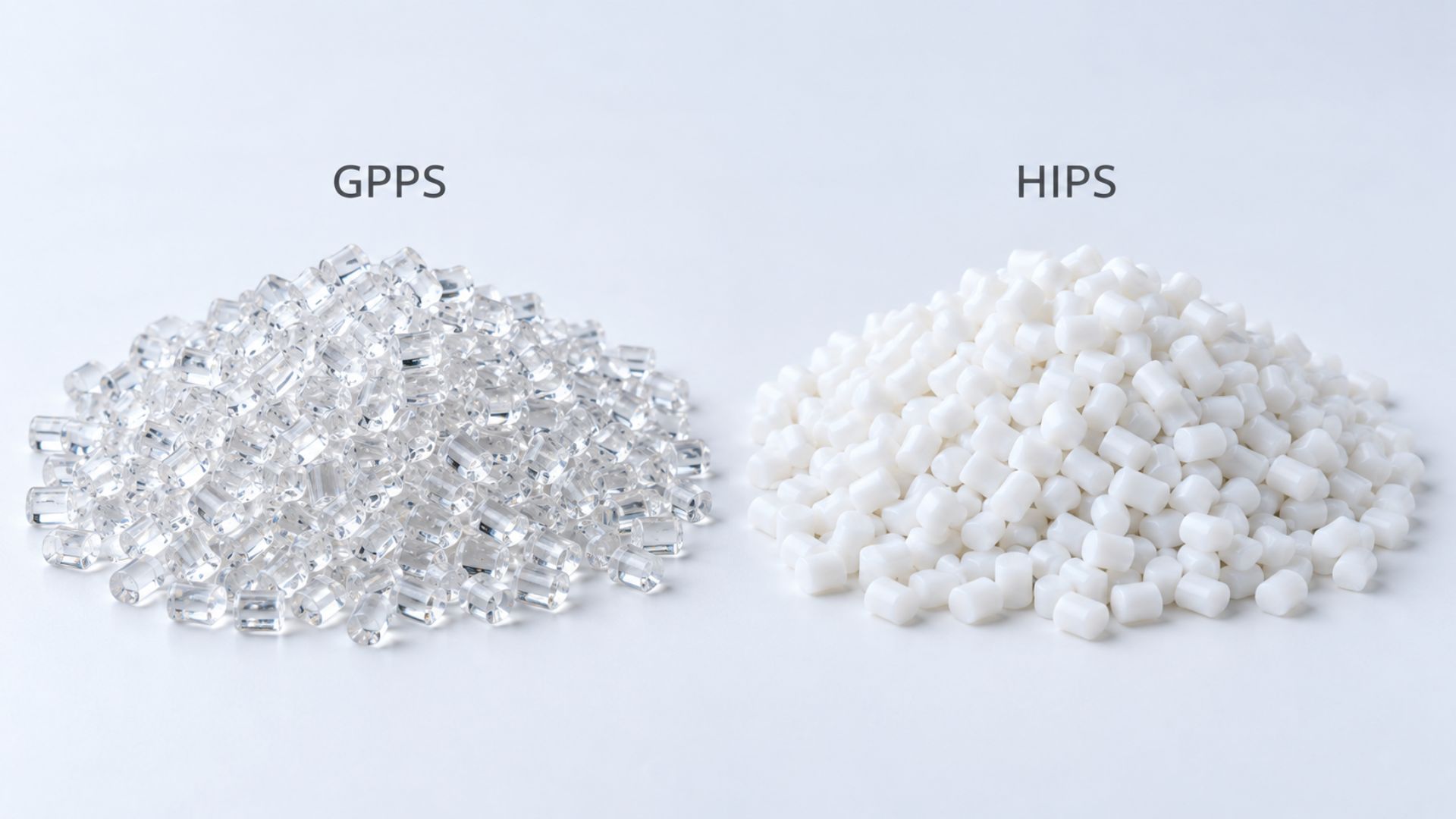
GPPS generally provides transparency and greater stiffness, but it is more susceptible to brittle fracture. HIPS contains a dispersed rubber phase that improves impact resistance through mechanisms that absorb deformation energy. This modification generally reduces transparency and stiffness. Selecting PS resin for injection molding therefore requires a clear distinction between optical requirements and resistance to handling or assembly stresses.
Material Properties Affecting Injection Molding
Melt Flow Behavior
The flow behavior of PS resin for injection molding determines how readily the melt travels through runners, gates, and thin cavity sections. Melt flow rate provides an initial comparison between grades under specified test conditions. Actual filling behavior also depends on temperature, shear rate, flow length, and cavity geometry, so the highest-flow grade is not automatically the most suitable material.
Dimensional Stability Of Molded Parts
The amorphous structure of PS generally produces lower molding shrinkage than many semicrystalline plastics. This characteristic can benefit components with defined assembly clearances or mating surfaces. Nevertheless, PS resin for injection molding remains sensitive to uneven packing, temperature gradients, and residual stress. Dimensional stability must therefore be evaluated on the finished component rather than inferred from shrinkage data alone.
Optical Performance Of Molded Surfaces
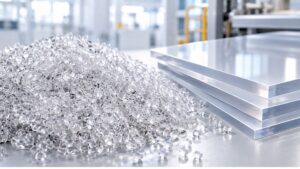
GPPS can provide high transparency and a glossy surface when the grade, tooling, and processing conditions are appropriate. HIPS is generally opaque because its rubber-modified structure scatters light. For either type, the surface quality of PS resin for injection molding depends on mold finish, flow behavior, contamination control, and the ability of the melt to reproduce the cavity surface.
Impact Performance Under Thermal Exposure
Impact resistance and heat resistance represent different material requirements. HIPS generally tolerates impact better than GPPS, but rubber modification does not automatically provide greater resistance to elevated temperatures. PS resin for injection molding should be assessed against the intended operating temperature and mechanical load. Vicat softening temperature and heat deflection temperature describe specific test responses rather than universal service-temperature limits.
Common Applications Of Injection-Molded PS
PS resin for injection molding is used in rigid containers, selected trays, household organizers, and other products requiring stiffness and a controlled surface appearance. GPPS is particularly relevant where transparency is necessary, while HIPS is appropriate where improved impact resistance takes priority. Manufacturers must distinguish injection-molded products from visually similar items produced through sheet extrusion and thermoforming. Synthos lists injection-molding applications including cups, containers, bowls, and caps.
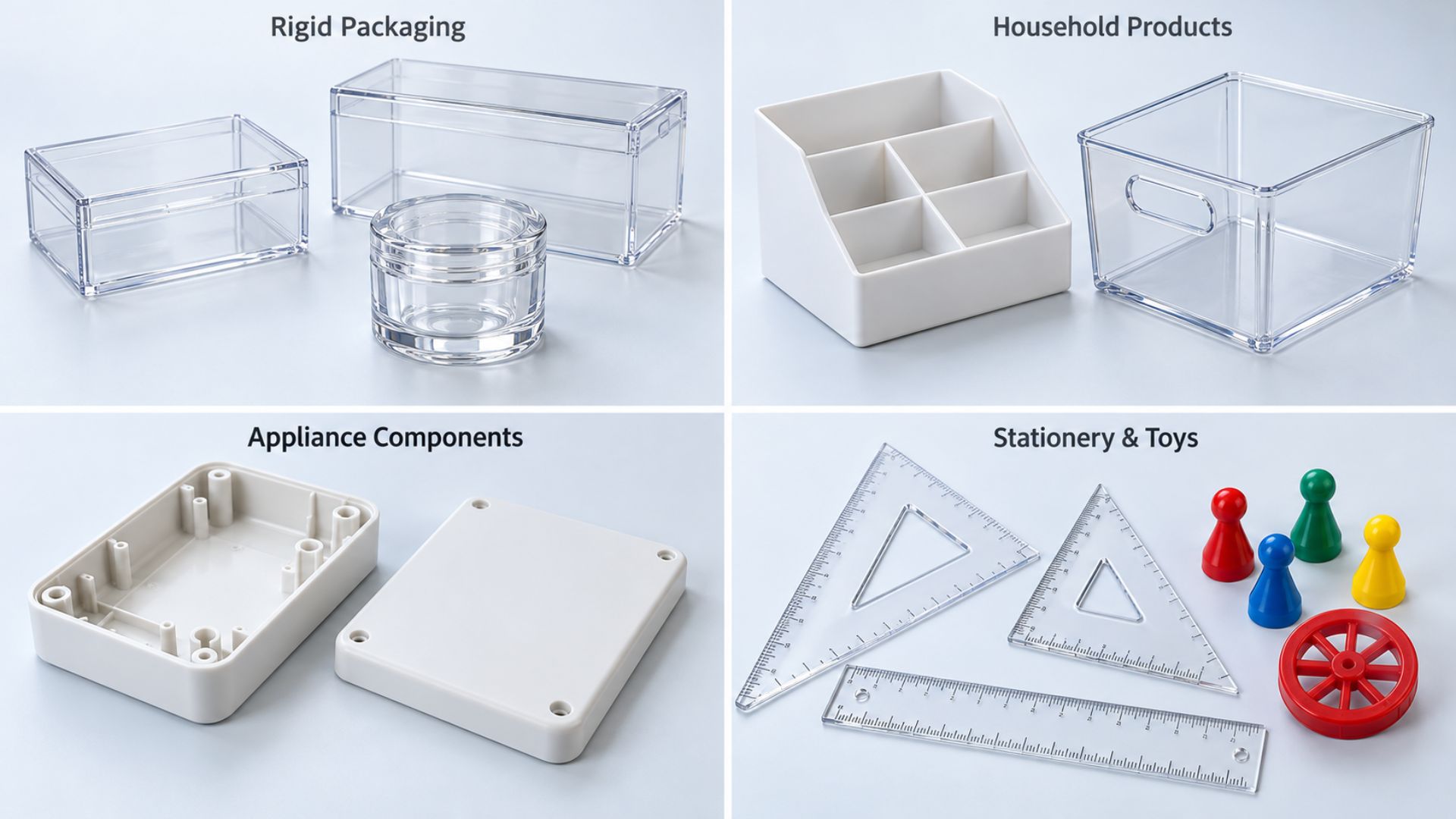
Selected appliance parts, electronic housings, stationery, toys, and display components also use PS grades. In these applications, PS resin for injection molding must satisfy the actual mechanical, thermal, and electrical requirements of the component. Standard GPPS or HIPS should not be assumed suitable for elevated-temperature service, demanding flame-resistance requirements, or repeated bending simply because another PS grade serves a related application.
Components with defined dimensional requirements can benefit from the relatively low shrinkage of PS, provided that the mold and process maintain consistent packing and cooling. Food-contact products require additional grade-specific documentation for the intended conditions of use and destination market. For example, TotalEnergies provides separate regional food-contact documents for its HIPS 8260 grade, illustrating the importance of product-specific verification.
Processing Parameters For PS Injection Molding
Melt Temperature Control
PS does not have a sharp crystalline melting point; it progressively softens into a processable melt as temperature increases. Manufacturer guidance for certain grades describes melt-temperature ranges around 180–260°C, although the approved range varies by product. The processing temperature of PS resin for injection molding must follow the selected grade’s recommendations and account for residence time and shear heating.
Barrel settings do not directly represent the temperature of the entire melt. Screw rotation, back pressure, and flow restrictions can introduce additional heat during plasticization and injection. Excessive temperature or prolonged residence can cause discoloration, surface streaks, and material degradation. A stable process therefore requires verification of actual melt conditions rather than repeated increases in heater settings.
Mold Temperature Control
Mold temperature affects the rate at which the melt surface solidifies and reproduces cavity details. A warmer cavity surface can improve surface replication and flow-front bonding, while a colder surface accelerates skin formation. For PS resin for injection molding, temperature uniformity is particularly important because local cooling differences can produce uneven shrinkage and inconsistent dimensions.
Autodesk’s general processing reference gives a suggested mold-temperature range of 20–70°C for PS, but this range is a starting reference rather than a universal setting. The selected grade, wall thickness, appearance requirements, and cooling-system capacity determine the appropriate operating conditions. Excessively cold tooling can also create condensation when the surface temperature falls below the surrounding dew point.
Injection Profile Optimization
The injection profile determines how the cavity fills before the melt becomes too viscous to flow. Insufficient velocity can contribute to premature freezing, while excessive velocity can increase local shear and air compression. PS resin for injection molding requires an injection profile matched to gate geometry, wall thickness, and venting capacity rather than a single speed applied without cavity-specific evaluation.
Packing pressure compensates for material contraction while the gate remains open. Insufficient packing can produce sink marks or dimensional variation, whereas excessive packing can increase internal stress and complicate ejection. The transfer from filling to packing should be repeatable, and holding time should be established through gate-sealing behavior and part-weight stability.
Cooling Cycle Optimization
Cooling time must allow sufficient stiffness for ejection without unnecessary extension of the production cycle. Thick sections generally require more cooling than thin sections, and isolated hot regions can govern the overall cycle. When processing PS resin for injection molding, shorter cycles are acceptable only when the finished parts retain their required dimensions and mechanical integrity.
Premature ejection can cause distortion around ejector pins, ribs, or unsupported walls. Longer cooling alone, however, cannot correct an inefficient cooling layout or a substantial wall-thickness imbalance. Cycle optimization should consider the location of heat accumulation, the uniformity of mold temperatures, and dimensional measurements after the component has reached a consistent conditioning state.
Common Molding Defects And Corrective Measures
Warpage From Uneven Shrinkage
Warpage develops when different regions of a component contract by different amounts during cooling. Uneven wall thickness, unbalanced cooling, and unequal packing can all contribute to this behavior. Corrective measures for PS resin for injection molding should begin with dimensional mapping and mold-temperature checks, followed by evaluation of gate location, packing conditions, and part geometry.
A component may appear acceptable immediately after ejection but deform as temperature gradients decrease. Measurements taken at inconsistent intervals can therefore obscure the actual cause of variation. Manufacturers should establish a defined inspection interval and distinguish deformation caused by early ejection from deformation associated with residual stress or asymmetric shrinkage.
Surface Defects From Unstable Filling
Burn marks, flow marks, and weld lines arise through different mechanisms and require separate diagnosis. Burn marks can result from trapped-air compression or degraded material. Flow marks may indicate unstable flow-front progression, while weld lines occur where separate melt fronts meet. PS resin for injection molding should be evaluated alongside cavity venting, gate design, and the injection profile.
Corrective action should address the identified mechanism. Improved venting may resolve air-related burning, while changes to flow-front temperature or gate configuration may improve weld-line quality. Raising melt temperature without examining residence time can worsen degradation. Cleaning the barrel or hot-runner system may be necessary when persistent deposits or contamination produce recurring surface defects.
Brittle Fracture In Molded Components
Cracking during ejection, assembly, or service can originate from insufficient material toughness, sharp corners, excessive interference, or high residual stress. GPPS is particularly sensitive to stress concentrations. An investigation involving PS resin for injection molding should compare the location of fracture with part geometry, ejector contact, gate position, and the forces applied during assembly.
A change to HIPS may improve impact performance, but it does not remove the need for suitable radii, draft, and assembly clearances. Contaminated regrind or excessive thermal exposure can also reduce consistency. Manufacturers should examine material history and processing records before concluding that brittle failure results solely from the nominal properties of the selected resin.
Incomplete Cavity Filling
Incomplete filling occurs when the melt cannot reach the end of the cavity before flow stops. Possible causes include restricted gates, insufficient shot volume, inadequate injection pressure, premature solidification, or trapped air. For PS resin for injection molding, a controlled short-shot study can reveal filling imbalance and identify the sections where flow becomes restricted.
Process adjustments should follow this diagnosis. A modest temperature or velocity increase may improve filling when the material remains within its approved processing range. However, persistent short shots may require changes to gate dimensions, venting, or wall thickness. A higher-flow grade should be considered only after these contributing factors have been evaluated.
Grade Selection for Production Requirements
Material Selection Between GPPS and HIPS
The choice between GPPS and HIPS should begin with the dominant functional requirement. GPPS generally suits transparent, rigid products with limited impact exposure, while HIPS generally suits opaque components requiring greater toughness. This distinction provides the first selection step for PS resin for injection molding, but the final decision must compare specific grades rather than broad material categories.
Heat resistance, surface finish, chemical exposure, and assembly conditions may change the preferred grade within either family. HIPS grades can also differ in gloss, flow behavior, and environmental stress-cracking resistance. The selected material should therefore satisfy the complete application specification instead of relying on impact strength or transparency as the only acceptance criterion.
Melt Flow Rate Evaluation
Melt flow rate, commonly abbreviated MFR and sometimes described as MFI, measures material flow under a defined temperature and load. Values obtained under different conditions are not directly interchangeable. The evaluation of PS resin for injection molding should compare equivalent test conditions and consider whether the measured flow corresponds to the actual filling requirements.
Mechanical data require similar care. Tensile strength, flexural modulus, and impact resistance depend on the test method, specimen preparation, and conditioning. A high MFR value does not establish adequate impact performance, and a strong laboratory impact result does not guarantee resistance to cracking around a sharp corner or an overstressed assembly feature.
Service Condition Assessment
The service environment defines whether a material remains suitable after production. Temperature, applied load, cleaning agents, sunlight, and repeated handling can affect performance. PS resin for injection molding should be evaluated under representative exposure conditions, particularly when the component remains mechanically stressed while in contact with oils, adhesives, or other potentially aggressive substances.
Appearance requirements also need measurable acceptance criteria. Transparency, gloss, color, visible weld lines, and surface contamination should be assessed against an agreed reference. For regulated applications, technical approval should include the relevant grade documentation and intended-use conditions rather than a general statement that PS is suitable for the industry.
Production Consistency Assessment
A production trial should confirm stable filling, repeatable part weight, acceptable dimensions, and satisfactory functional performance. The assessment of PS resin for injection molding should also include material feeding, color dispersion, and compatibility with the intended regrind practice. Trial conditions need sufficient stability for meaningful comparisons between candidate grades.
Consistency between material lots should be evaluated through documented incoming checks and controlled processing records. Variations in regrind content, contamination, or colorant dosing can resemble resin-related changes. Maintaining traceability allows manufacturers to separate these influences and determine whether a change in production behavior originates from the material, equipment, mold, or operating conditions.
Conclusion
The performance of PS resin for injection molding depends on coordinated material selection, component design, and process control. GPPS and HIPS offer different balances of transparency, stiffness, and toughness, while individual grades introduce further differences in flow and thermal behavior. Reliable production requires validation of these properties against actual molding conditions and finished-part requirements.
TLD Vietnam assists manufacturers in sourcing PS resin for injection molding according to application specifications and production conditions. Businesses can provide their product drawings, wall thickness, appearance criteria, and operating requirements to request suitable GPPS or HIPS options for technical evaluation.