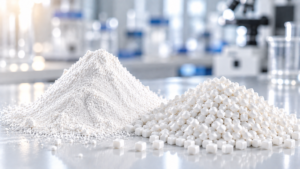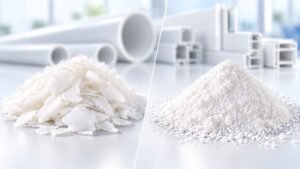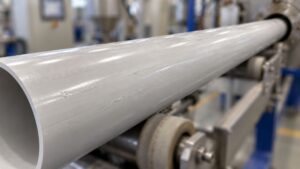

Chlorinated polyethylene, commonly known as CPE, is widely used in rigid Polyvinyl chloride (PVC) formulations to improve impact resistance, toughness, processing behavior, and long-term durability. In extrusion applications, the balance between PVC resin, CPE, calcium carbonate, processing aids, stabilizers, and lubricants directly affects both production efficiency and the final mechanical properties of the product. Understanding how CPE for PVC extrusion works is therefore important when developing or adjusting formulations for rigid PVC products. Read the full blog from TLD Vietnam to explore CPE selection and formulation for PVC extrusion.
What Is CPE?
CPE is a polymer produced by introducing Chlorine into the molecular structure of polyethylene. Chlorination changes the regular structure of Polyethylene, reduces its crystallinity, and creates a more flexible, rubber-like material with greater polarity. Depending on chlorine content, molecular structure, and manufacturing conditions, different CPE grades can provide different levels of elasticity, compatibility, processability, and chemical resistance.
In rigid PVC formulations, CPE is mainly used as an impact modifier. The rubbery CPE phase disperses within the rigid PVC matrix and helps the material absorb mechanical energy rather than crack under sudden loading. CPE grades used as impact modifiers commonly contain roughly 30-42% chlorine, while grades around 35-36% chlorine are widely associated with rigid PVC modification.
The performance of CPE for PVC extrusion is not determined by chlorine content alone. Molecular weight, Mooney viscosity, particle characteristics, thermal behavior, dispersion, and compatibility with other formulation components also influence the final result. For this reason, two CPE products with similar chlorine content may behave differently during extrusion or provide different impact properties in the finished PVC product.
Why Is CPE Used In PVC Extrusion?
Improves Impact Strength
The primary function of CPE for PVC extrusion is to improve impact resistance. Rigid PVC has good stiffness and dimensional stability but may become brittle under impact, particularly at lower temperatures or when the formulation contains a high mineral filler loading. Properly dispersed CPE creates a rubbery phase capable of absorbing and dissipating impact energy, reducing the tendency of cracks to initiate and propagate through the PVC matrix.
Improves Toughness And Flexibility
CPE increases the toughness of rigid PVC and allows the material to tolerate deformation before failure. This is particularly useful for profiles, pipes, sheets, and construction products that may experience impact during transportation, installation, or service. However, increasing CPE content excessively can reduce stiffness and tensile properties, so the target should be an appropriate balance between toughness and rigidity rather than simply maximizing the amount of modifier.
Contributes To Flame Resistance
Because CPE contains a relatively high level of chlorine, it has lower flammability than many conventional hydrocarbon elastomers. Its presence can contribute to the overall flame-performance characteristics of a PVC compound. However, CPE should not be considered a complete flame-retardant system by itself, because actual fire performance depends on the entire PVC formulation, product geometry, filler system, stabilizers, and any dedicated flame-retardant additives.
Provides Chemical Resistance
CPE has good resistance to many oils, acids, alkalis, and other chemicals. When incorporated into PVC, this property can support the durability of products used in chemically demanding environments. The actual resistance of a finished extruded product still depends primarily on the total formulation and operating environment rather than on the CPE component alone.
Supports Weather And Aging Resistance
CPE has useful resistance to weathering, ozone, and environmental aging, making it suitable for many exterior rigid PVC applications. This is one reason CPE for PVC extrusion is commonly considered for profiles, siding, pipes, and other products that may be exposed outdoors. Long-term outdoor performance nevertheless depends on the combined use of suitable stabilizers, pigments, titanium dioxide, and other weather-resistant additives.
How Does CPE Work As An Impact Modifier In PVC?
The effectiveness of CPE depends strongly on its morphology inside the PVC matrix. During mixing and fusion, CPE must be distributed sufficiently throughout the PVC compound to create small rubber-like regions. These regions deform when the material is subjected to impact, helping absorb energy and reduce stress concentration around cracks or defects.
Research on PVC/CPE blends indicates that an appropriately developed CPE phase can promote mechanisms such as shear deformation within the surrounding PVC matrix. Instead of a crack propagating rapidly through a brittle material, part of the impact energy is consumed through deformation around the CPE domains. This transition from brittle behavior toward more ductile deformation explains much of the improvement in impact strength obtained with CPE.
PVC fusion is equally important. Inadequate fusion may prevent the PVC particles, CPE, and other additives from developing the desired morphology, while excessive thermal or mechanical history can damage PVC stability. Some CPE grades may also influence fusion time, melt viscosity, and melt strength, which means CPE for PVC extrusion should be evaluated as part of the complete processing system rather than as an isolated additive.
Common Applications Of CPE In PVC Extrusion
CPE for PVC extrusion is mainly used in rigid PVC products where impact strength and durability are required. Typical applications include pressure and non-pressure PVC pipes, fittings, electrical conduits, window and door profiles, siding, wall panels, sheets, foam boards, decorative profiles, and other construction-related extruded products. The required CPE level varies considerably because a thin profile, a highly filled board, and a pressure pipe have different stiffness, impact, processing, and dimensional requirements.
How Much CPE Should Be Used In PVC Formulations?
Typical CPE Dosage
CPE dosage is normally expressed in parts per hundred resin (phr), meaning parts of CPE per 100 parts of PVC resin. In rigid PVC systems, formulations commonly use CPE within a broad range of approximately 5-15 phr, although the optimum level depends on product requirements, CPE grade, filler content, PVC resin properties, processing conditions, and the presence of other impact modifiers. Published studies on modified PVC systems also demonstrate significant changes in mechanical behavior within approximately 8-15 phr CPE.
Dosage Depends On The Application
A formulation requiring only moderate impact improvement may use a relatively low CPE level, while profiles, boards, or other formulations containing higher calcium carbonate loading may require more impact modification. Pipe formulations are normally optimized according to required impact, pressure, stiffness, and relevant product standards rather than according to one universal CPE dosage.
Too Little Or Too Much CPE
Insufficient CPE can leave a rigid PVC compound vulnerable to brittle fracture, especially when filler loading is high or service temperatures are low. Excessive CPE, however, does not necessarily continue improving performance proportionally. Higher elastomer content may reduce tensile strength, modulus, or dimensional rigidity and can also alter melt rheology, so CPE for PVC extrusion should be optimized through formulation trials rather than increased without a defined target.
Key Properties To Consider When Choosing CPE For PVC
Chlorine Content
Chlorine content affects polarity, crystallinity, flexibility, and compatibility with PVC. Increasing chlorination progressively disrupts the crystalline polyethylene structure and changes the behavior of CPE from a relatively rigid material toward a more elastomeric polymer. Impact-modifier grades therefore require a controlled chlorine level suited to PVC toughening rather than simply the highest possible chlorine content.
Mooney Viscosity And Molecular Weight
Mooney viscosity is commonly used as an indication of the rheological characteristics of elastomeric CPE. It is related to molecular structure and affects dispersion, processing behavior, melt properties, and mechanical performance. A suitable viscosity should be selected according to the extrusion process and formulation rather than evaluated as a stand-alone quality indicator.
Particle Characteristics And Dispersion
Good dispersion is essential for effective impact modification. Agglomerated or poorly distributed CPE cannot form the desired morphology throughout the PVC matrix, resulting in inconsistent mechanical properties. Particle characteristics, dry-blending conditions, formulation balance, and extrusion conditions all influence how effectively CPE becomes distributed during processing.
Thermal Stability And Product Consistency
PVC processing takes place within a relatively narrow thermal window, making consistency important for every additive in the formulation. CPE should therefore have controlled volatile matter, stable physical properties, and good batch-to-batch consistency. When selecting CPE for PVC extrusion, repeatability can be as important as achieving a high impact value in a single laboratory test.
How CPE Affects The PVC Extrusion Process
PVC Fusion Behavior
CPE can affect the way PVC particles fuse under heat and shear. The magnitude of this effect depends on CPE grade and the surrounding formulation, particularly processing aids and lubricants. Certain modified CPE systems have been reported to promote faster PVC fusion and improved melt strength, while other studies show that acrylic modifiers can have a stronger effect on fusion speed than conventional CPE.
Melt Viscosity, Torque, And Pressure
Adding an elastomeric polymer changes compound rheology. CPE can therefore affect melt viscosity, extrusion torque, head pressure, and energy consumption. These parameters should be evaluated together because changes in one component, such as CPE or lubricant dosage, may alter the processing balance of the entire system.
Output Rate And Surface Quality
A well-balanced formulation should provide stable extrusion pressure, consistent output, sufficient fusion, and a smooth product surface. Poor balance between CPE, processing aid, filler, and lubrication may contribute to unstable output, rough surfaces, or excessive torque. Optimizing CPE for PVC extrusion therefore requires both mechanical testing of the finished product and observation of the extrusion process itself.
CPE vs Other PVC Impact Modifiers
CPE vs Acrylic Impact Modifier
Both CPE and acrylic impact modifiers can provide strong impact performance in rigid PVC. Acrylic impact modifiers are widely used where high weatherability and efficient impact modification are required, while CPE offers a useful combination of toughness, processing flexibility, chemical resistance, and cost-performance balance. The better option depends on formulation design, application requirements, processing conditions, and target cost.
CPE vs MBS
Methacrylate-butadiene-styrene (MBS) can provide very strong impact modification and is widely used where good appearance or transparency is important. However, the unsaturated butadiene phase generally makes conventional MBS less suitable for demanding long-term outdoor exposure than weatherable CPE or acrylic systems. For opaque outdoor construction products, CPE for PVC extrusion is therefore often evaluated alongside acrylic modifiers rather than solely against MBS.
CPE vs EVA
Ethylene-vinyl acetate (EVA) is a flexible copolymer used in many polymer modification applications, but it is less commonly employed as the principal impact modifier for conventional rigid PVC extrusion. Research has shown that EVA can interact with CPE in certain modified PVC systems and may provide synergistic toughening under specific formulations. This does not mean EVA can directly replace CPE in a standard rigid PVC compound without reformulation and performance testing.
Common Problems When Using CPE In PVC Extrusion
Poor Impact Strength
Poor impact strength may result from insufficient CPE, inappropriate CPE grade, excessive filler loading, poor dispersion, or inadequate PVC fusion. The first step should be to identify whether the problem originates from formulation or processing rather than immediately increasing CPE dosage. Mechanical testing combined with examination of fusion conditions and formulation balance usually provides a clearer diagnosis.
Brittle PVC Products
A PVC pipe, profile, or sheet may remain brittle even when CPE is present if the modifier is not properly dispersed or if the polymer phase is heavily diluted by filler. Low processing temperature, insufficient shear, inappropriate lubrication, or unsuitable PVC resin can also contribute. Corrective action should therefore consider CPE level together with filler content, fusion quality, processing aid, and extrusion conditions.
Poor CPE Dispersion
Poor dispersion produces uneven modification and can lead to inconsistent impact performance. Causes may include inadequate dry blending, agglomerated additive, inappropriate mixing temperature, or incompatibility between formulation components. Improving mixing control and checking raw-material consistency should normally precede major formulation changes.
Excessive Extrusion Torque Or Pressure
High torque can arise when the melt becomes too viscous, fusion occurs too early, lubrication is insufficient, or the formulation contains an unsuitable balance of modifiers and fillers. The solution may involve adjusting lubricant balance, processing aid, CPE level, filler content, or temperature settings rather than changing only one parameter.
Poor Surface Finish
A rough or uneven extrusion surface can be related to poor fusion, inappropriate lubrication, filler dispersion, excessive melt temperature, or unstable extrusion pressure. Because these variables interact, surface defects should be diagnosed using both the appearance of the product and actual machine data such as torque, melt pressure, temperature, and output.
How To Optimize PVC Formulation With CPE
Optimize CPE Dosage Based On Performance Targets
The appropriate amount of CPE should be established according to impact specifications rather than a fixed industry formula. Laboratory impact testing and extrusion trials can identify the point at which additional CPE produces limited improvement or begins to reduce stiffness unnecessarily. This approach gives a more reliable basis for optimizing CPE for PVC extrusion.
Balance CPE And Processing Aid
CPE and processing aids perform different functions. CPE is primarily used for impact modification, whereas acrylic processing aids are generally designed to promote fusion, improve melt homogeneity, and increase melt strength. They should therefore be optimized together rather than treated as interchangeable additives.
Adjust Lubrication Carefully
Lubricants control friction, fusion, metal release, and melt flow during PVC extrusion. Too much external lubrication can delay fusion, while insufficient lubrication may increase torque and processing temperature. Any significant change in CPE, filler, or processing aid content may require the lubricant package to be reassessed.
Optimize Calcium Carbonate Loading
The optimum calcium carbonate level depends on required stiffness, impact strength, surface quality, density, processing performance, and cost. Fine and well-dispersed calcium carbonate allows formulators to achieve higher filler efficiency, but impact testing remains essential when filler levels are increased. CPE dosage should therefore be evaluated together with the mineral filler system.
Control Extrusion Temperature And Fusion
Extrusion temperature settings should provide sufficient fusion without exposing PVC to unnecessary thermal history. Barrel temperature, screw speed, shear, die conditions, and residence time all influence the final morphology of the compound. Stable processing conditions allow the effect of CPE for PVC extrusion to be evaluated more accurately and reduce the risk of compensating for a processing problem by unnecessarily modifying the formulation.
Conclusion
CPE is an effective impact modifier for rigid PVC, improving toughness while contributing to processing stability, chemical resistance, and durability. Its performance depends on the balance of CPE dosage with PVC fusion, calcium carbonate loading, processing aids, lubricants, stabilizers, and extrusion conditions.
Rather than simply increasing CPE content, manufacturers should optimize the overall formulation based on specific mechanical and processing targets. Controlled trials can help identify the appropriate CPE level and processing conditions for consistent impact performance and stable production.