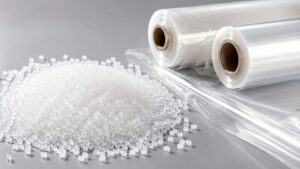

Plate-out is a common processing problem in PVC production, particularly in extrusion, calendaring, and injection molding. It occurs when certain components of a PVC formulation separate from the polymer system and gradually deposit on metal surfaces such as dies, screws, barrels, rolls, or molds. As production continues, these deposits can accumulate and begin to affect processing stability and product quality.
Plate-out should not normally be considered the result of a single raw material. PVC formulations contain resin, stabilizers, lubricants, processing aids, fillers, pigments, impact modifiers, and other additives that interact with one another during heating and fusion. A change in one component can therefore alter the behavior of the entire system. Understanding plate-out requires looking at both formulation balance and processing conditions rather than focusing only on the material found in the deposit. Explore the full TLD Vietnam blog for a detailed look at PVC plate-out, from causes to practical troubleshooting approaches.
What Is Plate-out In PVC?
During PVC processing, the dry blend is exposed to heat, pressure, and shear until the PVC particles progressively fuse into a continuous material. At the same time, additives must remain sufficiently dispersed and compatible with the developing PVC matrix. If some components have poor compatibility, are present in excessive amounts, or are pushed out of the polymer phase during processing, they may migrate toward the metal interface.
Once these materials reach the surface of a die, screw, barrel, roll, or mold, they can accumulate over time. The resulting deposit may appear white and powdery, smooth and waxy, sticky, yellow, brown, or even dark depending on its composition and the processing conditions. A plate-out deposit is often not a pure substance but a mixture of lubricants, stabilizer derivatives, fillers, pigments, degraded PVC components, and other formulation materials.
Plate-out is frequently observed around die lips because this area creates favorable conditions for deposition. Material experiences high shear while flowing through the die, followed by changes in temperature and pressure near the exit. Similar deposits may also form on calender rolls, extrusion screws, barrels, or injection molds when formulation components repeatedly contact the same metal surface.
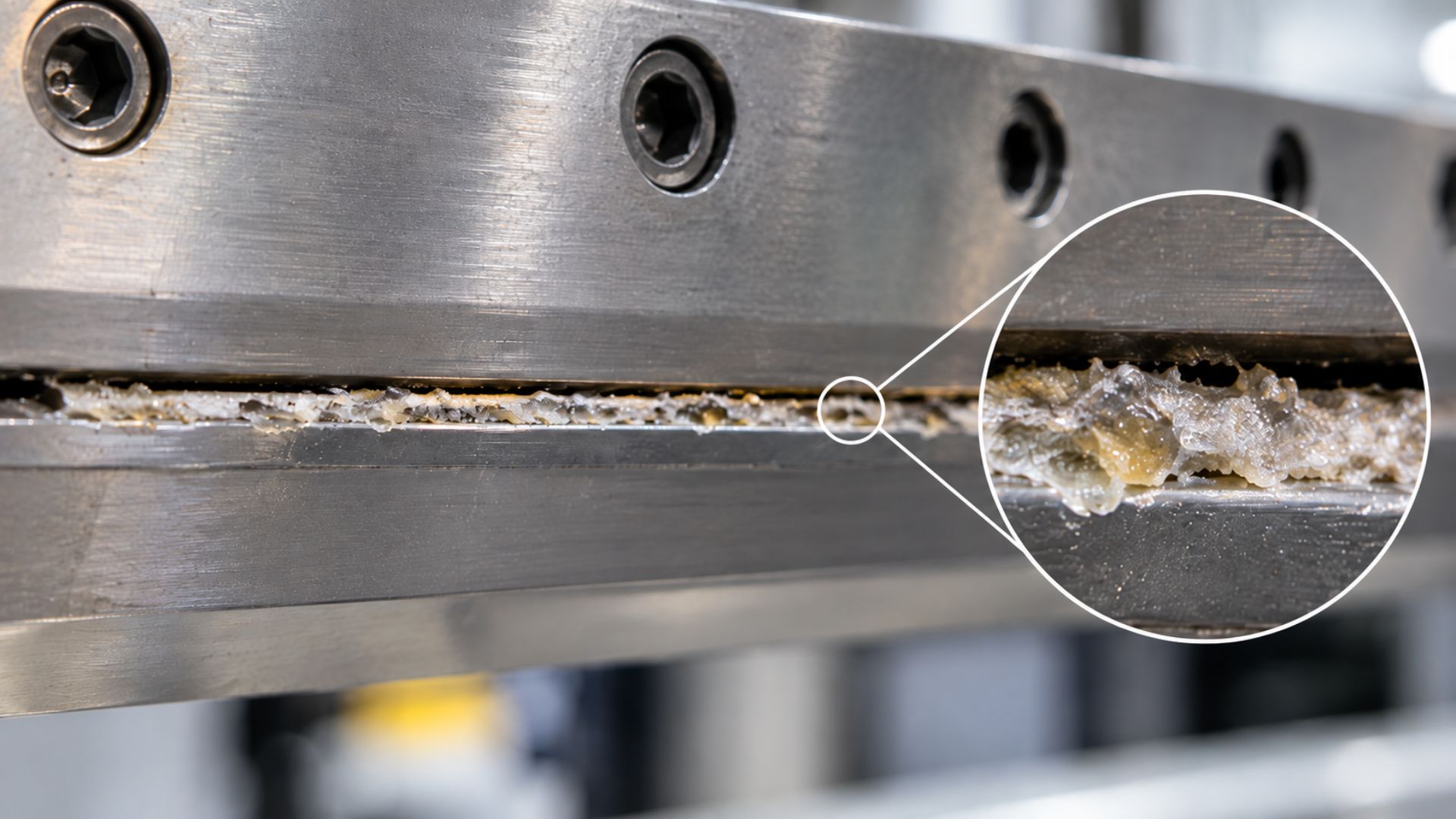
Plate-out should also be distinguished from blooming. Plate-out mainly refers to material accumulating on processing equipment while the PVC is being manufactured. Blooming, in contrast, describes the migration of formulation components toward the surface of the finished PVC product during or after production. Although both phenomena involve migration or poor compatibility, they occur at different locations and may require different corrective actions.
What Causes Plate-out In PVC?
Plate-out generally develops when the balance between PVC fusion, additive compatibility, lubrication, dispersion, and processing conditions is disturbed. The exact mechanism varies from one formulation to another, which is why similar processing conditions may produce plate-out in one PVC compound but not in another.
Poor Compatibility Of PVC Additives
Each additive used in a PVC formulation has a different degree of compatibility with the PVC matrix. Processing aids, lubricants, stabilizers, waxes, fatty acids, metal soaps, pigments, and other materials must function within a relatively complex multiphase system. If an additive has limited compatibility with PVC, it may preferentially migrate toward interfaces instead of remaining evenly distributed inside the compound.
Additive concentration is equally important. A material may perform normally at an appropriate dosage but begin to separate when its concentration exceeds what the formulation can effectively accommodate. This is particularly relevant for lubricants and low-molecular-weight components, which can have relatively high mobility during processing.
Compatibility is also affected by temperature and the state of PVC fusion. An additive that appears well distributed in the initial dry blend may behave differently after the formulation is heated. As PVC particles fuse, the local environment around the additives changes, meaning that formulation stability cannot be evaluated solely from the appearance of the dry blend.
Imbalanced Lubrication
Lubricants play a critical role in PVC because PVC has a relatively narrow processing window. Internal lubricants primarily help control friction within the compound, while external lubricants reduce friction between the PVC melt and metal surfaces. In practice, many lubricants have both internal and external effects, with the balance depending on their chemistry and compatibility.
Excessive external lubrication can reduce the interaction between PVC and the processing equipment to the point that fusion becomes slower or incomplete. At the same time, excess lubricant may accumulate at the polymer-metal interface. This creates conditions in which lubricant-rich material can gradually deposit on dies or other equipment surfaces.
Insufficient lubrication can also indirectly contribute to deposits. Excessive friction raises shear and local temperature, which may accelerate PVC degradation or destabilize other additives. Effective plate-out control therefore does not simply mean reducing lubricant content. The objective is to establish an appropriate balance between lubrication, fusion behavior, melt flow, thermal stability, and equipment conditions.
Poor PVC Fusion
PVC fusion is an important factor in plate-out because the polymer does not process in exactly the same way as a conventional fully melted thermoplastic. During heating and shearing, primary PVC particles undergo structural changes and progressively form a more continuous fused network. The degree and rate of fusion strongly influence mechanical properties and additive distribution.
If fusion is insufficient, additives and fillers may not become properly incorporated into the PVC matrix. Components with limited compatibility may remain concentrated at particle boundaries or other local regions, increasing their tendency to migrate toward processing surfaces. Excessive external lubrication, low shear, inadequate temperature, or an unsuitable processing aid system can all delay fusion.
Fusion that occurs too rapidly can also create processing problems because it may increase torque, shear heating, and thermal stress. The aim is therefore not maximum fusion as quickly as possible, but controlled fusion within the appropriate processing window for the specific PVC formulation and equipment.
Heat And Processing Conditions
PVC is sensitive to prolonged exposure to elevated temperatures. When thermal stability becomes insufficient, dehydrochlorination can occur, producing hydrogen chloride and creating conjugated polyene structures within the polymer chain. This process is associated with progressive discoloration and deterioration of the material.
Excessive barrel or die temperature can therefore contribute to plate-out, particularly when combined with long residence time. Degraded PVC, stabilizer reaction products, pigments, lubricants, and other formulation components may form complex deposits on metal surfaces. Yellow, brown, or dark deposits often indicate that thermal degradation should be investigated.
Temperature alone, however, does not describe the complete thermal history of the material. Screw speed, shear rate, output, equipment geometry, cooling efficiency, and residence time all influence the actual temperature experienced by the compound. A formulation can therefore show thermal plate-out even when the nominal machine temperature settings appear to be within a normal range.
Long residence time is particularly problematic in low-flow zones or dead spots where material remains inside the equipment longer than the main melt stream. Repeated heating can cause these stagnant materials to degrade and later detach into the product, producing dark particles, streaks, or contamination.
Fillers And Poor Dispersion
Inorganic fillers and pigments such as calcium carbonate and titanium dioxide do not normally melt into the PVC phase. They remain as solid particles that must be uniformly distributed throughout the polymer matrix. Their effect on processing therefore depends strongly on particle size, surface area, surface treatment, moisture level, agglomeration, and concentration.
Poorly dispersed particles can create local regions with different rheological and lubrication characteristics from the surrounding material. Agglomerates may interfere with fusion and alter the flow of the PVC compound near equipment surfaces. Fine particles with a high specific surface area can also interact more strongly with lubricants and other additives, changing the effective amount of these components available elsewhere in the formulation.
Calcium carbonate is therefore not automatically a direct cause of plate-out. However, changing the calcium carbonate grade, surface coating, particle-size distribution, moisture level, or filler loading can alter the lubrication and fusion balance of an existing PVC formulation. A formulation that runs stably with one filler may require adjustment when another filler with different surface characteristics is introduced.
Surface-treated calcium carbonate deserves particular attention because fatty-acid coatings influence particle-polymer interactions and filler dispersion. The coating can improve processing and reduce moisture sensitivity when correctly controlled, but differences in coating level or surface treatment can also change the effective lubrication behavior of the PVC compound.
For this reason, when plate-out appears after a filler change, the correct conclusion is not necessarily that the filler itself is defective. The more useful approach is to examine how the new filler interacts with the lubricant package, stabilizer system, processing aid level, PVC resin, and processing conditions.
How Does Plate-out Affect PVC Production?
Plate-out can affect both processing equipment and finished product quality. Its effects can be understood across three main areas: equipment performance, product quality, and production efficiency.
Effects On Processing Equipment
The first effect of plate-out is usually the gradual formation of deposits on equipment surfaces. At the die lip, even a relatively thin layer can modify the flow pattern of the PVC compound. As the deposit grows, material leaving the die may drag against the accumulated layer, disrupting the intended flow path and contributing to surface irregularities.
Deposits can also accumulate inside the die and gradually alter the effective flow channel or change the flow distribution across the die. In extrusion systems, similar buildup may occur on screws, barrels, rolls, or other metal surfaces exposed to the PVC compound.
Effects On Finished Product Quality
Changes in material flow can directly affect the appearance and consistency of the finished PVC product. Surface streaks are particularly common in extrusion applications because the same defect can continue along the length of the product. Gloss may become inconsistent, while color may vary when the deposit contains pigments, stabilizer products, or thermally degraded material.
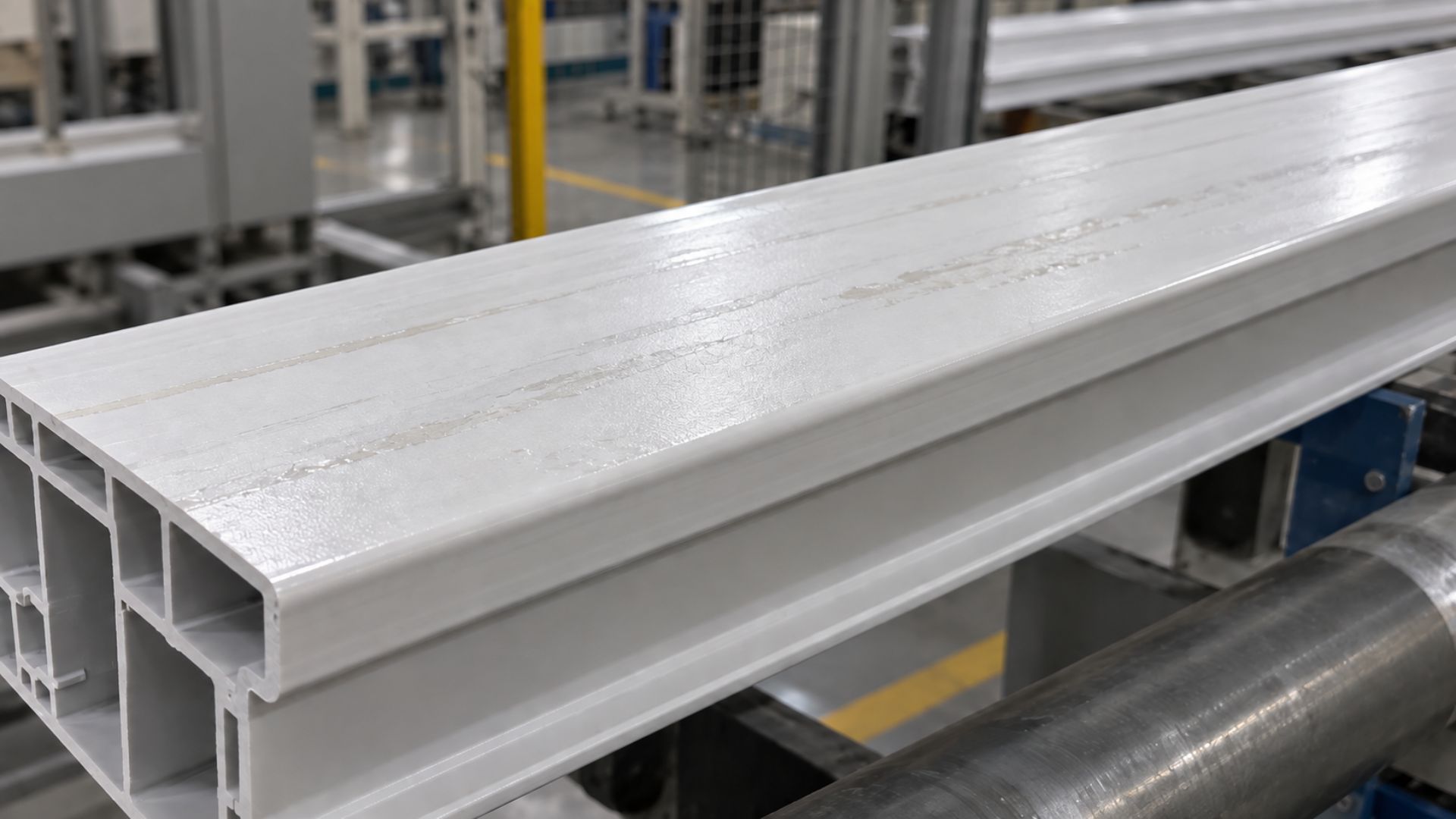
In transparent or lightly colored PVC, relatively small amounts of contamination can become especially visible. When accumulated deposits degrade, darken, and partially detach from the equipment, the detached material may appear in the product as yellow particles, brown marks, black specks, or burnt contamination.
Plate-out may also contribute to dimensional variation. Changes in flow distribution can affect thickness, dimensions, or surface finish in profiles, sheets, films, and other PVC products requiring precise geometry.
Effects On Production Efficiency
From a processing perspective, plate-out increases the need for equipment cleaning. Once deposits become severe, reducing temperature or adjusting the formulation may not immediately restore normal operation because the existing material remains attached to the equipment.
Production may therefore have to be stopped so the die, screw, barrel, roll, or mold can be cleaned. Gradual accumulation can shorten continuous production runs, increase downtime, and contribute to higher scrap generation.
Plate-out should therefore be considered not only a product-quality problem but also an equipment and process-stability issue. Controlling the underlying causes is important for maintaining consistent material flow, product quality, and stable PVC production.
How To Reduce Plate-Out In PVC
Reducing plate-out begins with identifying whether the dominant cause is associated with formulation, fusion behavior, thermal conditions, dispersion, or a combination of these factors. Changing several variables simultaneously can make troubleshooting more difficult because it becomes unclear which modification actually corrected the problem.
Optimize Lubricant Balance
The lubrication system should be examined carefully, particularly when deposits have a waxy or greasy appearance. External lubricant levels, internal-external lubricant balance, metal soaps, waxes, fatty acids, and stabilizer components can all affect the material-metal interface. Simply lowering one lubricant may not be sufficient because the resulting change can alter fusion time and processing torque.
Improve PVC Fusion
PVC fusion should also be evaluated. If the compound is under-fused, adjusting the temperature profile, shear conditions, processing aid level, or lubrication balance may improve additive incorporation and reduce migration. Fusion behavior can be studied more systematically through torque rheometry or other processing measurements rather than relying only on machine temperature settings.
Control Processing Temperature And Residence Time
Processing temperature should be optimized in relation to actual shear heating. A machine with relatively low set temperatures may still generate high melt temperatures under strong shear, while low output or long residence time may expose the material to heat for an excessive period. The entire thermal history of the PVC compound should therefore be considered.
Residence time should be reduced where possible, especially in equipment zones where material may stagnate. Dead zones, damaged surfaces, unsuitable screw geometry, or deposits already present inside the machine can increase local residence time. Equipment condition is therefore part of plate-out troubleshooting and should not be separated from formulation analysis.
Improve Additive And Filler Dispersion
Dispersion of additives and fillers is another important factor. Appropriate hot-mixing conditions are needed to distribute stabilizers, lubricants, processing aids, pigments, and fillers throughout the PVC dry blend. Mixing temperature, sequence of addition, cooling conditions, and material properties can influence the final homogeneity of the compound.
When calcium carbonate is used, consistency between batches is important because variations in particle size, surface area, surface coating, moisture, and agglomeration can change processing behavior. If the filler grade changes significantly, the existing lubricant package should not automatically be assumed to remain optimal. The formulation may need to be rebalanced based on the characteristics of the new filler.
Review Stabilizer And Lubricant Compatibility
Stabilizer and lubricant compatibility should also be reviewed as a complete system. Modern PVC stabilizer packages often contain several active and auxiliary components, some of which can interact with waxes, calcium stearate, zinc stearate, fillers, pigments, and other additives. A plate-out problem may therefore result from a combination of components even when each raw material individually meets its specification.
Identify The Composition Of Plate-out Deposits
The appearance and composition of the deposit can provide useful diagnostic information. A waxy deposit suggests a different mechanism from a powdery mineral-rich deposit, while yellow or brown deposits raise stronger concerns about thermal degradation. When plate-out remains difficult to identify, analytical techniques such as infrared spectroscopy, thermogravimetric analysis, elemental analysis, or microscopy can help determine which components are accumulating on the equipment.
The most reliable approach is to treat plate-out as a system-level processing problem. PVC resin characteristics, stabilizer chemistry, lubricant balance, filler properties, additive dispersion, fusion behavior, temperature, shear, and residence time should be evaluated together. Correcting only the visible deposit without identifying the underlying imbalance often results in the problem returning after another production run.
Conclusion
Plate-out in PVC is usually not caused by one raw material alone. It commonly develops when the balance between PVC fusion, lubrication, additive compatibility, filler dispersion, thermal stability, and processing conditions is disturbed.
The material found on the die or equipment surface can provide clues about the source of the problem, but the deposit should not automatically be treated as evidence that one particular ingredient is responsible. Lubricants, stabilizers, fillers, pigments, degraded PVC, and reaction products can interact and accumulate together.
Effective plate-out control therefore requires a systematic evaluation of both the formulation and the processing environment. Maintaining stable fusion, appropriate lubrication, good dispersion, controlled thermal history, consistent raw materials, and suitable residence time provides a more reliable basis for reducing deposits and maintaining stable PVC production.