
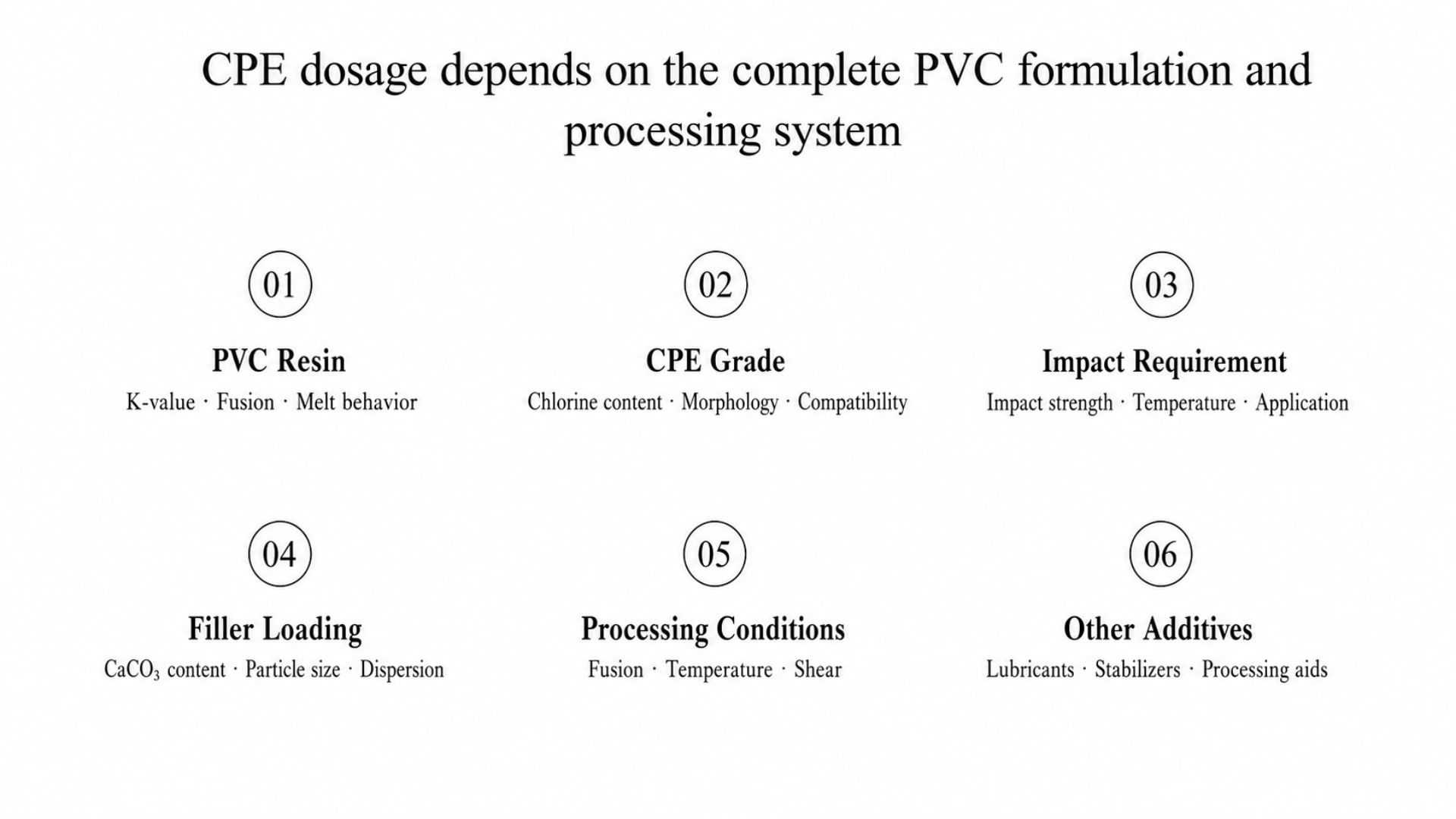
CPE is an important additive in rigid PVC because it impacts the impact resistance, toughness, stiffness, processing behavior, and total compound cost. The right dosage cannot be selected from one universal number: it depends on the PVC resin, the CPE grade, filler loading, processing conditions, and the performance required from the finished product. This guide by TLD Vietnam explains how the appropriate CPE dosage is evaluated and how formulators can determine a suitable addition rate for different PVC applications.
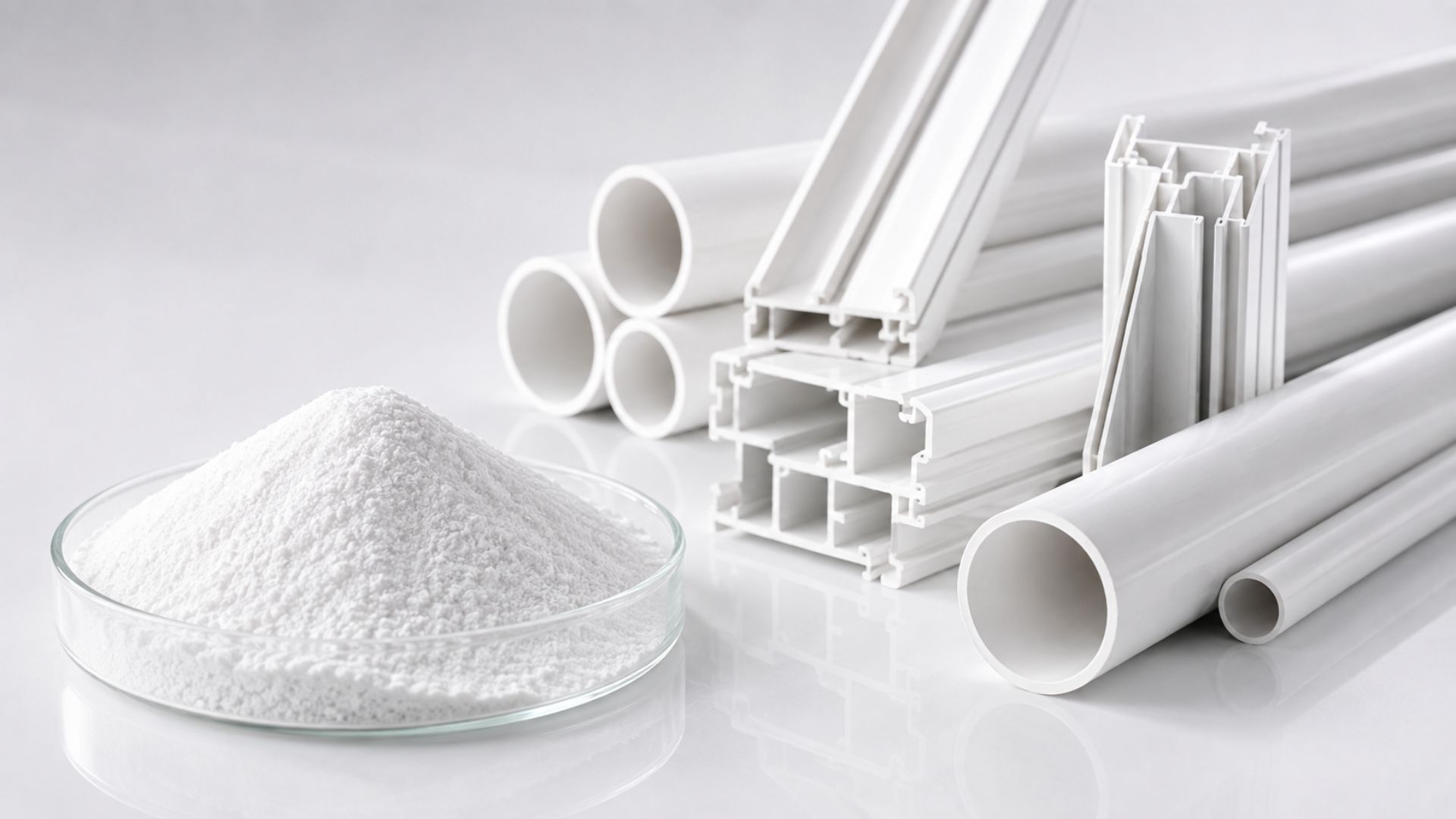
What Is CPE And Why Is It Used In PVC?
What Is CPE?
Chlorinated polyethylene, or CPE, is a polymer produced by chlorinating polyethylene. In PVC compounding, suitable CPE grades are widely used as impact modifiers because they introduce a rubber-like phase into the rigid PVC matrix. This dispersed elastomeric phase can absorb and dissipate impact energy, helping reduce brittle fracture and limit crack propagation.
CPE is especially relevant to rigid PVC products that must maintain toughness during handling, installation, service, or exposure to lower temperatures. Its effectiveness, however, depends on the CPE grade and on how effectively the modifier is incorporated into the complete PVC formulation. Research on impact modified PVC has shown substantial changes in fracture and impact behavior after the introduction of CPE.
The Role Of CPE In PVC
The primary role of CPE in rigid PVC is to improve impact performance. CPE improves the overall performance of PVC by enhancing impact strength, toughness, and elasticity. It also provides good flame resistance due to its high chlorine content, while improving resistance to oils, acids, alkalis, and other chemicals. In addition, CPE enhances the aging and weathering resistance of PVC, including resistance to UV radiation and harsh environmental conditions.
CPE does not work independently. Its performance is affected by PVC resin characteristics, calcium carbonate, stabilizers, processing aids, lubricants, pigments, and other modifiers. The CPE dosage should therefore be evaluated as part of the complete compound.
Too little CPE may leave the product below its required impact target. Too much may increase formulation cost and shift the balance between toughness and rigidity. It can also alter fusion behavior, melt response, or other mechanical properties. The objective is therefore not to maximize the amount of impact modifier. A suitable formulation should use enough CPE to achieve consistent target performance while maintaining the stiffness, processing stability, surface quality, and cost structure required for the application.
What Is The Typical CPE Dosage In PVC?
A Practical Starting Range For Rigid PVC
There is no single CPE addition rate that is correct for every rigid PVC formulation. Published studies have evaluated CPE at levels including 6, 7.5, 9, and 15 parts per hundred resin, showing that impact modification is normally studied over a range rather than at one universal concentration.
In PVC formulation, phr means parts by weight per 100 parts of PVC resin. For example, 8 phr CPE means that 8 parts of CPE are added for every 100 parts of PVC resin. For many rigid PVC development programs, approximately 5-15 phr can be used as a practical laboratory screening range. This should not be interpreted as a fixed industrial recommendation.
The optimum level may fall toward the lower or upper part of this range, or outside it, depending on the specific formulation and product requirements. The purpose of such a range is to establish useful trial points. A formulator can then compare mechanical properties and processing behavior at several levels instead of assuming that one standard value will work for every PVC compound.
How The Required Level Changes By Application
The final CPE dosage depends strongly on what the PVC product is expected to do. A rigid pipe formulation may need to maintain pressure performance, stiffness, dimensional stability, and adequate impact resistance. Window and door profiles may place greater emphasis on toughness around corners, fabricated joints, handling damage, and service exposure. Exterior siding and similar products may require a different balance between impact retention, rigidity, processability, and outdoor performance.
This explains why two rigid PVC products can require different CPE dosages even when they use similar PVC resin. The target should always be determined from the requirements of the finished product and confirmed through testing rather than transferred directly from another formulation.
Factors That Affect CPE Dosage In PVC
PVC Resin Type
PVC resin characteristics influence fusion, melt behavior, additive dispersion, and the morphology that develops during processing. Resin K-value, particle structure, molecular characteristics, and processing response can therefore affect how efficiently an impact modifier works.
When the PVC resin grade changes, an existing CPE dosage should not automatically be assumed to remain optimal. A different resin may require adjustment of the modifier, processing aid, lubricant system, or other formulation variables.
CPE Grade And Chlorine Content
CPE is not one uniform material. Different grades can vary in chlorine content, molecular characteristics, residual crystallinity, particle morphology, and intended application. These differences can affect compatibility with PVC, dispersion, elastomeric behavior, and impact-modification efficiency. As a result, equal phr levels of two different CPE grades do not necessarily provide the same performance. Selection should therefore be based on the technical characteristics of the actual CPE grade.
Impact Performance Requirements
The required impact strength is one of the most direct factors determining the amount of CPE required. Products exposed to severe mechanical stress, rough handling, installation loads, low-temperature conditions, or demanding impact specifications may require a stronger impact-modification system than products operating under less demanding conditions.
However, adding more modifier indefinitely is not an efficient approach. Once the required impact level has been reached, additional CPE may provide smaller incremental benefits while increasing cost or affecting other properties.
Filler Loading
Calcium carbonate is widely used in rigid PVC compounds and can substantially influence stiffness, impact behavior, rheology, density, and processing. Its effect depends not only on the quantity used but also on particle size, particle-size distribution, surface treatment, dispersion, and interaction with the PVC matrix.
When filler loading changes, the amount of impact modifier required to maintain a specified impact level may also change. The correct response is not necessarily to compensate by adding more CPE. Filler selection, dispersion, processing, and the complete additive package should also be reviewed.
Processing Conditions
Mixing conditions, fusion temperature, extrusion temperature, screw design, shear, residence time, line speed, and die conditions influence the morphology of the finished PVC compound. A formulation that performs well under one processing window may behave differently after transfer to another extrusion line.
For this reason, impact modifier level cannot compensate for poorly controlled fusion or unsuitable processing conditions. Before changing CPE, formulators should confirm that dry blending, lubrication, fusion, extrusion temperature, and equipment settings are appropriate.
Other Additives
Processing aids, stabilizers, lubricants, fillers, pigments, and other impact modifiers can affect the way CPE behaves during processing and in the final product. These materials may change fusion time, melt viscosity, dispersion, morphology, stiffness, or toughness. Published work on PVC compounds containing CPE has also shown that modifier addition can influence fusion characteristics depending on the surrounding formulation.
The formulation should therefore be optimized as one system. Changing only the CPE dosage while ignoring other additive changes can produce misleading results.
Final Product Requirements
Different PVC products require different property balances. Impact strength may be important, but it is rarely the only specification. Tensile properties, modulus, hardness, dimensional stability, surface appearance, processing speed, heat resistance, weatherability, cost, and applicable product standards may all affect the final formulation. The optimum level is therefore the one that allows the finished product to satisfy its complete performance specification rather than simply achieve the highest possible impact value.
How Does CPE Dosage Affect PVC Performance?
Impact Strength
Impact strength is normally the main reason for adding CPE to rigid PVC. When CPE is sufficiently dispersed through the PVC matrix, elastomeric domains can help absorb deformation energy and reduce the tendency for cracks to propagate rapidly through the rigid material.
As the modifier level rises from an insufficient starting point, impact performance can increase substantially. However, this relationship is not necessarily linear. Experimental studies have shown significant impact changes at different CPE concentrations, but the result also depends on PVC morphology, fusion, formulation composition, and test conditions.
Flexibility And Toughness
CPE introduces a more elastomeric component into the rigid PVC structure. At an appropriate level, this can increase toughness and reduce brittle behavior while retaining enough rigidity for the intended application. This balance is important because rigid PVC products generally require both dimensional stability and resistance to sudden mechanical loading. At higher levels, the material may move further toward a flexible or ductile response. Whether this is beneficial depends entirely on the product.
Tensile Strength
Impact modification can also change tensile behavior because the compound is no longer behaving as a single rigid PVC phase. Depending on the formulation and modifier concentration, higher CPE dosages may reduce modulus or tensile strength while increasing elongation and toughness. The magnitude of these changes depends on the resin, filler, additive package, morphology, and processing history. Tensile properties should therefore be measured together with impact performance rather than estimated from CPE content alone.
Fusion and Processing Behavior
CPE can influence PVC fusion and melt behavior. Research on CPE-containing PVC systems has reported changes in fusion time and processing torque after CPE addition, demonstrating that impact modification can interact with processing rather than affecting only the mechanical properties of the finished material. This is why modifier concentration should be checked through rheological evaluation or production trials. A formulation can achieve strong impact results in laboratory specimens but still be unsuitable for production if fusion becomes unstable or the processing window becomes too narrow.
Surface Appearance
Surface quality depends on many variables, including fusion, melt homogeneity, filler dispersion, lubrication, die conditions, and processing temperature. Changing the modifier level can alter this balance and may therefore affect gloss, smoothness, or visible flow characteristics in some formulations. Surface defects should not automatically be attributed to CPE. Processing aids, lubricant balance, filler dispersion, temperature profile, and extrusion conditions should be evaluated at the same time.
What Happens When CPE Dosage Is Too Low?
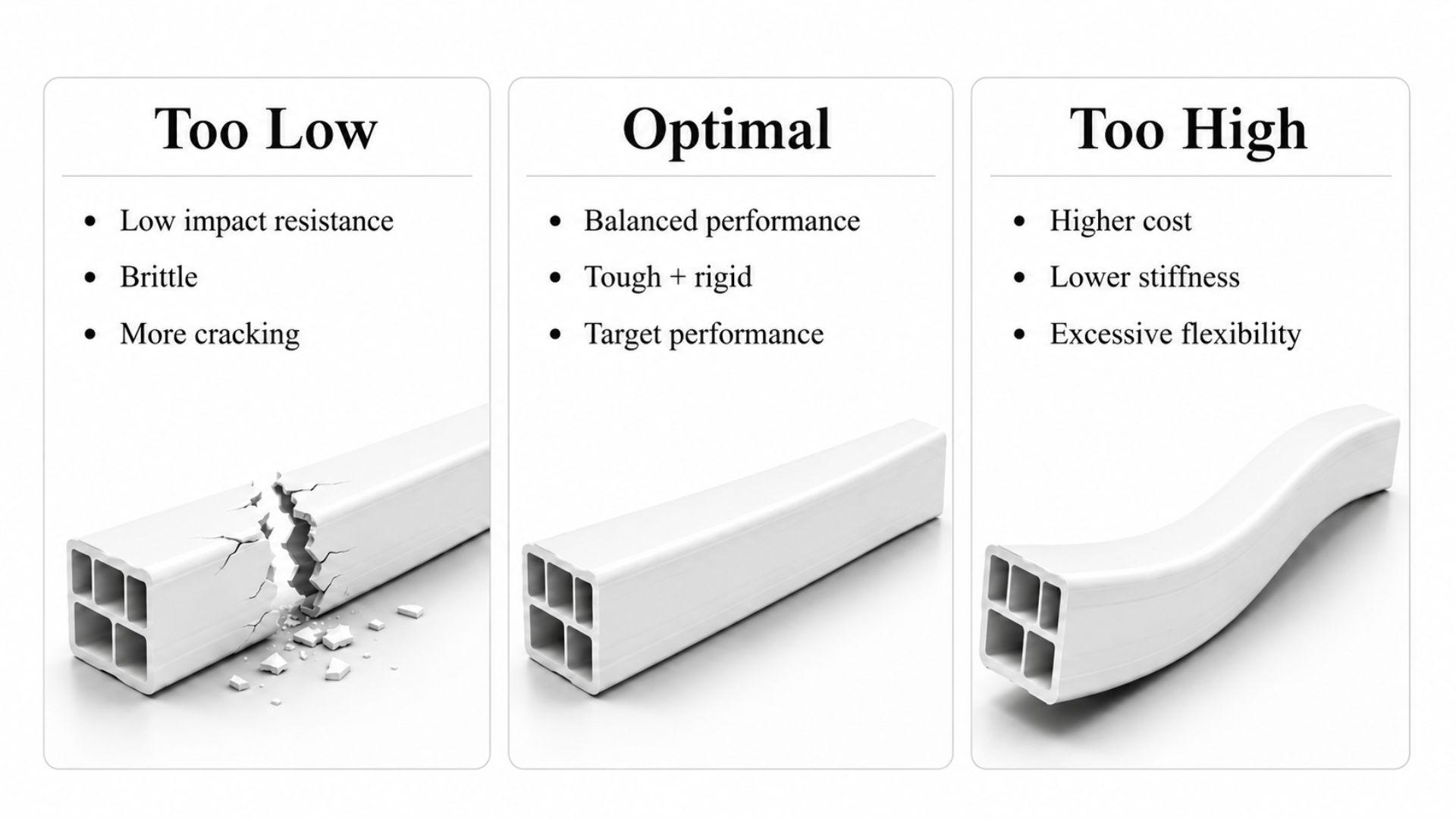
- Insufficient Impact Resistance: If the CPE dosage is below that required for effective toughening, the PVC matrix may remain too brittle. The finished product may fail impact tests or become more vulnerable to cracking during transportation, fabrication, installation, or service.
- Poor Toughness: A low addition level may produce some improvement without creating sufficient elastomeric modification to generate the required ductile response. Under impact, the material may still fracture sharply rather than absorb and dissipate enough deformation energy.
- Inconsistent Performance: A formulation operating very close to its minimum effective modifier level may become sensitive to normal production variation. Small differences in PVC resin, filler dispersion, mixing, extrusion temperature, line speed, or raw-material properties may move performance from passing to failing.
Industrial formulation therefore normally requires an adequate process and performance margin rather than simply selecting the lowest concentration that passes one laboratory test. The complete product specification should determine whether the impact-modification system is adequate. If impact performance remains below target, the formulator should review CPE grade, concentration, dispersion, PVC fusion, filler system, processing conditions, and other additives rather than simply confirming that CPE is present in the recipe.
What Happens When CPE Dosage Is Too High?
- Increased Formulation Cost: CPE is a functional additive, so using more than necessary raises compound cost without guaranteeing a proportional improvement in performance. Once the required toughness and impact resistance have been achieved, further addition should be supported by a measurable technical benefit.
- Excessive Flexibility: A high modifier concentration can shift the rigid PVC compound toward a softer or more ductile response. This may be acceptable for some applications but undesirable for products where dimensional stability and rigidity are important.
- Possible Reduction in Stiffness: Because CPE introduces an elastomeric phase, excessive levels can reduce modulus or stiffness in some formulations. The magnitude of this effect depends on CPE grade, PVC resin, filler loading, product geometry, and the rest of the formulation. This is one reason why selecting an impact modifier solely according to the highest achievable impact strength can produce an unbalanced compound.
- Changes in Processing and Fusion: Higher CPE concentrations may alter fusion characteristics, melt response, torque, and the effective processing window. If the original lubricant and processing-aid package remains unchanged, the compound may no longer process in the same way after a substantial change in modifier concentration. Processing observations should therefore be recorded throughout dosage trials rather than evaluated only after mechanical testing.
Impact strength is only one part of rigid PVC performance. An excessive impact modifier level may change tensile behavior, stiffness, hardness, dimensional response, or other mechanical characteristics. The selected concentration should therefore be based on a multi-property evaluation.
How To Optimize CPE Dosage In PVC Formulations
Define The Required PVC Performance
Optimization should start with measurable product targets. These may include impact strength at a specified temperature, tensile strength, elongation, modulus, dimensional stability, surface appearance, processing stability, and any relevant product-standard requirements.
Without clearly defined targets, there is no objective basis for deciding whether a modifier level is insufficient, adequate, or unnecessarily high.
Select The Appropriate CPE Grade
The CPE grade should match the intended PVC application and processing system. Formulators should review supplier technical information, intended application, material characteristics, chlorine content, physical form, and available formulation guidance. Grade selection should normally occur before fine dosage optimization because changing the CPE grade can change the relationship between addition level and final performance.
Conduct Laboratory Trials
A controlled formulation series is one of the most useful ways to determine an effective addition level. The amount of CPE can be changed in small steps while PVC resin, filler, stabilizer, lubricant, processing aid, and other components remain constant. For example, a development program might compare 6, 8, 10, and 12 phr rather than testing only one low and one high level. These values are illustrative trial points, not a recommended recipe. The actual trial range should be selected according to the application, previous formulation history, supplier recommendations, and initial testing.
Test Mechanical Properties
The test program should reflect the requirements of the finished product. Impact strength is essential when CPE is being used primarily as an impact modifier, but tensile strength, elongation, modulus, hardness, and low-temperature performance may also be relevant. The objective is to identify the region where additional modifier produces diminishing improvement or begins to compromise another required property.
Evaluate Processing Behavior
Mechanical testing alone is not sufficient. Fusion time, torque, melt temperature, extrusion pressure, motor load, output stability, surface quality, and other useful processing indicators should also be monitored. Laboratory rheology can provide valuable information, but it does not completely reproduce the shear history, residence time, cooling conditions, and equipment geometry of industrial production. The selected formulation should therefore be validated under representative production conditions.
Optimize the Cost-Performance Balance
The highest impact value is not necessarily the best formulation. The preferred level is generally the lowest robust concentration that satisfies mechanical, processing, appearance, quality, and production requirements with an adequate safety margin. This approach avoids both under-modification and unnecessary additive cost.
CPE Dosage In PVC: Formulation Considerations
CPE And Mineral Fillers
Calcium carbonate can change both the stiffness and impact response of a PVC compound. Particle size, surface coating, loading level, and dispersion influence how the matrix responds to stress and how cracks initiate and propagate. A formulation containing a relatively high filler level may therefore behave very differently from an otherwise similar low-filled formulation. When calcium carbonate loading or grade changes substantially, the established CPE dosage should be revalidated rather than transferred automatically.
CPE With Stabilizers And Processing Aids
Heat stabilizers and acrylic processing aids serve different functions from CPE, but they influence the processing environment in which the final PVC morphology develops. Processing aids can affect fusion, melt homogeneity, and melt strength, while the stabilizer system protects PVC against thermal degradation during processing. A significant change in either system can alter processing behavior sufficiently to justify renewed impact and fusion evaluation, even when the amount of CPE has not changed.
CPE With Lubricants And Other Impact Modifiers
Internal and external lubricants affect fusion, melt flow, metal release, and processing behavior. An unsuitable lubrication balance cannot necessarily be corrected by increasing impact modifier. Some formulations may also use, combine, or compare CPE with acrylic and other impact modifiers. In such systems, the total impact-modification package should be evaluated together rather than assuming that the performance contribution of each modifier is independent. The key principle is that CPE operates within a formulation system. Its effective level cannot be separated completely from the materials surrounding it.
CPE Dosage Optimization For Different PVC Applications
Application requirements should determine the final modifier level. Pipe compounds generally need adequate impact resistance while preserving stiffness, dimensional stability, and consistent processing. Window and door profiles often require strong toughness around corners, welded or fabricated areas, and sections exposed to handling stress. Exterior siding and profiles may require a different balance between impact resistance, rigidity, weather-related performance, and surface quality.
PVC sheets and other rigid products introduce their own thickness, forming, processing, and mechanical requirements. For each application, the CPE dosage should therefore be established through formulation-specific testing rather than copied directly from another rigid PVC product.
Common Mistakes When Selecting CPE Dosage For PVC
Using One Dosage For Every Application
A single CPE concentration cannot account for differences in geometry, PVC resin, filler loading, processing conditions, product standards, and mechanical requirements. A level that performs well in one pipe or profile formulation may therefore be inappropriate for another.
Ignoring the CPE Grade
Not all CPE grades are interchangeable. Differences in material characteristics can influence compatibility, dispersion, processing behavior, and impact modification. Changing supplier or grade while maintaining exactly the same phr level may therefore produce a different result. The new material should be validated before the formulation is approved.
Ignoring Filler Loading
A significant change in calcium carbonate level can change stiffness, fracture behavior, rheology, and processing. Maintaining exactly the same amount of CPE after a major filler change may therefore result in a different balance of properties. Both the filler system and modifier level should be evaluated when adjusting highly filled PVC formulations.
Optimizing Impact Strength Alone
Impact strength should not be optimized in isolation. A PVC product still needs to satisfy its requirements for stiffness, tensile behavior, dimensional stability, surface quality, thermal performance, processability, and cost. A formulation with the highest laboratory impact value is not automatically the most suitable industrial formulation.
Not Conducting Production-Scale Trials
Laboratory testing is necessary, but it cannot reproduce every aspect of industrial extrusion. Screw geometry, shear, residence time, cooling, line speed, die design, and scale can influence the final product. The selected formulation should therefore be confirmed under representative production conditions before commercial production is finalized.
Conclusion
The right CPE dosage in PVC is not a fixed value but depends on the resin, CPE grade, filler loading, additive package, processing conditions, and performance requirements. Rather than following a universal dosage, controlled formulation trials should identify the lowest CPE level that delivers the required impact performance while maintaining stiffness, processability, surface quality, and cost efficiency. Laboratory screening should be followed by production trials to validate the formulation under real manufacturing conditions.
FAQs
- What Is the Recommended CPE Dosage In PVC?
Typically 5- 15 phr, depending on the formulation and required impact performance. - Can Too Much CPE Affect PVC Properties?
Yes. Excessive CPE can reduce stiffness, affect processing, and increase cost. - How Does CPE Dosage Affect PVC Impact Strength?
Increasing CPE generally improves impact resistance, but excessive addition may offer limited further benefits. - How Do You Optimize CPE Dosage In PVC?
Test different levels and evaluate impact strength, stiffness, processing behavior, and cost to find the optimum dosage.