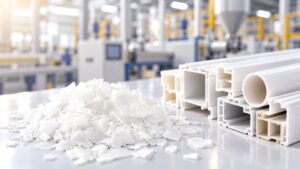

Titanium dioxide is one of the most widely used white pigments in the plastics industry thanks to its high refractive index, strong hiding power, brightness, and resistance to light exposure. In film manufacturing, choosing the right pigment can directly affect opacity, whiteness, processing stability, weatherability, and the appearance of the final product. Titanium dioxide for film is therefore commonly used in plastic film applications.
However, not every Titanium dioxide grade performs equally in film extrusion. Particle size, surface treatment, dispersion, heat resistance, and polymer compatibility all influence processing and final film quality. In this article, TLD Vietnam explains how Titanium dioxide for film works, where it is used, and what manufacturers should consider when choosing a suitable Titanium dioxide grade. Read more technical insights and material guides on the TLD Vietnam blog to support your plastic production.
What Is Titanium Dioxide In Film Production?
Titanium dioxide, or TiO₂, is an inorganic white pigment widely used in plastics, coatings, inks, paper, and other industrial materials. Its main advantage is an exceptionally high refractive index, which allows Titanium dioxide particles to scatter visible light efficiently. In plastic film manufacturing, Titanium dioxide for film is mainly introduced to create white or opaque films. It may also improve light-blocking performance, visual uniformity, UV durability, and overall product appearance. Unlike transparent films, which are designed to transmit light, white films need pigments capable of scattering and reflecting light. Titanium dioxide performs this function much more efficiently than most conventional mineral fillers.
Why Titanium Dioxide Is Used In Plastic Films
The primary reason manufacturers use Titanium dioxide for film is its ability to provide strong whiteness and opacity at relatively low pigment loading. When properly dispersed throughout a polymer matrix, Titanium dioxide particles scatter incoming light. This reduces the amount of light passing through the film and produces a bright, uniform white appearance.
These properties are particularly important for products such as shopping bags, food packaging, agricultural films, labels, industrial packaging, and multilayer films. Titanium dioxide may also help protect the contents of a package from light exposure. In applications where light can degrade food, chemicals, agricultural products, or other sensitive materials, improved opacity can provide an additional functional advantage.
Rutile Vs. Anatase Titanium Dioxide For Film Applications
Titanium dioxide exists primarily in two commercially important crystal forms: Rutile and Anatase. For most demanding plastic applications, Rutile Titanium dioxide is generally preferred. Rutile has a higher refractive index than anatase, giving it stronger hiding power and opacity. It also normally offers better resistance to UV exposure and weathering when appropriately surface-treated.
Anatase Titanium dioxide can provide good whiteness and is sometimes used in less demanding plastic applications. However, its lower weather resistance generally makes it less suitable for outdoor films or applications requiring prolonged UV stability. For this reason, many commercial grades of Titanium dioxide for film are rutile grades specifically engineered for plastics.
Key Functions Of Titanium Dioxide In Plastic Films
Although whiteness is the most obvious function of Titanium dioxide, its role in film production extends beyond simple coloration.
Whiteness And Brightness
A bright white appearance is essential for many consumer and industrial films. Titanium dioxide provides high brightness because its particles strongly scatter visible light. The effectiveness of Titanium dioxide for film depends not only on Titanium dioxide concentration but also on particle dispersion. Agglomerated pigment particles cannot scatter light as efficiently as well-dispersed particles. Good dispersion therefore allows manufacturers to obtain more uniform whiteness while using the pigment more efficiently. For printed packaging, improved film whiteness can also provide a cleaner background for graphics, logos, and product information.
Opacity And Hiding Power
Opacity describes the ability of a film to prevent objects or colors behind it from being visible. Because Titanium dioxide has a very high refractive index, Titanium dioxide for film can generate strong hiding power even at relatively moderate pigment levels. This characteristic is particularly useful in packaging applications where manufacturers want to conceal the packaged product, protect it from light, or create a uniform visual surface.
Film thickness also influences opacity. A thicker film generally provides greater hiding power than a thinner film containing the same pigment concentration. Therefore, Titanium dioxide loading should always be optimized together with film thickness, processing conditions, and the required optical performance.
UV Protection And Light Blocking
Titanium dioxide can absorb and scatter ultraviolet radiation, helping reduce UV penetration through a polymer film. This is especially relevant for Titanium dioxide for film used in agricultural and outdoor applications. Prolonged sunlight exposure can cause polymer degradation, discoloration, cracking, and loss of mechanical properties. However, UV performance depends heavily on Titanium dioxide grade and surface treatment.
Certain untreated Titanium dioxide surfaces may display photocatalytic activity, potentially accelerating polymer degradation. Plastic-grade rutile pigments are therefore commonly coated with inorganic or organic surface treatments to reduce undesirable surface activity and improve compatibility with polymer systems. Titanium dioxide should also be considered part of the overall stabilization system rather than a complete substitute for UV absorbers, hindered amine light stabilizers, antioxidants, or other additives.
Improved Appearance And Printability
Uniform pigmentation improves the visual consistency of plastic films. Properly dispersed Titanium dioxide for film helps reduce color variation, streaks, and uneven white areas across the film surface. A bright white substrate also improves color contrast for printed designs. For applications such as flexible packaging, shopping bags, labels, and branded films, this can significantly improve perceived product quality. Titanium dioxide itself does not automatically guarantee good print adhesion, as printing performance also depends on surface energy, corona treatment, ink formulation, polymer type, and other processing factors. However, a smooth and consistently pigmented substrate can support better visual print quality.
Types Of Plastic Films That Use Titanium Dioxide
Titanium dioxide for film can be incorporated into several thermoplastic film systems, although formulation requirements vary depending on the polymer, processing temperature, thickness, and final application.
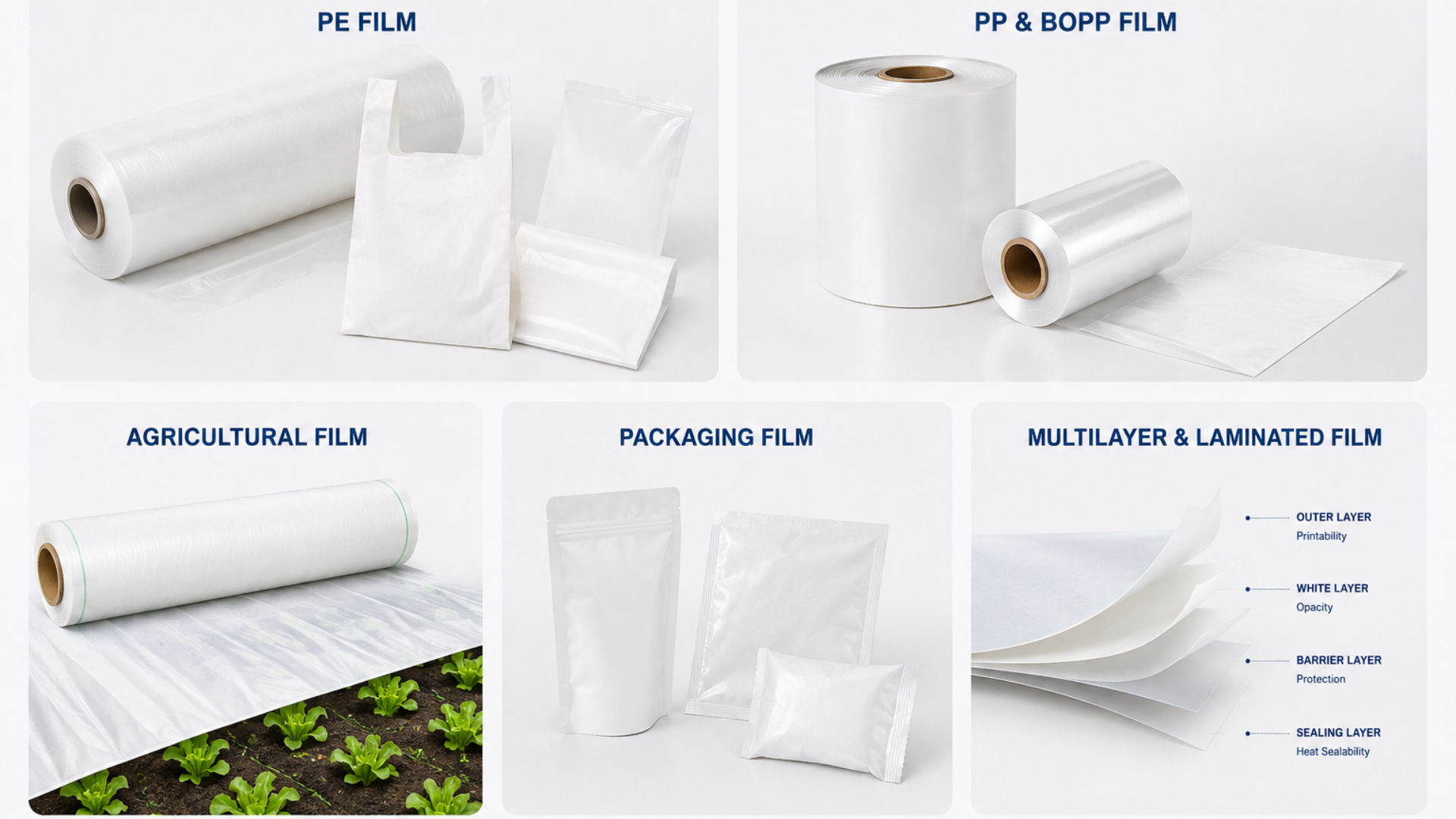
PE film
PE, shorted for Polyethylene is one of the largest materials used in film production. LDPE, LLDPE, and HDPE films are widely used for shopping bags, garbage bags, industrial packaging, protective films, agricultural films, and flexible packaging.
Titanium dioxide for film in PE applications is commonly introduced through white masterbatch. The Titanium dioxide is pre-dispersed in a compatible carrier resin, simplifying dosing and helping achieve more consistent pigment distribution during blown-film or cast-film extrusion. For thin PE films, dispersion quality becomes particularly important because even small agglomerates can create visible defects or weak points.
PP and BOPP film
PP, shorted for Polypropylene films are widely used in packaging due to their stiffness, clarity, moisture resistance, and relatively low density. White or opaque PP and BOPP films may contain Titanium dioxide to improve brightness and light-blocking performance. In these applications, Titanium dioxide for film needs good thermal stability because polypropylene processing temperatures can be relatively high.
BOPP film also undergoes orientation, where the polymer film is stretched in the machine and/or transverse direction. Poor pigment dispersion or inappropriate formulations can therefore affect film consistency during stretching. Specialized masterbatch formulations are commonly used to obtain controlled dispersion and processing behavior.
Agricultural Film
Agricultural films include greenhouse films, mulch films, silage films, and other plastic materials used in crop production. White or reflective agricultural films may incorporate Titanium dioxide for film to increase light reflection and opacity. Because these products are often exposed to sunlight for extended periods, weather resistance becomes particularly important. Rutile Titanium dioxide with suitable surface treatment is generally more appropriate for outdoor applications than conventional anatase grades. Nevertheless, the complete formulation usually requires additional UV stabilization to achieve the targeted service life.
Packaging Film
Packaging films must satisfy both functional and aesthetic requirements. White packaging can protect light-sensitive products while offering a clean background for branding and printing. Titanium dioxide for film can therefore be used in food packaging, consumer goods packaging, personal-care packaging, industrial packaging, and various flexible packaging structures. For food-contact applications, manufacturers must ensure that the selected pigment, additives, masterbatch, and finished film comply with applicable food-contact regulations in the target market.
Multilayer And Laminated Film
Modern packaging increasingly uses multilayer structures in which individual layers provide different functions. Rather than pigmenting the entire structure, manufacturers may incorporate Titanium dioxide for film only into a selected white layer. For example, an outer layer may provide printability, a middle white layer may create opacity, and another layer may provide sealing or barrier performance. This approach can help manufacturers optimize pigment usage while maintaining the optical and functional properties required from the complete film structure.
How Titanium Dioxide Is Added To Film
Titanium dioxide can theoretically be added directly during plastic processing, but industrial film manufacturers frequently use masterbatch systems because they simplify handling and improve pigment dispersion.
Direct Titanium dioxide addition
Direct addition involves feeding Titanium dioxide powder together with the polymer and other additives during compounding or extrusion. This method gives manufacturers direct control over pigment concentration and formulation. However, Titanium dioxide powder has a very fine particle size. Poor handling can result in dust generation, inconsistent dosing, agglomeration, and inadequate dispersion. Manufacturers using Titanium dioxide for film directly therefore require suitable dosing, mixing, dispersion, and filtration systems. Direct addition is often more practical for compounders and masterbatch producers than for film converters seeking a simple production process.
Titanium dioxide In White Masterbatch
White masterbatch consists of a concentrated Titanium dioxide pigment dispersed in a polymer carrier. For many film producers, this is the most convenient way to use Titanium dioxide for film. A well-formulated masterbatch improves pigment handling and dosing while helping achieve consistent dispersion during extrusion. Carrier polymers are normally selected according to the final film resin, such as PE-based masterbatch for polyethylene film applications.
Masterbatch may also contain processing aids, antioxidants, dispersants, or other additives depending on its intended application. The quality of the masterbatch therefore depends not only on the Titanium dioxide concentration but also on pigment grade, carrier resin, dispersion technology, additive package, and manufacturing process.
Typical Titanium dioxide Loading In Film Applications
There is no single Titanium dioxide loading suitable for every film. The required amount of Titanium dioxide for film depends on several factors, including film thickness, desired whiteness, required opacity, polymer type, Titanium dioxide grade, masterbatch concentration, filler content, and end-use requirements. A lightly tinted or partially opaque film may require relatively little pigment, while highly opaque white packaging may require significantly more.
For this reason, manufacturers should avoid selecting formulations purely according to Titanium dioxide percentage. Optical measurements such as whiteness, opacity, transmission, and hiding power should be evaluated together with processing and mechanical performance. Pilot trials are often the most reliable way to determine the optimum pigment loading.
How To Choose Titanium Dioxide For Film Production
Selecting Titanium dioxide for film should be based on processing requirements and final film performance rather than pigment price alone.
Dispersibility
Dispersion is one of the most important properties for film applications. Titanium dioxide particles naturally tend to form agglomerates because of their small particle size and high surface energy. Good Titanium dioxide for film should disperse efficiently throughout the polymer matrix under normal processing conditions. Poor dispersion may result in visible white spots, surface defects, inconsistent coloration, reduced optical efficiency, and even film breakage. For very thin films, these problems become more noticeable because even relatively small agglomerates represent a significant proportion of total film thickness.
Particle Size And Surface Treatment
Commercial pigment-grade Titanium dioxide is engineered to achieve an optimum balance between particle size and light scattering. Simply using extremely small particles does not necessarily increase whiteness. Maximum visible-light scattering occurs within a controlled particle-size range. Surface treatment is equally important.
Inorganic coatings such as alumina or silica and various organic treatments may be applied to Titanium dioxide for film to improve dispersion, reduce photocatalytic activity, enhance processing behavior, and increase weather resistance. The ideal treatment depends on polymer system and application.
Heat Resistance
Film extrusion exposes pigments to elevated temperatures. An appropriate Titanium dioxide pigment should remain stable and should not cause significant discoloration during processing. Heat resistance is particularly important when Titanium dioxide for film is used in polypropylene or other polymers processed at comparatively high temperatures. The complete masterbatch formulation should also be evaluated because carrier resin, dispersants, lubricants, and other additives may influence thermal stability.
Weather And UV Resistance
Outdoor products require greater resistance to sunlight than indoor packaging. For agricultural films and other externally exposed products, Rutile Titanium dioxide for film with suitable surface treatment is generally preferred. The pigment should have low photocatalytic activity and good weatherability. However, long-term outdoor durability still depends on the complete polymer stabilization system, including UV stabilizers and antioxidants.
Compatibility With PE and PP resins
Titanium dioxide is an inorganic pigment, so achieving uniform distribution in an organic polymer requires an appropriate surface treatment and dispersion system. When masterbatch is used, carrier-resin compatibility becomes especially important. A PE-based masterbatch is normally preferred for many PE film formulations, while PP-compatible systems may be selected for polypropylene applications. Poor compatibility can affect dispersion, film appearance, melt flow, mechanical properties, and extrusion stability. Therefore, the most suitable Titanium dioxide for film should always be evaluated within the actual resin and processing system rather than only through pigment specifications.
Common Problems When Using Titanium Dioxide In Film
Even high-quality Titanium dioxide can cause processing problems when pigment selection, dispersion, concentration, or operating conditions are inappropriate.
Poor Dispersion And White Spots
White specks are among the most visible signs of insufficient pigment dispersion. They may originate from Titanium dioxide agglomerates, poorly dispersed masterbatch, contamination, or inadequate mixing. Because Titanium dioxide for film particles should be distributed uniformly throughout the polymer matrix, strong dispersion performance is essential. Masterbatch quality, extrusion shear, screen packs, polymer viscosity, processing temperature, and feeding accuracy should all be examined when troubleshooting this problem.
Film Breakage And Reduced Mechanical Properties
Adding inorganic pigment changes the composition of the polymer matrix. At appropriate concentrations and with good dispersion, Titanium dioxide can be incorporated without unacceptable loss of film performance. However, excessive pigment levels or large agglomerates may act as stress-concentration points. This can reduce elongation or increase the risk of tearing and film breakage, particularly in very thin films or highly oriented structures. Manufacturers should therefore optimize Titanium dioxide for film loading based on both optical and mechanical requirements.
Die Build-Up And Processing Issues
Deposit formation around extrusion dies can disrupt continuous production and affect film appearance. Die build-up may be related to several factors, including masterbatch formulation, incompatible additives, volatile components, processing temperature, carrier resin, pigment surface treatment, and extrusion conditions. When evaluating Titanium dioxide for film, manufacturers should therefore consider processing behavior in addition to color and opacity. Long production trials can sometimes reveal processing issues that are not obvious from short laboratory tests.
Uneven Color And Opacity
Variation in film whiteness may result from unstable dosing, inconsistent masterbatch quality, inadequate mixing, thickness variation, or pigment dispersion problems. Since optical performance is highly dependent on uniform pigment distribution, production control is essential. Monitoring dosing accuracy, film gauge, extrusion stability, and raw-material consistency helps maintain the intended performance of Titanium dioxide for film across production batches.
Applications Of Titanium Dioxide-based White Masterbatch
Titanium dioxide-based white masterbatch allows film manufacturers to introduce pigment efficiently while simplifying storage, dosing, and processing. Typical applications of Titanium dioxide for film include:
- Shopping and carrier bags: Provides a clean white appearance, improved opacity, and a suitable background for printing and branding.
- Food and consumer packaging: Helps create attractive opaque packaging and can reduce light transmission to light-sensitive products, subject to applicable regulatory requirements.
- Agricultural films: Used in white or reflective films where opacity, solar reflection, and outdoor durability are required.
- Industrial and protective films: Provide whiteness and hiding power for protective sheets, wrapping films, industrial bags, and other technical film products.
The actual Titanium dioxide concentration and masterbatch formulation should be adjusted according to film thickness, extrusion process, target opacity, mechanical requirements, and application conditions.
Conclusion
Titanium dioxide for film is widely used in plastic film production to enhance whiteness, brightness, opacity, and light blocking. Rutile Titanium dioxide is commonly preferred for its high refractive index, hiding power, and weather resistance. However, performance depends not only on pigment concentration but also on dispersion, particle size, surface treatment, polymer compatibility, film thickness, and processing conditions. Manufacturers should therefore select Titanium dioxide based on the complete production system and validate performance through extrusion trials.