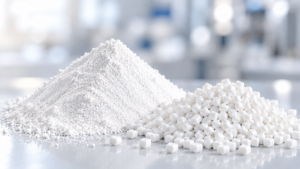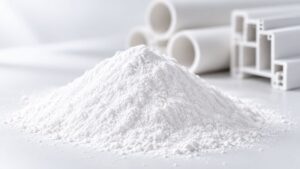

Ground calcium carbonate, or GCC, is a mineral filler produced by grinding natural limestone, calcite, chalk, or marble. It is used in paper, plastics, paints, rubber, adhesives, and construction materials.
The comparison of wet grinding vs dry grinding is important because the selected production method affects more than particle size. It also influences particle size distribution, moisture content, surface area, dispersion, product form, energy consumption, transportation, and suitability for the final application.
The question of wet grinding vs dry grinding cannot be answered by stating that one method is always superior. The correct grinding process depends on the required GCC properties and how the material will be handled and used. This blog by TLD Vietnam explains the key differences between wet grinding and dry grinding in GCC production.
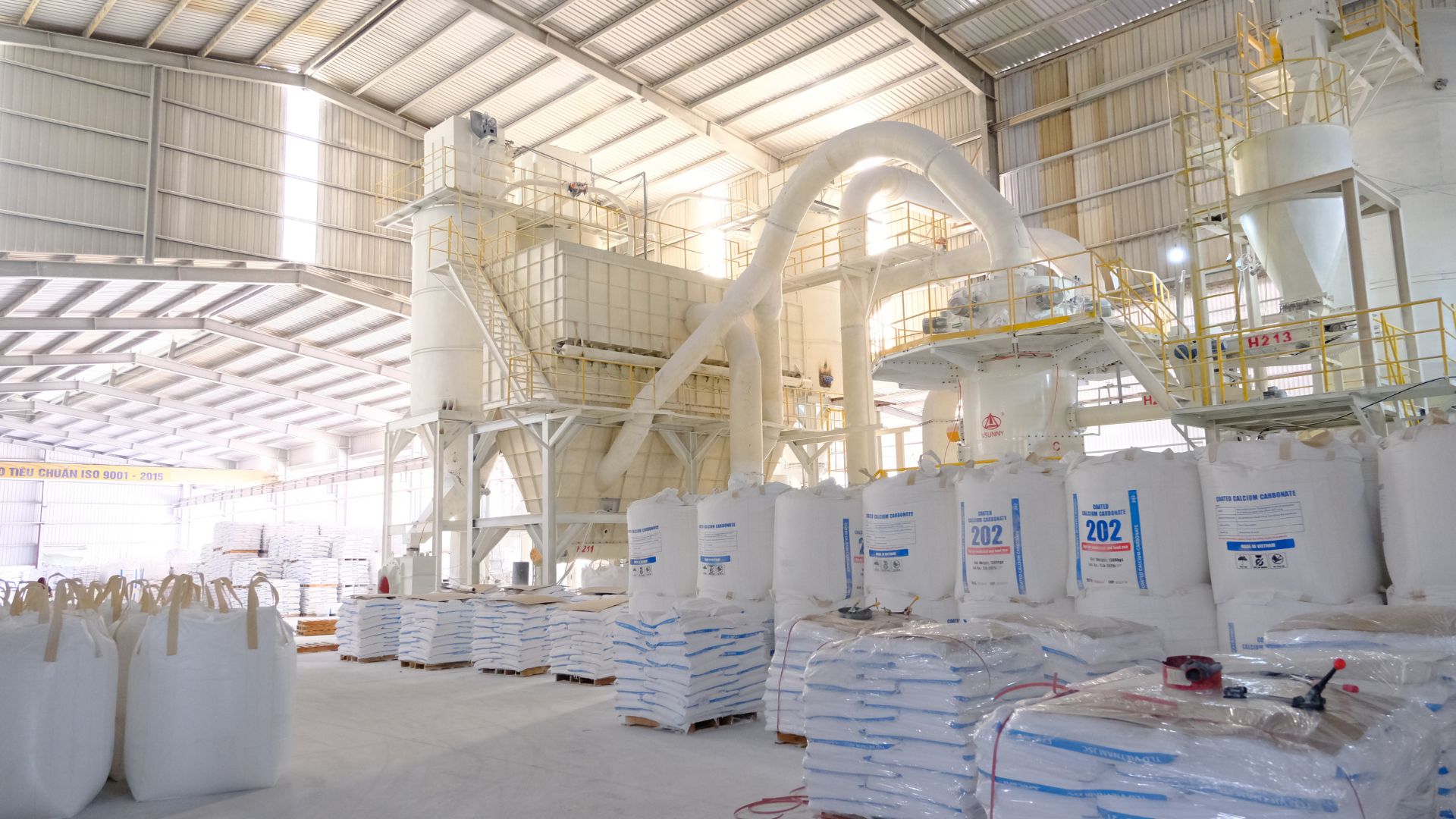
What Is GCC?
GCC is made by mechanically reducing natural calcium carbonate rock into fine particles. Its properties depend on the geological source and production method. Purity, whiteness, crystal structure, hardness, and impurities all affect the finished product.
How GCC Is Produced From Natural Limestone
Production begins with extracting suitable limestone or marble. The rock is crushed and may be washed, sorted, or dried before grinding.
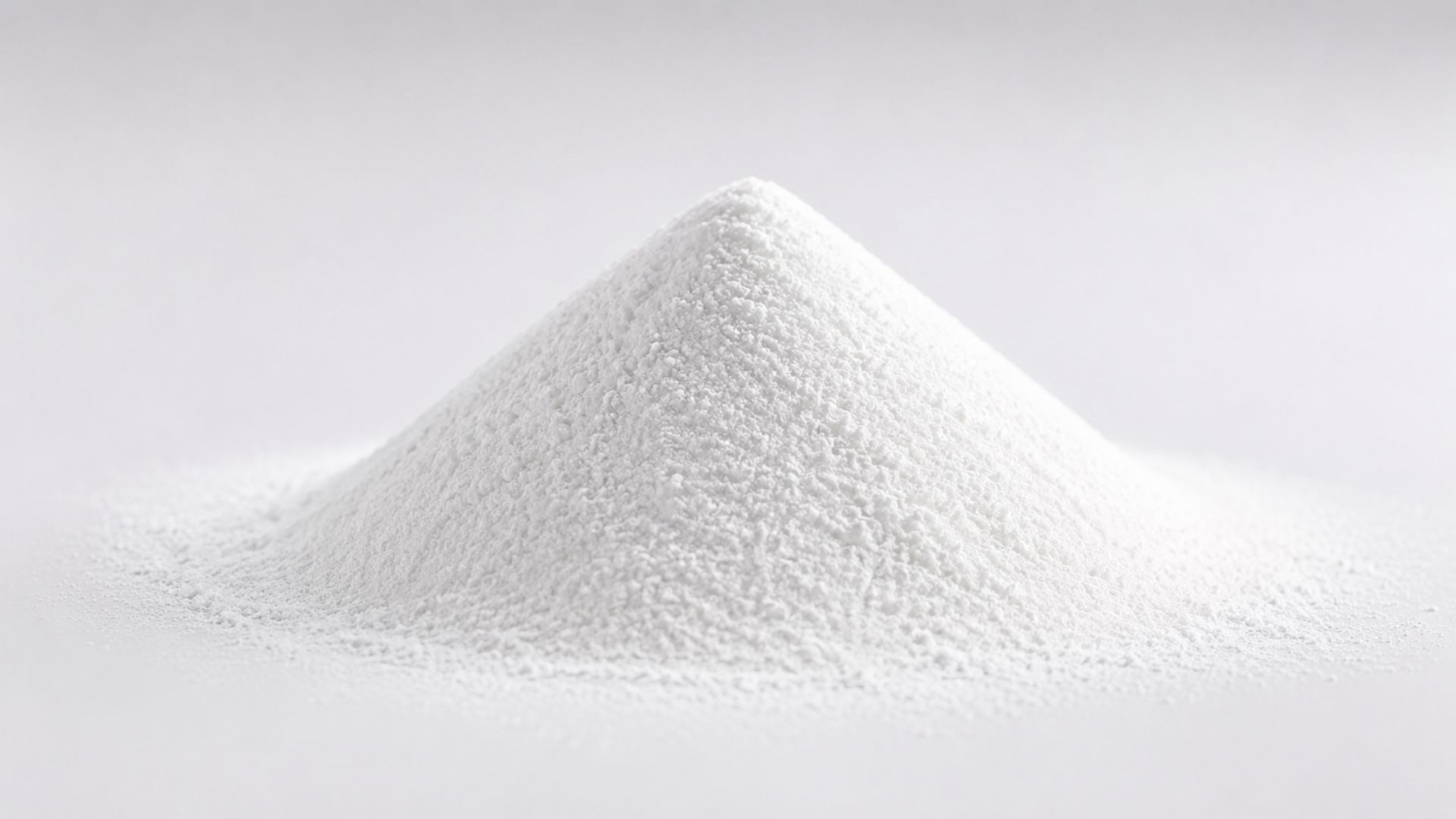
The prepared material enters a dry or wet grinding system. Classification separates acceptable particles from oversized material, which returns for further grinding. GCC may then be coated, dried, concentrated, stored as a slurry, or packed as powder.
Why The Grinding Process Matters
Grinding determines how the original mineral is converted into a functional industrial filler. It affects:
- Average particle size
- Particle size distribution
- Coarse particle content
- Specific surface area
- Moisture content
- Agglomeration tendency
- Surface-treatment efficiency
- Dispersion in the final formulation
Two GCC products may have the same D50 value but perform very differently because their D97, top cut, moisture, surface properties, or degree of agglomeration are not the same.
For this reason, evaluating wet grinding vs dry grinding requires more than comparing average particle size. The full particle profile and final application must also be considered.
What Is Dry Grinding In GCC Production?
Dry grinding reduces Calcium carbonate without using water as the grinding medium. The feed must have sufficiently low moisture to move through the mill and classifier without sticking.
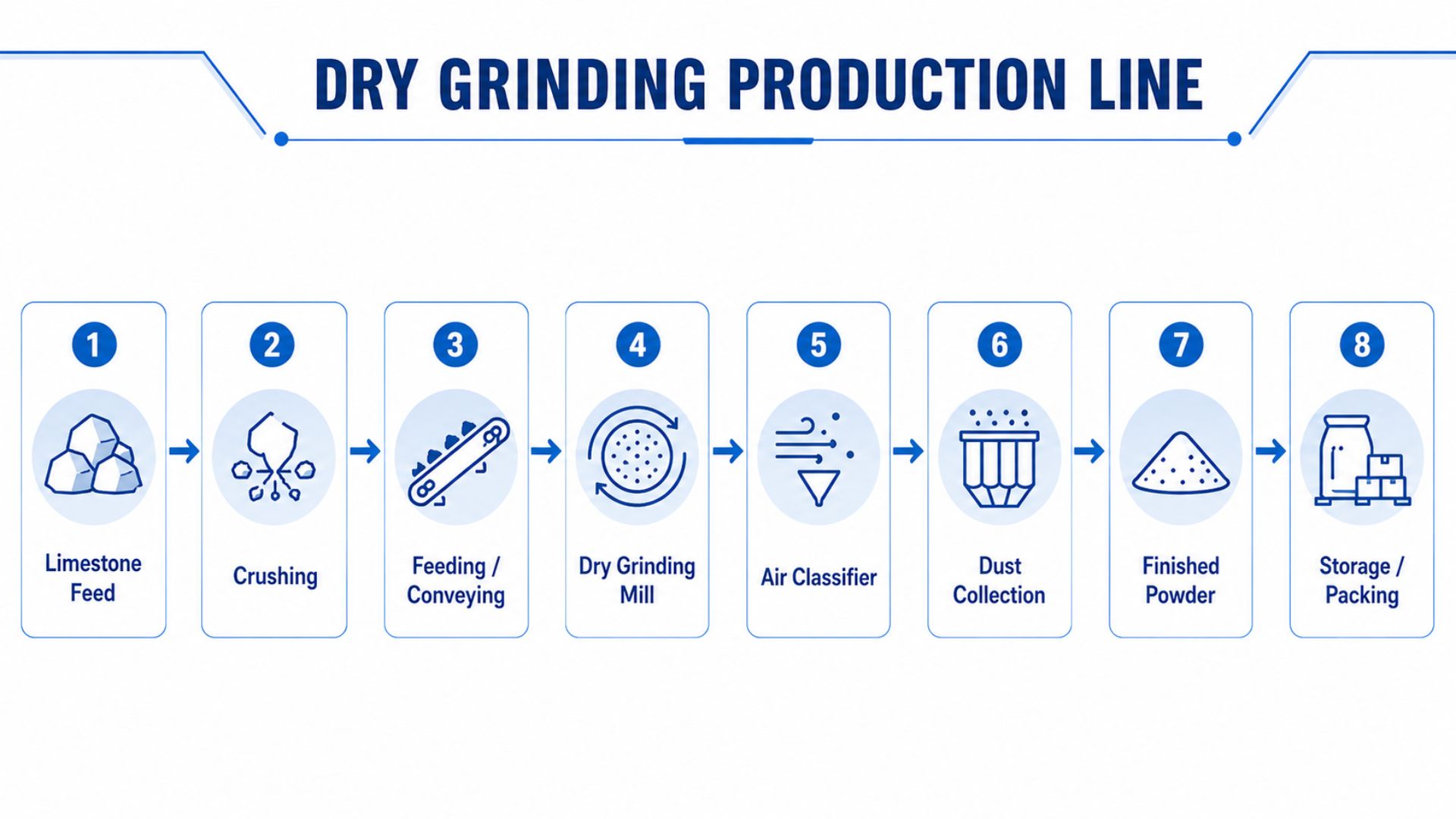
A typical GCC manufacturing process consists of limestone crushing, drying, grinding, air classification, surface treatment, and packaging. Depending on the product specifications, the drying or surface treatment stage may be omitted.
How The Dry Grinding Process Works
Crushed limestone enters a mill where impact, compression, or attrition reduces particle size. Air carries the powder to a classifier. Fine particles are collected, while coarse particles return to the mill.
As particles become finer, electrostatic attraction and high surface energy encourage agglomeration. Feed rate, airflow, classifier speed, and temperature must therefore be controlled.
Common Equipment Used in Dry Grinding
Dry GCC plants may use ball mills, vertical roller mills, Raymond mills, ring roller mills, or impact mills, usually combined with air classifiers that control D97, D98, and top cut.
Key Characteristics Of Dry-Ground GCC
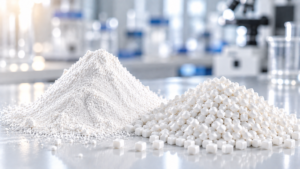
Dry-ground GCC is normally supplied as a low-moisture powder that is easy to pack, transport, and feed into mixers or compounders. It can be coated with stearic acid to improve hydrophobicity and polymer compatibility.
Advantages Of Dry Grinding
The product is already dry, so no filtration, dewatering, or slurry-drying stage is needed. Dry GCC is also practical for silos, bags, and long-distance transport. Surface treatment is generally easier to apply and control.
Limitations Of Dry Grinding
Producing ultrafine particles can require more energy because fine powders tend to agglomerate. Dry systems also generate dust and need enclosed transfer equipment and efficient filtration. Its particle distribution may be broader than in a well-controlled wet process, although modern classifiers can still provide accurate top-cut control.
What Is Wet Grinding In GCC Production?
Wet grinding reduces Calcium carbonate in water. The mineral is mixed into a slurry, and dispersing agents are often added to keep particles separated.
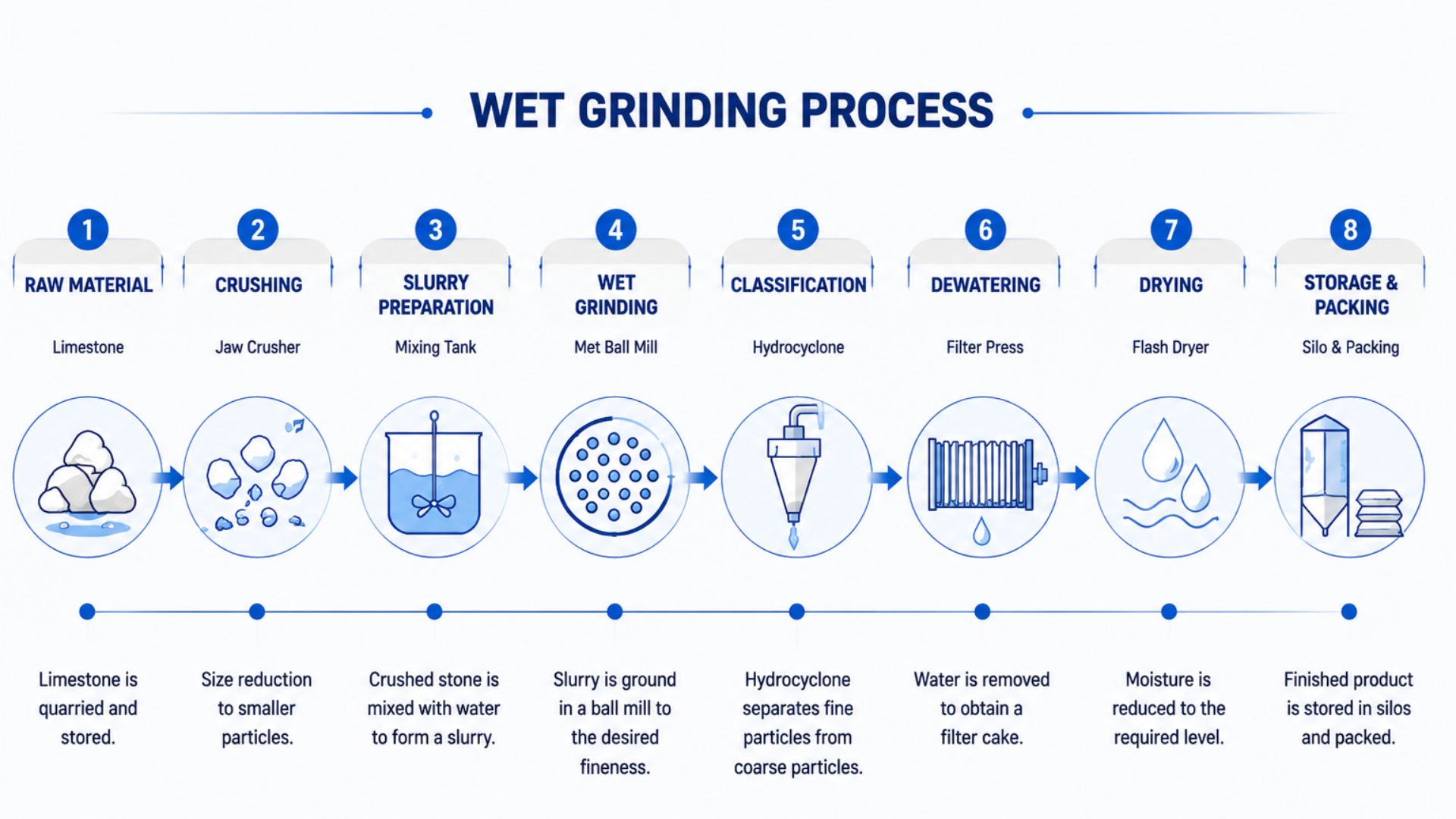
In a typical wet grinding process, limestone is first crushed and pre-ground before being mixed with water to form a slurry. The slurry then undergoes wet grinding, particle classification, and is either stored as a slurry or dried to produce the final powder, depending on product requirements.
How The Wet Grinding Process Works
Pre-ground Calcium carbonate is mixed with water at a controlled solids concentration. The slurry enters a wet mill, where grinding media and agitation reduce particle size. After classification, coarse particles return for further grinding. The accepted slurry is adjusted for solids content, viscosity, pH, and storage stability. When powder is required, the slurry must be dewatered, dried, and sometimes deagglomerated.
The Role Of Water And Dispersing Agents
Water suspends particles and reduces dust, but it does not prevent agglomeration by itself. Dispersants, often based on polyacrylates, help maintain particle separation and suitable slurry viscosity. Too little dispersant can cause flocculation and inefficient grinding, while too much may increase cost or affect downstream formulations.
Common Equipment Used In Wet Grinding
Wet ball mills, stirred-media mills, bead mills, and attrition mills are common. Results depend on media size, agitator speed, solids concentration, residence time, dispersant level, and classification efficiency.
Key Characteristics Of Wet-Ground GCC
Wet-ground GCC is usually supplied as a fine, high-solids slurry with a narrow particle size distribution. It suits aqueous processes such as paper coating and some water-based paints.
Advantages Of Wet Grinding
Wet grinding can produce ultrafine particles efficiently because the liquid medium helps control heat, dust, and agglomeration while supporting stable slurry rheology.
Limitations Of Wet Grinding
The product contains water, so it cannot be used directly in many moisture-sensitive plastics, reactive formulations, or dry blends. Slurry requires tanks, pumps, and agitation. Long-distance transport is less efficient, and producing powder requires filtration and drying that may create agglomerates.
Wet Grinding vs Dry Grinding: Key Differences
Selecting between wet grinding and dry grinding requires evaluating multiple technical and operational factors rather than focusing on particle size alone. Product form, particle characteristics, moisture content, processing costs, and downstream application all influence which grinding method is the most appropriate. The following comparison summarizes the main differences between the two processes.
| Factor | Dry Grinding | Wet Grinding |
| Grinding environment | Dry or air-based | Water-based slurry |
| Typical product form | Powder | Slurry |
| Ultrafine grinding | Possible but more difficult | Generally easier |
| Particle distribution | Often broader | Often narrower |
| Moisture | Low | High unless dried |
| Dust during milling | Higher | Lower |
| Surface coating | Relatively easy | More complex |
| Drying requirement | Usually unnecessary | Required for powder |
| Long-distance transport | More practical | Less efficient than slurry |
| Typical applications | Plastics, rubber, dry construction products | Paper, aqueous coatings |
Wet Grinding vs Dry Grinding: Product Form
The most fundamental difference between the two processes is the final product form. Dry-ground GCC is supplied as a powder that can be fed directly into dry blending, compounding, and extrusion processes. Wet-ground GCC is typically delivered as a slurry, making it well suited for paper manufacturing and other water-based production systems.
Wet Grinding vs Dry Grinding: Particle Size And Fineness
Wet grinding generally produces ultrafine GCC more efficiently because particles remain suspended during milling, reducing heat generation and limiting agglomeration. Dry grinding can also achieve fine particle sizes, but controlling agglomeration and energy consumption becomes increasingly challenging as particle size decreases. However, ultrafine GCC is not always the preferred choice, as many industrial applications require a balance between particle size, processability, and cost.
Wet Grinding vs Dry Grinding: Particle Size Distribution
Wet grinding typically provides a narrower particle size distribution, which benefits applications requiring smooth surfaces, controlled rheology, or consistent optical properties. Dry grinding may produce a broader distribution, although modern air classification systems can significantly improve particle size control. In some formulations, a broader distribution can even enhance particle packing and material density.
Wet Grinding vs Dry Grinding: Moisture Content
Moisture content is a critical consideration when selecting a grinding method. Dry-ground GCC is preferred for moisture-sensitive applications such as plastic compounding, PVC extrusion, powder coatings, and dry construction materials. Wet-ground GCC generally requires dewatering and drying before it can be used in these applications, as excessive moisture may lead to processing instability and product defects.
Wet Grinding vs Dry Grinding: Processing Costs
Wet milling may be efficient for ultrafine grinding, but total cost rises when slurry must be filtered, dried, and deagglomerated. Dry grinding avoids these stages when powder is the required final form. The full comparison should include milling, classification, additives, drying, storage, transport, and preparation before use.
Wet Grinding vs Dry Grinding: Storage And Transportation
Dry GCC can be stored in silos or bags and shipped over long distances. Wet GCC requires tanks, pumps, and agitation. Slurry may suit nearby large users, but powder is usually more practical for international trade.
Wet Grinding vs Dry Grinding: Surface Treatment Compatibility
Surface treatment is generally more straightforward with dry-ground GCC because coating agents such as stearic acid can be applied directly to the powder. Surface-treated GCC is widely used in plastics, rubber, and PVC compounds to improve compatibility with polymer matrices. Wet-ground GCC can also be surface modified, but the treatment process is more complex due to the additional drying and post-processing steps required.
How Grinding Methods Affect GCC Properties
The impact of wet grinding vs dry grinding extends beyond whether the material is supplied as slurry or powder. The grinding method affects the complete particle population and therefore influences processing, appearance, rheology, and final performance.
Particle Size: D50, D97, and Top-Cut Control
D50 is the size below which 50 percent of particles fall. D97 or D98 shows the size below which 97 or 98 percent fall and gives a better indication of the coarse fraction. Top cut refers to the upper particle-size limit. In plastic film, poor top-cut control may cause roughness, weak spots, die lines, or film breakage. In coatings, coarse particles can reduce smoothness and gloss.
Particle Size Distribution
A narrow distribution contains particles within a limited range. It supports controlled surface and optical properties, while a broader distribution may improve packing. The preferred profile depends on the application.
Specific Surface Area
As particles become finer, the total surface area increases. This changes the amount of dispersant, resin, binder, plasticizer, or coating agent required. Ultrafine GCC may improve smoothness or opacity but can increase viscosity and formulation cost. Finer is not automatically better.
Particle Agglomeration
Agglomeration occurs when fine particles stick together and behave like larger particles. Dispersants help limit this during wet grinding. Dry ultrafine GCC may agglomerate through electrostatic forces. Wet-ground particles may also form clusters during unstable storage or drying.
Moisture And Volatile Content
Moisture is critical in plastics, powder coatings, adhesives, and reactive systems. A fine GCC grade can still perform poorly if the moisture is too high or inconsistent. Dry-ground GCC usually has an advantage; wet-ground GCC requires reliable drying for dry applications.
Whiteness And Brightness
Whiteness and brightness depend mainly on raw material quality. Grinding may improve uniformity, but cannot correct poor stone. Wet-ground GCC is not automatically whiter than dry-ground GCC.
Oil Absorption And Rheology
Oil absorption depends on size, shape, surface area, porosity, and treatment. High oil absorption can raise binder or plasticizer demand, while slurry interactions affect viscosity and storage stability.
Dispersion In The Final Application
Dispersion depends on treatment, moisture, agglomeration, mixing energy, polymer polarity, dispersant choice, and processing conditions. A finer GCC may perform worse than a slightly coarser grade if it is poorly dispersed. Particle size should therefore never be evaluated alone.
Which Grinding Method Is Better for Different GCC Applications?
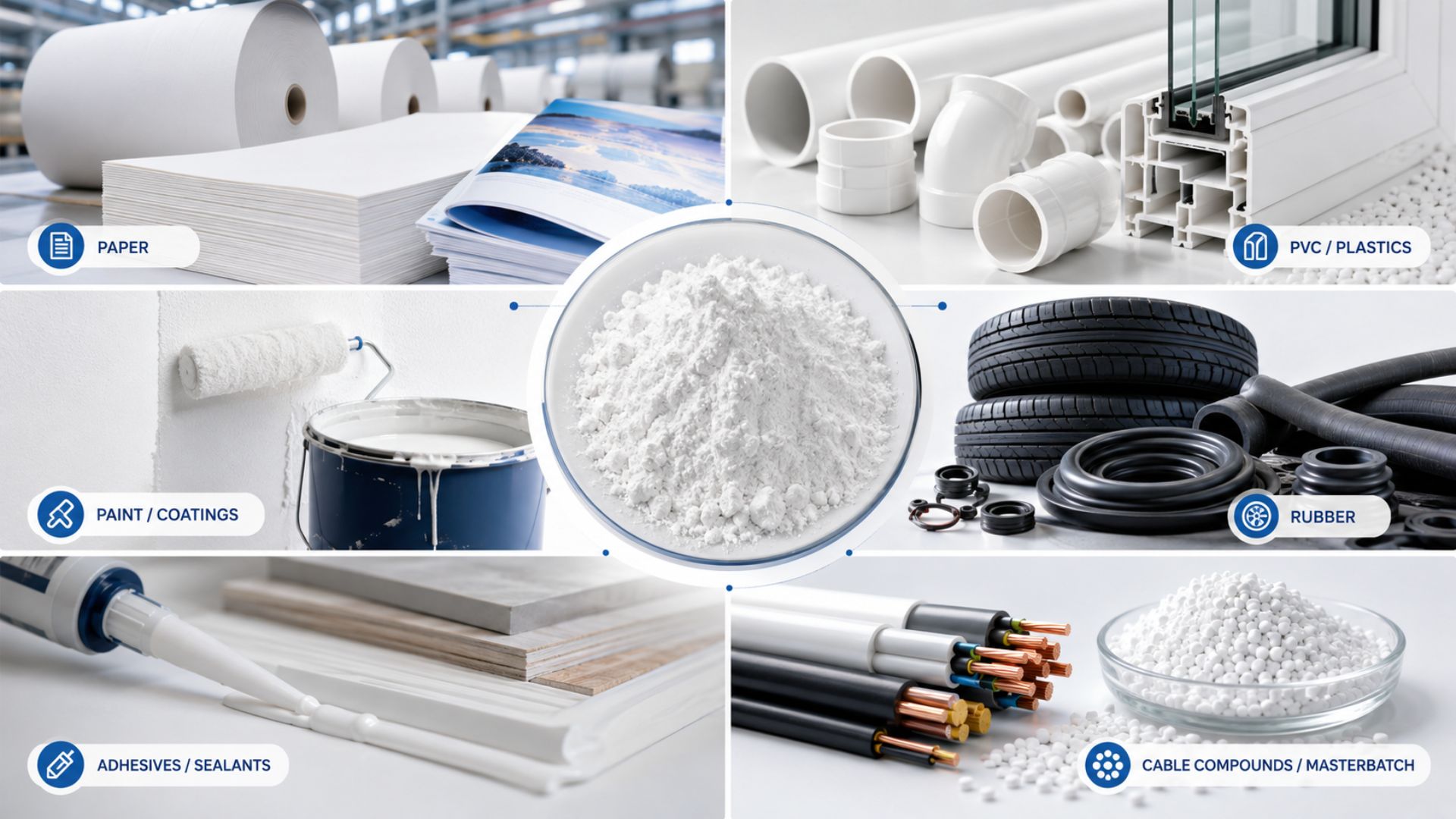
The most suitable grinding method depends on the performance requirements of the final application rather than the grinding process itself. Different industries prioritize different GCC characteristics, including particle size distribution, moisture content, surface treatment, rheological behavior, and powder handling. The table below summarizes the typical grinding method for common GCC applications.
GCC For Paper Manufacturing And Paper Coating
Wet-ground GCC is widely used in paper coating because it is supplied as a stable slurry that integrates directly into aqueous processing systems. Its fine particle size and narrow distribution contribute to improved coating smoothness, brightness, opacity, printability, and coating uniformity. For paper filling, both wet-ground and dry-ground GCC may be suitable depending on the production process and mill configuration.
GCC For Water-Based Paints And Coatings
Both wet-ground and dry-ground GCC can be used in water-based coatings. Wet-ground slurry offers excellent dispersion and rheology control, while dry-ground GCC provides greater flexibility in storage, transportation, and formulation. The optimal choice depends on the desired gloss, viscosity, solids content, and manufacturing process.
GCC For Plastics And Polymer Compounds
Dry-ground GCC is generally preferred for plastics because of its low moisture content and compatibility with surface treatment technologies. Coated dry GCC disperses efficiently in polymer matrices, supports stable extrusion and compounding, and helps maintain consistent product quality. Wet-ground GCC typically requires drying and deagglomeration before use in most plastic applications.
GCC For Rubber Applications
Rubber manufacturers typically use dry-ground GCC because it blends easily with other solid ingredients during compounding. Particle size distribution, surface treatment, moisture content, and dispersion quality all influence compound consistency, processing behavior, and final mechanical properties.
GCC For Adhesives And Sealants
The preferred GCC form depends on the formulation system. Water-based adhesives can utilize slurry products directly, whereas moisture-sensitive sealants generally require dry powder. In these applications, rheology, oil absorption, surface chemistry, and dispersion often have a greater impact on performance than the grinding method itself.
GCC For Construction Materials
Dry-ground GCC is the standard choice for construction products such as dry mortar, wall putty, self-leveling compounds, and cement-based formulations. Its low moisture content, easy powder handling, and compatibility with dry mixing processes support efficient production and consistent product performance.
How To Choose Between Wet Grinding Vs Dry Grinding
Choosing between wet grinding and dry grinding should begin with the requirements of the final application rather than the assumption that one method is inherently superior. Manufacturers should first determine whether the production process requires GCC in powder or slurry form, then define the target particle size, such as D50, D97, or D98, together with the maximum acceptable coarse fraction. Moisture sensitivity is another critical consideration, as moisture-sensitive polymers, reactive chemicals, and dry blends generally perform better with dry-ground GCC.
Surface treatment requirements should also be evaluated, since hydrophobic coatings used in plastics and sealants are typically applied more consistently to dry powder.
In addition, storage and transportation conditions, including transport distance, packaging, silos, tanks, humidity, and unloading systems, can significantly influence the most practical option, with slurry often preferred for nearby users and powder better suited for long-distance supply.
Cost comparisons should take into account the entire production chain, including grinding, classification, additives, filtration, drying, storage, transportation, and material preparation, rather than focusing solely on milling costs.
Finally, laboratory specifications should always be validated through production trials that assess dispersion, viscosity, processing stability, surface quality, mechanical properties, moisture content, and defect rates. Ultimately, the choice between wet grinding and dry grinding should be based on measurable application performance and total processing efficiency, rather than particle size or purchase price alone.
Conclusion
Wet grinding and dry grinding, each suited to different application requirements. Wet grinding is ideal for ultrafine slurry used in paper and water-based systems, while dry grinding is preferred for plastics, rubber, construction materials, and other applications requiring low moisture, surface treatment, and cost-efficient transportation. Rather than asking which method is better, manufacturers should choose the process that best matches the required product form, particle characteristics, moisture level, processing performance, and overall cost. Ultimately, the best GCC grade is not the finest one, but the one that consistently delivers the required performance in its intended application.